Categories
Magazine

Misremembering, Retroscription, and Creative Practice

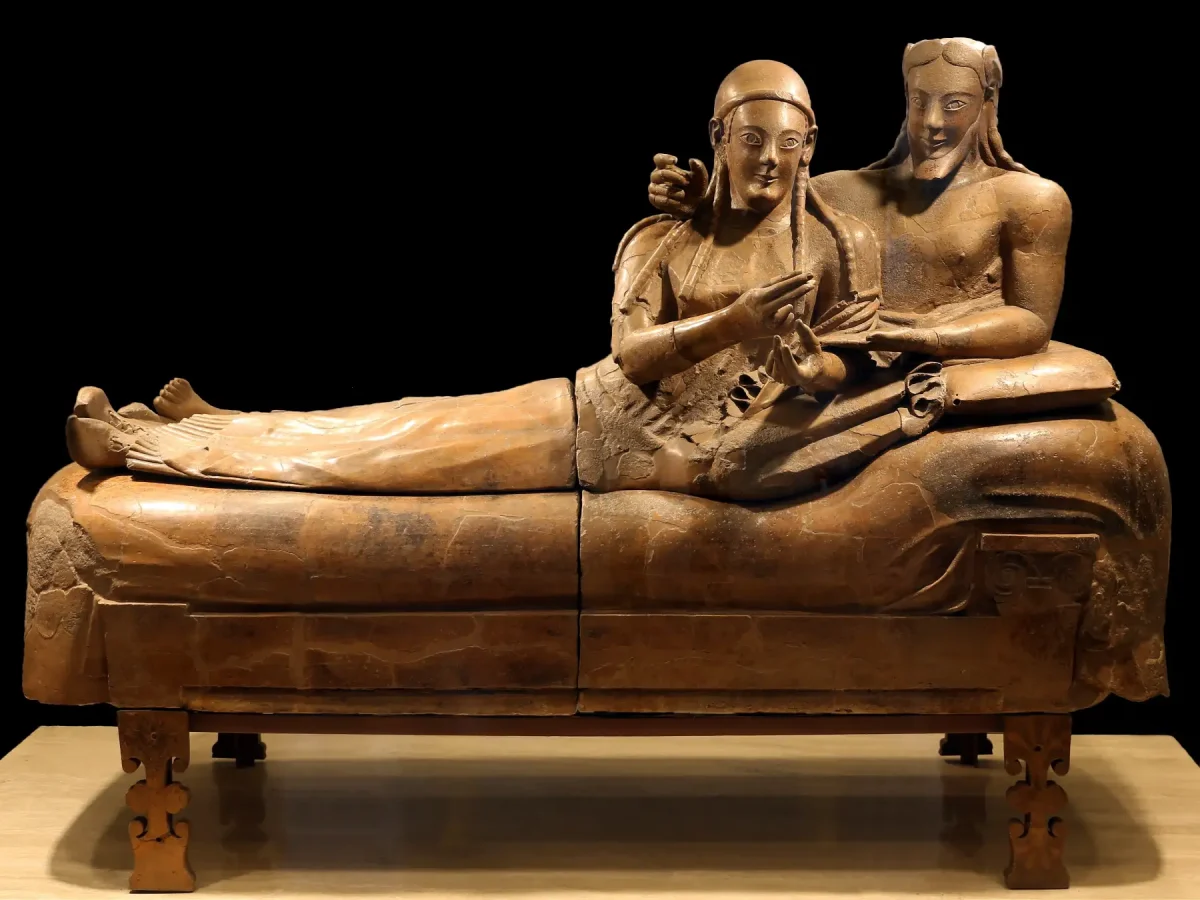
Tomb effigy: Sarcophagus of the Spouses. National Etruscan Museum, Rome. Courtesy: Wikimedia Commons.

Misremembering, Retroscription, and Creative Practice

Kirsty Gunn
Editor’s note: This essay is a response to a sentence in the mission statement of the Literary Activism symposium that took place in Delhi on 27th and 28th March, 2026. Its title was ‘Doing the Dirt on Tragedy’. Kirsty Gunn took part via Zoom in a panel discussion.
When Amit Chaudhuri had a memory he couldn’t quite place, of having read about something DH Lawrence had written – a curiously jaggedy little kind of sentence that described all at once, he thought, Lawrence’s attitude towards the grand Western idea of tragedy – it sparked the beginning of a Literary Symposium and set off in me a reaction I could only counter by getting down on the page a few memories and some questions about them of my own.
For misremembering, nearly remembering, remembering anew… All of this happens and more, when we take in and hold to ourselves literary materials and their affects; to find them again, those sentences and phrases, so to have them for some imagined ‘later’, when one might think about them anew, repurpose and remake them into fresh texts and pieces. As happened with this conference, when a misremembering turned into a re-remembering… And a something else again that had uncertainty and doubt at its very core.
I love it. I love the way Amit, in his mind, had overwritten Lawrence’s words with his own, unconsciously rescribing the English Modernist’s pronouncement so as to make it particular and funny and new  – opening Lawrence’s sentence up, and changing it, inviting us all in.
For how many times do writers, in particular, redraw words and sentences this way, knowingly or unknowingly, as though writing from a shared memory, in a kind of dream? Walter Benjamin addresses the idea of this kind of shared project when he talks of writing down another’s words as an act of reverence, a way of taking in someone else’s exact phrases and vocabulary and becoming somehow… more…through the appropriation.  ‘When you copy out words, they impact on your soul,’ he wrote.* And I am constantly myself copying out others’ thoughts in such a way – my journals and notebooks are crowded with the sentences of others, randomly scattered, seeded – with no scholarly method or categorisation going on in my hoarding. My noting down and recording this and that – no doubt sowing at the same time into the original some of my own misrememberings and misquotings for use in some imagined future project  – is simply about pleasure and love. And reverence, oh yes. Reverence. Benjamin is right, I think, to bring the soul into all this.
When Amit went on to contextualise the sentence he thought he’d remembered but in fact had put together quite differently – that wound back in turn to Lawrence’s collection of essays Etruscan Places – I realised I had, until that moment, forgotten all about Richard Wilbur’s poem ‘To the Etruscans’. Given that the idea of tragedy (and, because of the mis-remembering, enclosed within it, the Western notion of an equally historically masculine and individualised Western concept of sex) was our theme, how interesting it was to go back to that poem and find in it neither a set of binding chains that may encircle both the fallen hero and love locked poet, nor a closed off tomb to signify the end of the pair of them. But instead, to discover within that poems stanzas,  a kind of shared and living, fluent joy. ‘Dream fluently, still brothers, who when young/ Took with your mother’s milk the mother tongue’, Wilbur writes, and, it’s true… Though I once found the very idea of this poem to be rigid with all the fixed certainties of Western civilisation, those repeated iterations of greatness and vanity and despair, ambition come to naught, along with Ozymandias and his like… Now I could hear only in Wilbur’s words the sound of an ongoing sort of dance, as writ in the paintings on the walls of the Etruscan caves and heard in the ‘pure matrix, joining world and mind’, – of life, of fluency contained in word and image both. For ‘Not reckoning that all could melt and go’, the poet may conclude, but only after having given us, throughout the poem, the feeling of the ongoing circle, the celebration of ‘some line of verse’ that is indeed ‘left behind’ for us to keep, no matter what.
In her essay about language and poetry, ‘Voice of the Tribe’, Gillain Clarke begins: ‘One of the most moving poems I know by heart is the one in which the American poet Richard Wilbur addresses six lines to the poets of ancient Etruria, a people and a language wiped out, lock stock and barrel, by the Romans.’  And I guess she’s not alone, in taking up the stuff of Wilbur’s poem and using it in such a way as can serve her own themes of a nearly lost Welsh language; therefore the careful preservation of turns of speech, of pronunciation, of idiolect she maintains in her own work: ‘A lost language represents the obliteration of a culture’, she continues. There will be many others like her who can use the poem in that – I am now thinking, after our conference – ‘old’ way of evaluating literature and art and how we talk about these things that are to do with who we are. All the stuff we make and describe is vulnerable, of course, to the processes of time and political overthrow and economics. How can we not feel hemmed in by that knowledge? But there are, too, emerging now, these other interpretations, other ways of reading…There is this other kind of fluent language.
I seem to think I met Richard Wilbur’s poetry back when I was a teenager, sitting in Bill Manhire’s fabulous Contemporary American Poetry seminar, surrounded by, as they felt to me to be then, utterly grown up students – PhD candidates, or advanced graduates who were often published poets themselves. There was Bill, rolling up his tiny little make-your-own cigarettes, head down, listening, nodding… Everyone there in that seminar room having something to say, but, as I remember it, in the most hearteningly questioning, uncertain kind of way… ‘Could it be?’ ‘I wonder if…?’ Perhaps it was ‘To The Etruscan Poets’ that we were talking about then – though how much of this part of the memory, too, I wonder, is a misremembering? Still it lives and is real – that class a game changer in more ways than I can account for here. I do know for sure that the poem seemed back then, to my teenager self, to be quite definitely all about those grand old themes of tragedy – of loss, of emptiness, of waste. The particular and the lovely…An entire civilisation gone down, down, down in a pile of dust – and all we can do, poor fools, is Carpe Diem while the sun shines bright, then rage, rage, rage against the dying of the light.
I visit her now, in my mind, that young woman who was me, and want to tell her that things need not be so hectic. That all writing may address grave themes but also comes bearing the invitation to be part of a wider party. ‘You are not on your own with this,’ I want to say to her, that other one, as she desperately seeks to come up with her own singular idea, the great thought that will mark her work out from the rest. ‘Take it easy’, I want to tell her. Just enjoy this reading, writing. You are along for a wonderful ride. Here’s this poem. Look at it again. Can you reach through the words and feel its happy resignation, yes, ‘joining world and mind’, its lively feeling? Here’s the last stanza, and don’t just read it and think you have to know – but let yourself respond in these written seconds of time put down upon the page and react to it now: ‘Like still fresh tracks across a field of snow’, Wilbur finishes, ‘Not reckoning that all could melt and go.’ And see? When you read in this other way? How the tracks are ‘still fresh’ after all?  Those marks which ‘could melt and go’  in the end have not done so, held back as they are from ever becoming the past tense by the infinite present allowed by of the poem’s use of the conditional. The lines – as if by magic – are held in time. Nothing has been lost. We are here, attending.
So this thinking, , and remembering,  misremembering, re-remembering… It might well be a means to acknowledge how that solitary tragic figure so sorely judged by Lawrence, and debated, questioned and redefined in our recent Symposium, could also be a starting point in a journey towards an understanding of literature that is generated less by the idea of art being learned via the singular artist – with a singular and distinctive creative practice that can be then unpacked and pronounced upon and categorised – than by an appreciation of the beautiful generous muddle and mix that is reading and writing altogether. Less to do with the distinctive and much more linked to concepts that are general, and shared; a criss cross of sentences and phrases and concepts that we each pick up and put down in turn, adding to the storehouse of words and pages, remembering this, forgetting that, rephrasing the one and repurposing the other. This is not my idea; we might say instead, it is our shared endeavour.
And how we return to literature  as we might return to a memory we are all discussing: Was it like this? Did I remember correctly? Does my thinking about this story or that poem relate to something I know, or something I may only think I have read already? Reflecting upon a line here – from a short story of a poem or a novel – and going on to reconsider its repercussions – only to discover that it was not that line at all… Still, no matter; fresh thinking has followed in the wake of the memory of the text even so. Writing begets writing begets writing…And just as our dna, 99.99%  of it,  is shared with our fellow human readers and thinkers, so the membranic enclosure of literature surrounds us all, a living organism in a constant state of chance, adjustment and flux. ‘Ozymandias’ may comprise the desolate wastes of a ruined civilisation, the dusty leftover stuff from which the tyrant’s buildings and massive structures were made, but the poem’s ‘lone and level sands stretched far away’ might also denote a place, not of desolation, but of imagination. Lawrence’s Etruscans, after all – like Richard Wilbur’s – would know the difference between Shelley’s kind of emptiness and their own abandoned caves. For there is such a difference. But the marvellous thing is how we can contain, in our memory and writing lives, both versions of ours and civilisations’ ends. A matrix indeed.
At the Conference I talked a little about a word I have come to put into use, in my own way, as a teacher of writing practice. The word is ‘retroscription’ – and in circulation, I believe, in the film business, to describe a script being passed around by a team of writers and processed, adjusted and altered on its journey to becoming a finished screenplay. I put it to work, the same word, in a particular kind of creative process that involves first reading and then writing over what has been read. A kind of ‘copying’ again, then. There is, first, an intensive, submerged kind of attention that is paid to a text as students seated together around a table share the words under review, reading aloud and commenting in a detailed way upon their affect and effect. Often I ask them to read in a sequence, one picking up another’s sentence where it was left off and continuing around the room in this way until we have heard the entire passage. Sometimes I have them read in unison, as though in plain chant or even as a kind of singing. Other times I will call on just one student to read the text and then repeat it, to read it again with everyone listening as though to a charm.  In all cases, though, after this part of our session, I let a short space of time elapse and then ask the writers to go back to their memory of the passage and to ‘retroscribe’ it. Write it again, as though copying, in their own words – and then add to it: What do they think and remember was happening in that poem? How did they feel about that passage from a short story or excerpt it when the words of it first came upon them and they had time to let the sentences they had spoken aloud out of their own mouths come to settle in their minds as experience?
It’s a powerful activity, to remember and redraw writing in this way; a great test of great work  (for the exercise doesn’t work at all for, say, genre writing, or fantasy or sci-fi, or anything that lacks the idiosyncratic charge of work made by imagination rather than to order) for only the good stuff can bear the re-reading and close attention of this kind; the dross would turn to ash upon very contact. Real writing does indeed cast a spell – and one can hear it, sound it, feel it working, at a creative table such as the one I describe here. The students listen, experience, remember, misremember; then they turn the work into their own.
Retroscription is as good a word as any for this encounter; in fact it’s a word, I’m coming to believe, having taken part in our two days together in March, that may as well be applied to all the writing we who love reading want to remember and think about some more. To make  time for such ‘remembering’ not only as a means of imagining and understanding the world but as a means of being inside it. Those images from the cave that engendered Lawrence’s essay bringing about in turn the poem I read in Bill Manhire’s class and misremembered until I came upon it again and then wrote this piece… Our conference, Amit’s own memory that began it, his words, and Gillian Clarke’s and Richard Wilbur’s… All come together now in more words that come from theirs and so we may as well agree are simply ours. ‘Dream fluently, still brothers…’ We are dreaming still.
*All quotes taken from sentences copied down in my notebooks and diary – with little noted by way of reliable attribution, and therefore, quite possibly, merrily and productively misremembered.
Kirsty Gunn writes fiction and essays and directs, with Gail Low, The Voyage Out Press, a publication exploring ideas of uncertainty, risk and the role of the imagination in writing and education.
Categories
Magazine

Coming Out of Lockdown

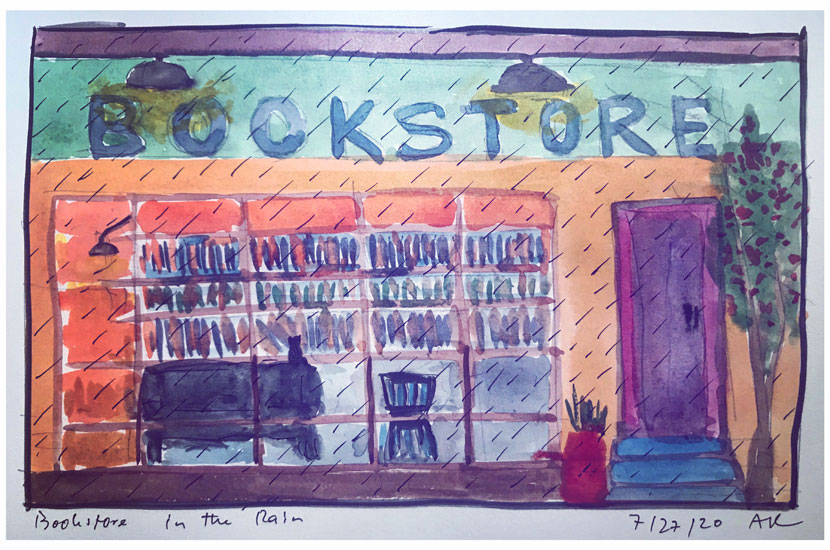
‘Bookstore In The Rain’ by Amitava Kumar

Coming Out of Lockdown: Literature, Life and Leaving the Centre

Kirsty Gunn

A year or so ago, I invited the Scottish writer Duncan McLean to come down from the Isle of Orkney where he lives to Dundee where I was hosting a series of literary events we called ‘Writers Read.’

This was a monthly get-together of students, teachers and anyone who was interested in reading and publishing, held in a convivial cafe where the espresso machine blasted every few minutes and the door onto the street would be opening and closing as people came in and out with their coffees, or settled down in one of the booths or at a table. The atmosphere was terrific; the cafe filled with poets and writers of all stripes, young and old, a combination of friends and newcomers, some published, some not … When our actual readings began, things quietened a little – though the machine still rang out, though less often, the door still banged – but the atmosphere remained informal. Charged with seriousness – with attention, with interest, with excitement – but informal. Sometimes we had a microphone (it didn’t work that well; Jamie, who runs Tonic which is the name of the cafe, had one on hand for visiting singers or quiz nights), often not. We would sit on bar stools in a corner of the room, and writers would read from their work. Then we talked about it, people asked questions, the writer read some more… Conversations, themes would develop. Afterwards, there might be a book signing , or there’d be news of a further event or publication, but it was the discussion that kept everyone at Tonic well after the reading had finished. Something had started; people wanted more of it. The visiting writer would hang around, have a coffee or a glass of wine…carry on talking until, in time, I would thank Jamie and everyone at Tonic and would usher our visitor out the door. As I say again: these evenings were informal. The writer was part of an event; this person was not a rock star or a guru or ‘famous’ but an artist and intellectual, a creative thoughtful individual who was happy to read and talk about writing with others who were also interested. *

Duncan was one in a long and wonderfully varied programme – of novelists, poets, nature writers, songwriters, non-fiction writers and more – and it had taken him a while to get to us. I’d asked him to be a guest at ‘Writers Read’ some time before – I’ve long admired Duncan’s work, right back from when he first published his extraordinary vivid and shockingly funny and dark collection of stories Bucket of Tongues back in the nineties, and had invited him to Dundee on another earlier occasion to read with his friend Alan Warner, whose work I also love, and who has known Duncan for a long time. That event had resulted in both writers first going out and living and then creating, overnight, a short story from that experience which they then read aloud the next morning, minutes after having finished it. I can’t remember when I laughed so much at a literary reading. Duncan is a tall man, with great presence, and is also a playwright and translator -so he has a fine ear for the sound of a word, for the second by second delivery of a sentence. Anyway, all of this is to say that after that first visit it had taken a number of years for us to get him to come back to Dundee for his second because life is busy, but more than that, life, for Duncan, is lived on an island that is relatively hard to get to, and hard to leave. Though only a ferry’s ride from the mainland nevertheless Orkney lies off the northernmost part of the British Isles and the ferry docks in the remote and, locals will admit, most closed off county in Scotland, Caithness; it takes a fair amount of time to get to and from both places. So, there are trains but they are not frequent; flights are not scheduled often and are expensive. The North Sea can be rough; ferry crossings, last minute, get cancelled. Dundee is by no means a literary ‘centre’ (though I have to say, at our ‘Writers Read’ sessions we were working on that) but Duncan McLean is also nowhere near Dundee.

This is precisely what I had asked Duncan to come and talk to us about. For a while now, he has been writing and thinking about what it is to have a literary life that is at a distance from the so-called literary centres of the world – the New Yorks and Londons, for versions of these places exist, too, in Edinburgh and Calcutta and Wellington and Toronto and lots of other places; ‘hubs’ I may also call them in this essay. He has his own Orkney-based publishing venture and magazine, Abersee, that encourages a local literary culture, yet one that is also outward facing, and internationalist: referencing translation; international politics and imperialism. ‘Think global, act local’ is Duncan’s motto, overturning the usual tendency to globalise local culture ( as evidenced in trends in mainstream publishing over the last thirty years or so**) by maintaining a steadfastly local presence and celebration of language and sensibility in the magazines and pamphlets he publishes which bring world issues and international preoccupations to Orkney. And does he want to do more than this? Increase his remit to set Orkney in a global context? Does he want to build Abersee, in time, towards becoming a profit making business that he can sell on to a larger house that’s decided it wants to acquire something of the funky presence of an island-based literature to add grit and ‘inclusivity’, burnished by the presence of a writer who was once hailed by the New Yorker as one of Robin Robertson’s, then literary publisher at Secker and Warburg, ‘Scottish beats’, along with Irvine Welsh and James Kelman, and photographed by Irving Penn?

The answer to these questions is a massive rumbling laugh. Duncan could not be less interested. He is doing what he is doing because he is engaged by the local – as expressed through language and poetics – and one of the many things we talked about in that ‘Writers Read’ was his work around the New Zealand short story writer Frank Sargeson, who had published in the thirties and forties a kind of New Zealand ‘demotic’ fiction. Though writers such as EM Forster had praised Sargeson’s work, and while he was revered in France and Europe, London, the English Speaking Centre, had been unable to hear the particular New Zealand rural idiom of his voice. Duncan has written about all this, in the LRB actually – a terrific example of his thinking globally, and acting local right there – and continues to maintain a lively interest in New Zealand literature post-Mansfield, seeing in its regional priorities and sounding of voice something akin to what he has been part of as a member of the so-called Scottish renaissance, that time when working class idiolect and dialect from Glasgow and the outlying country found a place in the pages of internationally published fiction. All this, the founding of an individual’s language, the relation of islands to the Centre, whether the North and South Islands of New Zealand or the Isle of Orkney, the quality of what Elizabeth Bowen described in Katherine Mansfield work as ‘speaking’ness’… it means Duncan and I had a lot to discuss. ***

‘Beach Reading’ by Amitava Kumar

I am inclined at this point to bring into this essay another Scottish publisher and writer who is working quietly away, far from the hub – also based on an island, I realise, though living on an island is by no means a prerequisite, in this essay, for being defined as one removed from the Centre! – to form a literary centre that is defined as such by a person of culture, of literature – not of business and finance. Kenny Taylor, who lives and works on the Black Isle, in Easter Ross-shire, is the editor of NorthWords Now magazine, a free literary paper circulated twice a year throughout the north of Scotland – though also available, in certain places, as far south as Edinburgh and Glasgow. Since taking over the role from the poet and teacher Chris Powici, Kenny – a nature writer and naturalist who has previously worked for National Geographic and the BBC, and published widely on environmental issues and Scottish wildlife – has worked vigorously to increase the remit of NorthWords Now – to extend its gaze further and further North, as Scotland as a country aligns herself increasingly with Scandanavian culture, and works to build networks that might span the Arctic circle all the way into northern China. This is a new kind of ‘trade route’, Kenny suggested, at a literary conference in another relatively remote place, Arbroath****- though not ‘remote’ at all of course, if you live and work near there and are not locked up in some hub. There, at Hospitalfield House, a group of international writers and scholars from New York, Oxford and Paris amongst other places, had gathered to talk about the essay form; discussions that would provide the basis of a collection of essays, Imagined Spaces, itself a further unlocking of dominant centrist paradigms. ***** Kenny had been suggesting, not necessarily much interested in economics himself, or in the fiscal sense of opening up a train route across the top of the globe, that the new network she’d been outlining might have impact in literary terms. He is already translating and publishing the work of little-known Norwegian poet Olav Hauge in the magazine and other places, while encouraging that kind of internationalist literary activity in the submissions of his writers – who include the poet Lesley Harrison, whose collection Blue Pearl is published by New Directions and who carries Duncan MacLean’s ‘global’ thinking in her ‘acting local’ dna.

Altogether then, the activities of NorthWords Now, along with Duncan’s Abersee in Orkney -a kind of publishing and thinking that is free of metropolitan priorities and is open to new geographies and imaginative principles -this feels more and more relevant and interesting to me in a way that mainstream global publishing is not. Relevant because… Thoughtful. Of a modest scale, perhaps, and very much operating at grass roots level, but principled and imaginative; an activist-based working model with an agenda that is truly intellectually and aesthetically driven, and at far remove from the spread sheets and profit margins of the multinationals, leaping as they are, upon all kinds of newsworthy issues, to be ‘Now’ and ‘Exciting’ and ‘Contemporary’ while remaining locked down in the conservative, financially defined, profit-motivated Centre.

In a recent discussion with a publisher who asks to be kept nameless – someone with a highly respected background and profile in the literary world and who has seen a great number of authors through his offices gain international prestige and acclaim but who has always followed his own taste and never published anyone for any other reasons – I was told that literary publishing is now ‘pretty much dead’. The big conglomerates keep on people like him, he said, to make them feel that they are still publishing ‘real’ literature; that they might capture the odd Nobel Prize winner or catch a new latest thing, ride the wave of the zeitgeist, while adding together the figures on the mainstream list so it all tallies up. Another publisher I know calls this sort of activity ‘fig leaf publishing’ – where a distinguished editor is brought in to polish company prestige and create a bespoke list so that the giants roaming around at the top of the top ten bestseller lists have at their back something artisanal and intellectual that feels ‘highbrow’, was the word he used. ******This seems to be where and what the Centre is about: A golden triangle of the big multinationals set firmly in the midst of their world cities reaching out to further centres and hubs around the world that seem to reflect its values in a range of book festivals, trade fairs and prizegivings. All exuding sophistication, worldliness and prestige through astute financial management, big international visibility and vast amounts of ‘cultural capital’ and making us believe, somehow, that this is what literary life is all about.

How moribund it appears now, this enormously scaled business; how monotonous, after the other merry conversations about language and place and identity happening in a rangeof individual centres of thought and culture that are nowhere near some hub. And, I think now,how realistically and truthfully ‘inclusive’ is the kind of thinking going on in these far-flung places – set against the mainstream politics of our mainstream age that is played out upon the bright lit stage of the metropolis, back lit by an authorised, privatised concept of ‘culture’.

And talking of stages, and by way of concluding this piece of mine – that I can see, by the notes that appear at the end of it, and by the many pages that have accumulated in my writing of it that have not been accommodated here and could go on for more page numbers than I have available here – let me return to that image of the writer talking with his readers in a cafe in the rain, the door flapping intermittently to let in those who’d come in to escape the weather and found themselves staying, to listen on. For in comparison to that jolly afternoon, a final example comes to mind that may summarise, perhaps, what I’ve been trying to get at here; an anecdote to describe the way the very idea of literature – or LITERATURE!, for the word seems to come in shout capitals these days – has become, over the past thirty years or so, more and morecontrolled and enclosed by lockdown centrist thinking.I was in the ‘Green Room’ of an INTERNATIONAL LITERARY FESTIVAL, before my scheduled EVENT that afternoon, and – just as is suggested by the terms that were and are in use at these kinds of affairs, the language of the entertainment business employed with no sense of irony –waitingto ‘go on’ . I was in conversation with a writer friend. This was no discussion at Tonic, though. We were inhabiting a kind of Hollywood, so it now seems to me – with its hosts of young people toting clipboards, and sound engineering teams and lighting specialists on hand to ‘mic’ us up!’ and ‘do the sound check’ and run ‘spots’ teststo make sure one can read and not be blinded by the strength of the theatrical lighting. There was a restless anticipatory atmosphere around the marquees and tents, the roped off VIP areas and Media offices. A BIG NAME AUTHOR was in the vicinity, we’d been told, and, though no one could see him, like a rock star he’d been ‘flown in’ and was there, somehow in our midst. I remember having lost track of time, suggesting to the author I was talking with – no stranger herself to the celebrity culture, a fabulous writer who also knows a thing or two about ‘working a room’ and holds large throngs of people spellbound in events that she still calls ‘Readings’ – that we might pop in to another reading I’d justrealised was on at the same time, our author lanyards allowing us open access while we were visitors at the festival, to all events. She was aghast. ‘You can’t interrupt the performance that way’, she said, with no sense of irony or side in her elision of literary activity and entertainment. No matter that the author was someone we both admired, whose work we had been following over the years and had been engaged by… The show had started, the doors were closed.

So the lockdown, the securing of literary value to the market place, is complete. From reader to ‘readership’, from the individual who thinks and reads and makes judgment about what she reads, writes about it even, to ‘customer’ to ‘audience’ to ‘the market’… I seem to have missed exactly when I became aware of not wanting to be stuck in that place, but now, out and about, breathing fresh air I realise I don’t want to be troubled again by the implications of what my fellow author said to me that day; I want to put it behind me. ‘We could just slip in’ I’d said, ‘and sit at the back. After all it’s XX. He won’t mind. He knows how much we love his books.’ She turned to me then, and was firm, set as she was in her place in this new literary landscape of ours, a bright, bright star. A writer who knows well how it works, publicity, marketing. How everything is figured out for benefit, weighed and valued, culture as commodity and how behaviour, predilections, taste – all follow suit . ‘You can’t just SLIP IN’ she said to me, and, to my regret that afternoon, I took her advice, as though what she’d said was the only reality, as though it were somehow true. ‘It’ s too late’ she said. ‘It’s started. You’ve missed it.’ For it’s only now, coming out of the tent for some air, I’ve realised how, in the manner of all closed performances, an event – literary or otherwise, historical or current – can only indicate one version of what is going on. And yes, the door is shut on that spectacle, the programme fixed. But look, come with me onto the grass. Something else is starting. Let’s see what’s happening over here…

Notes:
* The ‘Writers Read’ series was something I initiated while directing a writing programme at the University of Dundee. It developed out of an earlier iteration along similar lines – that is, the creation of an informal space in which to bring all kinds of writers to the city, from the very well known (including real live rock stars and actors, Booker prize winners and their publishers) to the reclusive and near invisible from whom we also learned an enormous amount about resilence and patience and writing as intellectual activity. It was a terrifically successful and interesting programme – starting at the DCA, which was an exciting and unique contemporary gallery at the time, as the Literary Salon Series, and continuing, after a change of management and ethos there at groovy Tonic, where Jamie and Dave and Melanie and the team gave over their cafe to our deliberations.

** See Amit Chaudhuri’s writings and talks on this subject for a gnarly and comprehensive survey of the landscape which has informed his establishing of the Literary Activism Centre through institutions in England and India.

*** I have written a great deal about Katherine Mansfield and her relationship to the Centre – most recently in Katherine Mansfield Studies, ‘On Being Chased By A Bull’, EUP, and Duncan MacLean and I have ongoing conversations about NZ literature and the demotic and contemporary Scottish culture which are regenerative and inspiring.

**** Kenny Taylor spoke about the idea of the north at Hospitalfield House as part of a conference about essays and uncertainty, and is published, in conversation with Duncan MacLean, in the forthcoming volume ‘Imagined Spaces’ that came about as a result of that conference.

***** ‘Imagined Spaces’ is published by The Voyage Out Press, a small publishing company the writer and publishing historian Gail Low and I have established to explore ideas of hesitancy, uncertainty and tact in literature and celebrate intellectual collaboration and generosity.

****** A whole new essay to be written here! On the relation of so-called ‘high’ art and ‘serious’ literature to metropolitan publishing; the creation of a ‘consumer culture’ disguised as non-transferable ‘value’.

Kirsty Gunn writes fiction and essays and directs, with Gail Low, The Voyage Out Press, a publication exploring ideas of uncertainty, risk and the role of the imagination in writing and education.

Amitava Kumar is a novelist, non-fiction writer, and artist. The pictures above comprise his response to Kirsty Gunn’s essay.