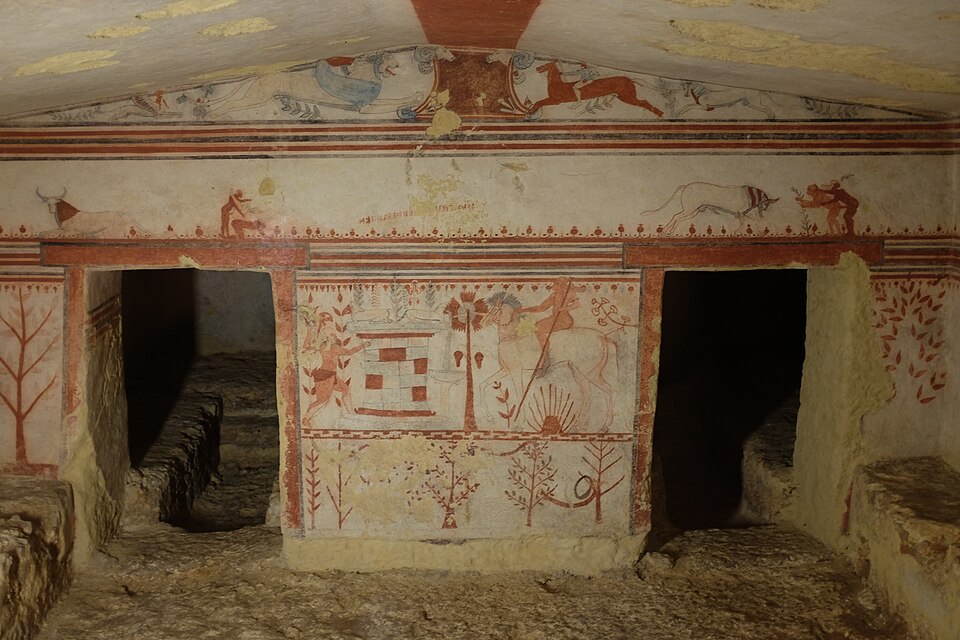
Tomb of the Bulls, interior, Italy. Courtesy: Wikimedia Commons.
I was trying to track down a quote from D H Lawrence that’s been in my head for a long time: ‘doing the dirt on tragedy’. Unable to find it anywhere, I asked some Lawrence experts if they knew where it was from. Frances Wilson, Lawrence’s biographer, reminded me that the actual quote – a very famous one – was ‘doing the dirt on sex’ (my emphasis). Of course! But how had I arrived at the misremembered formulation?
On reflection, it seems to be what musicians nowadays call a ‘mash-up’: a mash-up or segueing between Lawrence’s observation on sex and his feelings about tragedy – because there’s little doubt about his impatience with the latter, his rebellion against what it symbolises regarding weight and ‘meaning’ in the post-Socratic, post-Christian, and, finally, the post-Enlightenment world. If by post-Socratic, post-Christian, and post-Enlightenment we mean the ‘West’, then Lawrence’s rejection of the tragic gestures towards the limits of what the ‘West’, or ‘Europe’, means for him. How do we know about this rejection? It occurs in constant bursts through his writing, informing it throughout. And it accounts for his polemical investment in what he calls ‘life’, a key-word for Lawrence signifying the antithesis of all values religious, metaphysical, otherworldly, and tragical. This investment deepens, instead of diminishing, with the proximity of his own death. The closer he is to death, the more he rejects the hereafter, as in the opening pages of Apocalypse: ‘Whatever the dead or the unborn might know, they cannot know the marvel of being alive in the flesh.’ Descending the Etruscan tombs, he notes the frescoes on the walls: ‘It is all small and gay and quick with life… here is the real Etruscan liveliness and naturalness. It is not impressive or grand. But if you are content with just a sense of the quick ripple of life, then here it is.’ Then: ‘the underworld of the Etruscans was a gay place’. And, echoing Nietzsche: ‘This profound belief in life, acceptance of life, seems characteristic of the Etruscans’. (My emphasis)
In Etruscan Places, Lawrence identifies the civilisation that the tombs contain as a world-view predating, and destroyed by, Rome: by what we now take to be ‘the West’. Is rejecting tragedy necessary to recuperating lineages outside that putative West – lineages that do not fit into the self-awareness of Empire (‘Roman’/‘impressive or grand’) or into the legacies of Christian piety, or Enlightenment rationality? That would be too simple. After all, the Etruscan tombs are situated, geographically, within the boundaries of Europe. So it’s Europe’s self-awareness that Lawrence is aiming to open up by questioning tragedy’s ultimate dominance. Our ambition is similar: to make possible new conversations between diverse cultural lineages about what has lain, and lies, beyond tragedy, while discarding the usefulness of the idea of the West and its others through this act of distancing.
Amit Chaudhuri
23.11.2025