Categories
Magazine

The 11th Literary Activism symposium mission statement: ‘Doing the Dirt on Tragedy’

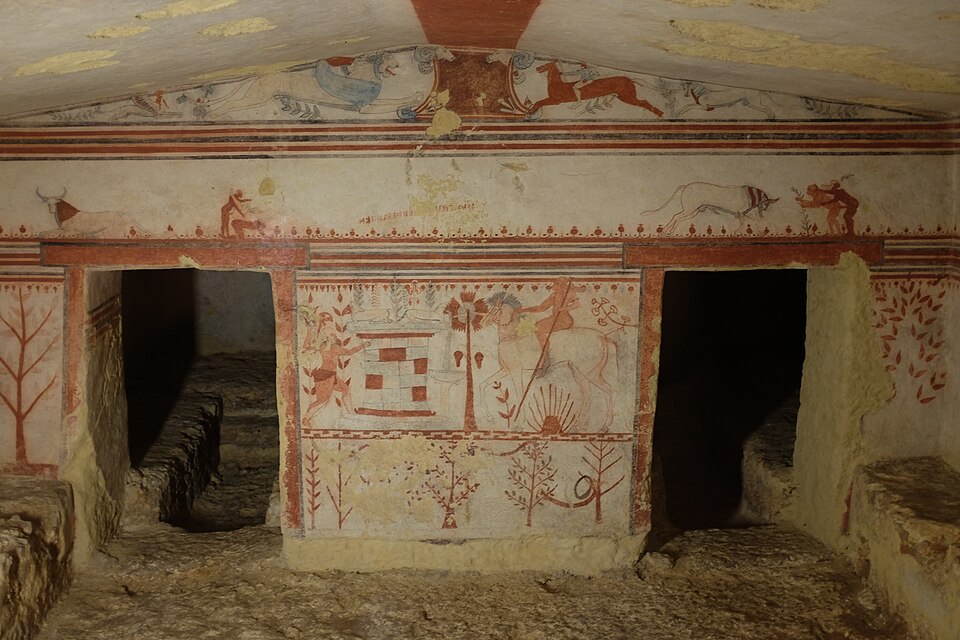
Tomb of the Bulls, interior, Italy. Courtesy: Wikimedia Commons.
I was trying to track down a quote from D H Lawrence that’s been in my head for a long time: ‘doing the dirt on tragedy’. Unable to find it anywhere, I asked some Lawrence experts if they knew where it was from. Frances Wilson, Lawrence’s biographer, reminded me that the actual quote – a very famous one – was ‘doing the dirt on sex’ (my emphasis). Of course! But how had I arrived at the misremembered formulation?
On reflection, it seems to be what musicians nowadays call a ‘mash-up’: a mash-up or segueing between Lawrence’s observation on sex and his feelings about tragedy – because there’s little doubt about his impatience with the latter, his rebellion against what it symbolises regarding weight and ‘meaning’ in the post-Socratic, post-Christian, and, finally, the post-Enlightenment world. If by post-Socratic, post-Christian, and post-Enlightenment we mean the ‘West’, then Lawrence’s rejection of the tragic gestures towards the limits of what the ‘West’, or ‘Europe’, means for him. How do we know about this rejection? It occurs in constant bursts through his writing, informing it throughout. And it accounts for his polemical investment in what he calls ‘life’, a key-word for Lawrence signifying the antithesis of all values religious, metaphysical, otherworldly, and tragical. This investment deepens, instead of diminishing, with the proximity of his own death. The closer he is to death, the more he rejects the hereafter, as in the opening pages of Apocalypse: ‘Whatever the dead or the unborn might know, they cannot know the marvel of being alive in the flesh.’ Descending the Etruscan tombs, he notes the frescoes on the walls: ‘It is all small and gay and quick with life… here is the real Etruscan liveliness and naturalness. It is not impressive or grand. But if you are content with just a sense of the quick ripple of life, then here it is.’ Then: ‘the underworld of the Etruscans was a gay place’. And, echoing Nietzsche: ‘This profound belief in life, acceptance of life, seems characteristic of the Etruscans’. (My emphasis)
In Etruscan Places, Lawrence identifies the civilisation that the tombs contain as a world-view predating, and destroyed by, Rome: by what we now take to be ‘the West’. Is rejecting tragedy necessary to recuperating lineages outside that putative West – lineages that do not fit into the self-awareness of Empire (‘Roman’/‘impressive or grand’) or into the legacies of Christian piety, or Enlightenment rationality? That would be too simple. After all, the Etruscan tombs are situated, geographically, within the boundaries of Europe. So it’s Europe’s self-awareness that Lawrence is aiming to open up by questioning tragedy’s ultimate dominance. Our ambition is similar: to make possible new conversations between diverse cultural lineages about what has lain, and lies, beyond tragedy, while discarding the usefulness of the idea of the West and its others through this act of distancing.
Amit Chaudhuri
23.11.2025
Categories
Events

‘The Non-Peer Reviewed Essay’: Mission Statement and Schedule, the 10th Symposium

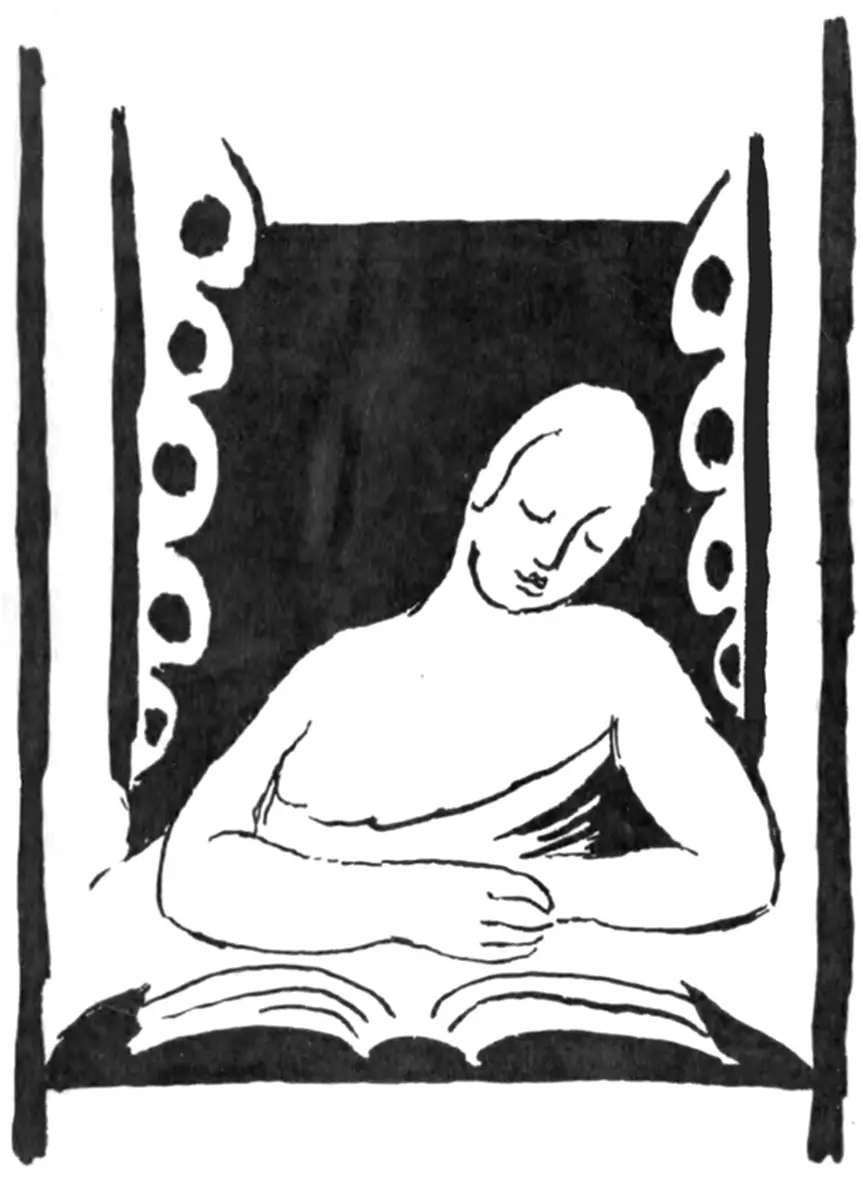
Artwork by Vanessa Bell, from the cover of Virginia Woolf’s Mr. Bennett and Mrs. Brown, published in 1924. Courtesy: Wikimedia Commons.

Mission Statement: ‘The Non-Peer Reviewed Essay’

  • This odd formulation – ‘non-peer reviewed essay’ – is a response to the excessive deference paid in India by academia to the idea of peer review: an instance, in a sense, of academia deferring to itself and to the sacred value and respectability it accords to sociological verifiability. In the process, we have been gradually forgetting the essay’s eccentricity as a form and its independence from conventional truth value. Some of the thoughts in this mission statement are, as would probably be obvious, pertinent both to the academic and the journalistic article.
  • This symposium wishes to reconsider essays that have a deep seriousness of intent but deliberately reject the processes and accoutrements of legitimacy required by academic journals as well as by the conventions of mainstream journalism, non-fiction, and popular history. The emergence of the non-peer reviewed essay also questions the construct through which American academia in particular has defined any kind of hybrid prose enquiry: belles-lettres.
  • A certain shift that involved rethinking essayistic form and expression was made possible by publications like the London Review of Books in the 1990s and early 2000s, by platforms like n+1’s ‘The Intellectual Situation’, the Books pages of The Caravan magazine in India, and the White Review in the United Kingdom. Some of these forums changed subtly or even disappeared (as is the case with the last example) while others have obstinately pursued their agenda of open forms and critical thought. It should be added here that the peer-reviewed essay has itself narrowed down over the recent decade into a site of citation.
  • Academia often ignores the revival that critical thought has had in the last thirty years in the non-professional domain of the essay – in some cases, of the personal essay that has a specific autobiographical subject, which also might turn out to be a critical essay. This segue between the personal and the critical was once a formative characteristic of modern criticism in writers such as Tagore, Woolf, and Lawrence. Ironically, in some of these writers, the essay, notwithstanding the fact that it carried the particularities of personality and style, explored or embodied, in crucial instances, the idea of a radical impersonality very different either from the sociological objectivity that is one of the peer-reviewed essay’s ambitions or from the notion of ‘fairness’ or balance in a review.
  • I’m restricting myself to the Anglophone world here, but this is not to say that this history has not reshaped, in similar or different ways, intellectual non-peer reviewed (and peer reviewed) work in other languages. Part of the rethinking of the ‘non-peer reviewed’ emerged from a Europe beyond Turgenev, Tolstoy, and Scandinavian detective novels – the Europe of Sebald, Walser, and, now, the excellent Annie Ernaux – which, characteristically, has led to a radical opening up. On the other hand, it needs to be noted that the revival has engendered a spurious sense of ownership that has largely left the non-European non-Anglophone essayist (writing, say, for Charbak or Hakara) dispossessed.
  • The contemporary remaking of this form has been particularly important to those who, in the period of globalisation, have noted with dismay the marginalisation of poetic practice and the immovable dominance of the novel. But there continues to be a kind of ignorance of this revival and of its provenances and implications, which include an impact on both fiction and non-fiction writing that is today referred to slightly glibly by catchphrases and terms like ‘autofiction’ and ‘genre-bending’.
  • The history of the non-peer reviewed essay and its crucial relationship to critical thought has also undergone a kind of erasure in the academy, in that academia both knows and teaches that history (when students are asked to read, say, ‘A Room of One’s Own or ‘The Metaphysical Poets’) while seldom addressing the way it informs its own practices – which remain overtly demarcated, professionalised, peer-reviewed, and, despite the apparent crisis in the humanities, self-perpetuating.

Schedule

Venue: Seminar Rooms 1, 2, & 3, India International Centre, New Delhi

Friday, 28th March

11:00 am
Opening Remarks

11:15 am to 12:15 pm
Arvind Krishna Mehrotra: ‘Seeing Double, Hearing Double: An Experience of Reading’ [Chair: Khwaja Ovais]

12:30 pm to 1:30 pm
Lara Choksey: ‘Peer Review in Public: The Case of Sociobiology’ [Chair: Shubham Gupta]

1:30 pm to 2:15 pm
Lunch Break

2:15 pm to 3:15 pm
Colin Vanderburg: ‘Quiet Please, Critics at Work’ [Chair: Vedika Kaushal]

3:30 pm to 4:30 pm
Brian Dillon: ‘Essays and Affinities’ [Chair: Vighnesh Hampapura]

Saturday, 29th March

11:00 am to 12:00 pm
Edwin Frank: ‘The Fiction of Original Response’ [Chair: Maya Joshi]

12:10 pm to 1:10 pm
Amit Chaudhuri: ‘What on Earth Does Non-Fiction Mean?’ [Chair: Carlin Romano]

1:10 pm to 1:50 pm
Lunch Break

1:50 pm to 2:50 pm
Sumana Roy: ‘Disobedient Women and the Terror of Reviewer 2’ [Chair: Aparna Chaudhuri]

3:00 pm to 4:00 pm
Jon Cook: ‘The Essay’s Situations’ [Chair: Sanchit Toor]

4:00 pm to 5:00 pm
Panel – ‘What Can the Essay Do?’

Mandakini Dubey, Vineet Gill, Saikat Majumdar, and Cynthia Zarin [Moderator: Gautam Choubey]

The speakers
  • Amit Chaudhuri is a novelist, poet, essayist, and musician. He is Professor of Creative Writing and Director of the Centre for the Creative and the Critical at Ashoka University. He conceptualises the ‘literary activism’ symposia.
  • Arvind Krishna Mehrotra is a poet, writer, and translator. His new book of poems, Of Least Concern, will be published by Literary Activism/Westland later this year.
  • Brian Dillon is an Irish writer based in London and Professor of Creative Writing at Queen Mary University of London. His books include Affinities, Suppose a Sentence, Essayism, and The Great Explosion, among others.
  • Colin Vanderburg is a Senior Editor at n+1 magazine and a PhD candidate in English at New York University.
  • Cynthia Zarin is the author of the novel Inverno; six books of poetry, including Orbit and Next Day: New and Selected Poems; five books for children; and two essay collections, Two Cities and An Enlarged Heart: A Personal History. She teaches at Yale University.
  • Edwin Frank is the founder and editor of the New York Review Books Classics series and the editorial director of New York Review Books. He is the author of Snake Train: Poems 1983-2013 and Stranger than Fiction: Lives of the Twentieth-Century Novel.
  • Jon Cook is Emeritus Professor of Literature at the University of East Anglia. Currently involved in a research collaboration with colleagues at Jadavpur University in Kolkata, he is also co-authoring a book on Democracy and Decolonization.
  • Lara Choksey is Lecturer in Colonial and Postcolonial Literatures at University College London, where she is also Associate Faculty in the Sarah Parker Remond Centre for the Study of Racism and Racialisation. Her book, Narrative in the Age of the Genome, considers measures of the human in genomic narratives.
  • Mandakini Dubey is Assistant Professor of English at Ashoka University. With several publications in literary and general interest magazines, she is working on her first book, provisionally entitled Esoteric Empire: Victorian Orientalism Between the Lines.
  • Saikat Majumdar is a novelist, academic, and a commentator on the arts, literature, and higher education. He is Professor of English and Creative Writing at Ashoka University. His latest publication is The Amateur: Self-Making and the Humanities in the Postcolony.
  • Sumana Roy is the author of two works of nonfiction, How I Became a Tree and Provincials; Plant Thinkers of Twentieth-Century Bengal, a work of literary criticism; Missing: A Novel; My Mother’s Lover and Other Stories; and two collections of poems.
  • Vineet Gill is a writer and senior copy editor at Penguin Random House India. He is also the author of Here and Hereafter: Nirmal Verma’s Life in Literature.
Categories
Symposium 8: The Writer-Critic and Literary Studies

Schedule: 31 March and 1 April 2023

As it’s being presented in partnership with the India International Centre, New Delhi, the Symposium is open to all, and you don’t need to register.

Dedicated to the memory of Dubravka Ugrešić (27.3.1949 – 17.3.23)

31st March 2023

11:15 am
Opening remarks
11:30 am to 12:30 pm
Vidyan Ravinthiran: ‘Against Citation’
12:40 pm to 1:40 pm
Jane Goldman: ‘“floating like flowers on water”: lyric activism, textual editing, translation and the politics of otium’
1:40 pm to 2:30 pm
LUNCH
2:30 pm to 3:30 pm
Sumana Roy: ‘The Poet-Professor in the Indian Provinces’
3:40 pm to 4:40 pm
Ashutosh Bhardwaj, Rosinka Chaudhuri, Martin Crowley, Rita Kothari: ‘The Writer-Critic Across Languages’, moderated by Amit Chaudhuri

1st April 2023

11:30 am to 12:30 pm
Michel Chaouli: ‘The Bastard of History: What James Baldwin Taught Me About Poetic Criticism’
12:40 pm to 1:40 pm
Amit Chaudhuri: ‘On what it means to have been a writer in the age of globalisation: Rereading Tom Paulin and Virginia Woolf’
1:40 pm to 2:30 pm
LUNCH
2:30 pm to 3:30 pm
Lisa Borst: ‘Organizing in the Program Era’
3:40 pm to 4:40 pm
Matthew Beaumont: ‘In Praise of Unlearning: The Writer-Critic and the Essay’

Speakers

Matthew Beaumont, a Professor of English Literature at University College London, is the author of several books, including Nightwalking (2015) and The Walker (2020). A short story, his first foray into fiction, was shortlisted for the White Review Short Story Prize in 2018. He has recently written a novel.

Ashutosh Bhardwaj writes in various forms of prose, from conflict zone reporting and investigative journalism to fiction and literary criticism.

Lisa Borst is the web editor of n+1 magazine, where she has also contributed writing about self-publishing, zine culture, and other topics.

Michel Chaouli teaches literature and philosophy at Indiana University Bloomington. His book Thinking With Kant’s Critique of Judgment was published by Harvard University Press in 2017. In his next book, he develops the idea and the practice of poetic criticism. It is entitled Something Speaks To Me and will come out with the University of Chicago Press next year.

Amit Chaudhuri is a novelist, poet, essayist, and musician. He is Professor of Creative Writing and Director of the Centre for the Creative and the Critical, Ashoka University. He conceptualises the ‘literary activism’ symposia.

Rosinka Chaudhuri is Professor of Cultural Studies and Director of the Centre for Studies in Social Sciences, Calcutta. She has written and published extensively on literary culture, history, and poetry in three monographs and several edited books and anthologies.

Martin Crowley is Professor of Modern French Thought and Culture at the University of Cambridge. He is the author most recently of Accidental Agents: Ecological Politics Beyond the Human (2022), and serves as General Editor of the journal French Studies.

Jane Goldman, poet and academic, Reader at the School of Critical Studies, Glasgow University, and a founding General Editor of the Cambridge University Press Edition of Virginia Woolf’s works, has published widely in avant-garde poetics, modernism, and Woolf studies, and is author of three volumes of poetry: Border Thoughts (2014), SEKXPHRASTIKS (2021), and Catullus 64 (2023).

Rita Kothari is Professor of English and Director, Centre for Translation, Ashoka University. She has written many books and articles, the latest of which is Uneasy Translations: Self, Experience and Indian Literature (2022).

Vidyan Ravinthiran teaches at Harvard. He is the author of two collections of verse. Worlds Woven Together, a selection of his essays on poetry, came out last year, as did Spontaneity and Form in Modern Prose. Asian/Other, a fusion of poetry criticism and memoir, is forthcoming from Icon in the UK and Norton in the US.

Sumana Roy is the author of How I Became a Tree, a work of nonfiction, Missing: A Novel, My Mother’s Lover and Other Stories, and two poetry collections, Out of Syllabus and V. I. P: Very Important Plant. She is Associate Professor of English and Creative Writing at Ashoka University.

Categories
Blog

Classic for a Reason