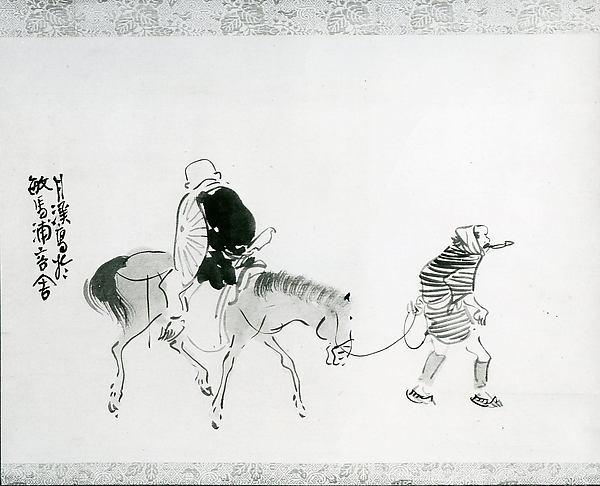
Matsumura Goshun, Monk Renshō Riding His Horse Backwards, 1782-84. (Courtesy: Wikimedia Commons)
On Failing: Mission Statement
Amit Chaudhuri
The fifth symposium in the UEA ‘literary activism’ series took place on 14–15 February 2020 in partnership with Ashoka University at the India International Centre, New Delhi.
What is it that draws us to failing? We might not consciously want to fail, but, if we’re engaged in creative practice, might unconsciously develop, over time, measures to protect ourselves from what Pound called ‘SINGLE AND UNIQUE SUCCESS’. The free market, in the last twenty-five years, might have exhibited to us the importance of success—that success is not good fortune or a reward for accomplishment, but basic survival—and we might conspire to succeed only to a degree that’s necessary for us to fail: because we know that it’s only by failing that we can produce viable work, and only by succeeding to some extent that we can have the freedom to be non-viable. Failure has not only no dignity in the post-free market world we inhabit; it has no legitimacy, no vocabulary for selfappraisal. There are no actual ‘alternative spaces’ in the free market. Where do we locate ourselves, then, if we’re to speak about ‘failing’? For millennia we learnt from failure, and from failures: what do we make of that antithetical way of estimating significance? Various conceptions of form have, across cultures, embodied the liberations of failing: synecdoche; the image; metaphor—all these arise from a preferred inability to represent fully. Failure creates immediacy. This symposium asks participants to account for the attractions specific to failing; for why, and how, it awakens our desire; why it is taboo today in a way quite different from the by-no-means unbroken era before the market; and to reassess this history.