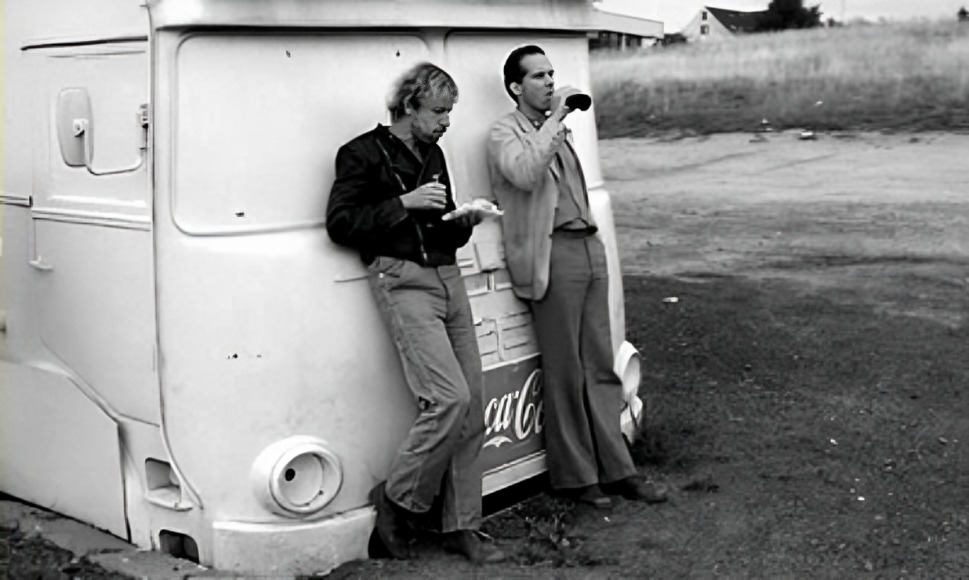
Still from Wim Wenders’ Im Lauf Der Zeit (1976). Courtesy: Wikimedia Commons
Compulsory Conformity
Charles Bernstein
For the editor’s note, see here. The essays by Paul Bové and Charles Bernstein are responses to the mission statement for the Literary Activism symposium on the ‘non-peer reviewed essay’.
Professionalism gave itself over to repetition so that journals became safe
spaces for familiarity and conversation among the agreeable.
— Paul Bové
I’m getting bugged driving up and down this same old strip
I gotta find a new place where the kids are hip
— The Beach Boys
The bounded is loathed by its possessor. The same dull round even of a
universe would soon become a mill with complicated wheels.
— William Blake
Compulsion sometimes seems as inevitable as ‘aggression’ in Conrad Lorenz’s mid-’60s’ depiction of our species; but it is neither inevitable nor desirable. Still: desirable to whom?, since, as usual, I feel out on the loops and my aversion to compulsion is surely a minority, and compulsory, taste. Never underestimate the desire for conformity or the desire to avert it. It’s a crashing bore to point out that the ‘anti’s’ are as conformist as those they are anti to. I don’t even own a pair of blue jeans: the symbol of nonconformity of my youth is now the sign of rightwing populism. In poetry, Compulsory Bohemianism (CB) has merged with Compulsory Confessionalism (CC) and Compulsory Lyric (CL) to be the Official Cold Brew (OCB) of Packaged Poetry (PP) USA. The pockets of resistance are now manned by card-carrying members of AWP (Amalgamated Written Pogroms), who say, chill out: there are no sides anymore, except the people like you who say there are sides. We are all political now, especially if you can keep your moral superiority to just one global and one local issue.
Don’t try to confuse me with complexity: I know right from wrong, you motherfucker!
Peer review is a means of normalizing discourse if it is applied by anonymous readers to anonymous authors. A hundred years ago, New Zealand student exams were sent to England for grading. My inner peer reviewer says I should explain that, but I say: you get it. In Wim Wenders’s Im Lauf der Zeit one of the characters, thinking of all those American pop songs Europeans have internalized, says ‘the Yanks have colonized our unconscious’. But the truth is, we colonize our own unconsciousness: we don’t need England or the Yanks.
Even so, the idea that we can decolonize is akin to joining a nudist colony to go back to nature.
Hank Lazer and I edited poetics series for the University of Alabama Press, 67 books before we were made redundant, two retired Jewish poet-professors had come to the end of our “lauf” (run). But ’twas a splendid run, in which we used the requirement that two anonymous readers review our proposed manuscripts and write detailed reports. Unlike the double-blind peer review of anonymous journal submissions, Hank and I sent manuscripts to our reviewers that we had already selected from solicitations as well as submissions. Almost none of our recommendations got turned down and the reviews were uniformly engaged, generous, and helpful to the author. That’s because we carefully paired the reviewers with the reviewed, the way you pair Chateau Lafite with filet mignon. Don’t get me wrong: a Chateau Lafite costs a lot more than we ever paid a reviewer.
We did sometimes have problems, but as David Antin used to say, we all do the best we can.
I am sure it’s because I never submitted to a psychotherapy session, but I recoil at submitting my work to a magazine, especially where I don’t know the editors. I prefer to be solicited. Despite what you are thinking, it’s not me. These are the terms of disciplinarity, and any sexual connotations are not of my making.
DON’T EVEN THINK OF S&M HERE!
I published my first two books myself, under the imprint ‘Asylum’s Press’. Insane asylum or sanctuary?: that’s the question. I didn’t use a commercial printer either, just xeroxed and side-stapled my typewriter pages. No publisher would have accepted those two books: Asylums and Parsing (mid-1970s). All my early publications were by poet-editors with whom I was in active correspondence: not submission/solicitation, these were exchanges. The scale was small, but we read each other’s work and talked about it. L=A=N=G=U=A=G=E (1978-1981) was much same: the contributions came out of exchanges and there were very few unsolicited submissions; we were far too under-the-radar for many outside our ever-widening sphere to want to be part of the magazine.
Editing, the kind I want, is matter of selection and curation: you choose what you want to publish by knowing the field and being open to new voices. But aesthetic preference is fundamental.
I’m an aesthetic fundamentalist.
Flipping Frederic Jameson’s ‘always historicize’ on its head, as Karl Marx did done to Georg Hegel, how about: Always aestheticize. But don’t only aestheticize. In other words: always historicize always and, also, aestheticize historicize.
O ye’ll tak’ the high road, and I’ll tak’ the low road,
And I’ll be in Scotland afore ye,
But me and my true love will never meet again,
On the bonnie, bonnie banks o’ Loch Lomond.
Teaching in a PhD program for thirty years, it was impossible not to be struck by repetition of the same core group of authorized references and code words across graduate students and faculty papers; these are time-stamped references that have a five-to-ten-year shelf life, though two or three names and terms persist over decades. While such references are viewed in the profession as a mark of the elite, a simple exercise is to recommend to young scholars that they avoid any such names or terms. While precarious, it might help our young scholar stand out from the pack.
You see something similar in the national periodicals of cultural prestige, with the same authors cross-reviewed in each other’s publications. Then again, there is almost no overlap of the literary studies ‘must cite’ list and the list of ‘prize winning’ authors. I have my own kinds of poetry I want and repeat the same names over a lifetime of teaching and writing. I’m all for preference based on aesthetic judgment, such as those presented in editor-driven, iconoclastic publications. I worry when the same constellations of preference capture multiple platforms and become not expressions of particularized judgement but capitulations to professionalization or cultural norms. Such homogenization mimics commercial culture even though driven by cultural capital and ideological control.
Double-blind peer review has the advantage of countering preferential treatment of elect social groups, as long as I don’t tip my hat to my disfavored affiliation (as I have done repeatedly in this short recit). Something like the opportunity standardized college admission tests offered Jews, moi aussi. But that’s problem, n’est-ce pas?
Some ‘flagship’ publications will want to establish/reflect consensus, just as others of us have a compulsion for dissensus. We need each other.
My years as a professor was well in the post-classical/post-canonical period where the idea of a received list of Great Books was no longer viable. Early in my time at Penn, the English faculty adopted a compulsory ‘pro-seminar’ for graduate students: ‘pro’ as in the pro-shop at a golf course. The pro-posed content was mostly Literary Theory of the 1970s, a provisional canon I very much like and wudda thot showed ze problem with compulsory. [Note that the three previous sentences would rightly be flagged as self-indulgent by any conscientious peer reviewer.] Still, only a couple of us dissented and I was admonished (contrary to empirical evidence!) that my non-disciplinary approach would make it harder for students to get jobs than the built-in obsolescence proposed.
Now, if anybody knows obsolescence it’s me; I was obsolete before I started. My seminars always focused on obsolete theories and obsolete poets. I just thought graduate students should have an opt-out option (O O O) or offered more than one model.
Peer Pressure: A colleague later kindly shared with me that the function of mandatory requirements was something like hazing: a bonding experience for the ‘cohort’: Dead Poets Society as professional training, with name redacted replacing Vachel Lindsay’s “The Congo.” But perhaps a better explanation is that such dicta provide master narratives for whatever symptoms the young scholar chooses to treat.
When Tracie Morris and I edited The Best Experimental Writing 2016 for Wesleyan University Press, we put together an unexpected list of the work we found most significant. I made a rule to exclude my own immediate generational company (much to the annoyance of my own immediate generational company). Our selection was stellar. But the series editors had an idea of ‘fairness’ that meant that some of the poems in the volume had to come from unsolicited submissions, which the four of us were to rate by a complex ranked choice system that favored consensus/compromise over each of our individual preferences. While all these poems were good enough, the anthology was ultimately watered down. It would have been better if Tracie and I had selected the entire collection.
But such a view is considered odious and anti-democratic.
The problem is that many of the poets I most care about would not submit their work to a bureaucratized selection system. You must seek them out and cajole them to send something. On top of that, the statistical/consensus ranking system promotes the choice of the average, not the most radical or significant. And yet, many small press journals have moved to a submission-only system with bureaucratic adjudication and selection by consensus that is ill-suited for aesthetic judgment, which often means going out on a limb, finding something others dislike.
But here’s the rub. The mainstream publications that presumably select their poems without peer review are locked into a crippling conformism – what Paul Bové calls ‘peerage’ ––that is no better than anonymous submission or professional adjudication. The publications, critical and literary, that are most bold, that are worthwhile reading, are likely edited by people who are committed to making their own judgments and not relying on consensus or professionalization. In that sense, editing is akin to writing. No one ever made a mistake being too radical or iconoclastic. Or if they do make that mistake, it is still more interesting than the blandness that is sine qua non (or just the sin) of lyric peerage.
We peer into a blank page that knows no bottom. It’s natural to recoil, to seek the familiar and damn the rest. But this reflexive recoil is perhaps the only delusion we are free to avoid.
Charles Bernstein is the author, most recently, of The Kinds of Poetry I Want: Essays and Comedies (University of Chicago Press, 2024) and Topsy-Turvy (Chicago, 2021). His work was the subject of The Poetry of Idiomatic Insistences, edited by Paul Bové (boundary 2/ Duke University Press, 2021).
This essay is a response, in part, to Amit Chaudhuri’s ‘Mission Statement: ‘The Non-Peer Reviewed Essay’ and Paul Bové’s ‘There’s No Moral Right to…’