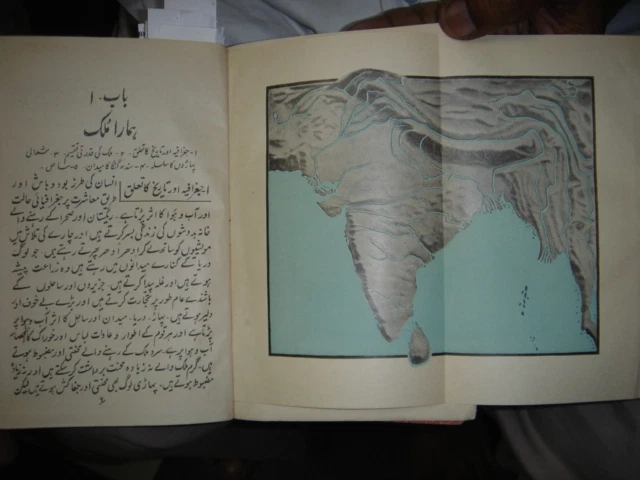
From New History of India by Abdur Rashid
Editor’s note: Arvind Krishna Mehrotra has been translating Shamsher Bahadur Singh, and, on the morning of 14th August, looked again at a poem he’d earlier considered ‘skippable’ and sent it to me. Written 78 years ago in the year of India’s Independence, it seemed to me to speak to a short poem Tagore wrote eleven days before his death, when the world was at war. So I have translated Tagore’s poem, and it appears below Singh’s.
‘We’re a new history open at the first page’
Shamsher Bahadur Singh
Translated from Hindi by Arvind Krishna Mehrotra
- We’re a new history open at the first page.
- The light of new values shines
- today
- in a new dawn, when we, our many nations,
- civilizations, histories,
- are becoming one:
- It’s a new
- consciousness
- in which
- a new soul
- is blossoming.
- The new Man has the face of the sun.
- The first moment will herald the victory of peace.
- – 1947
Translator’s note: Like poems, translations, too, are acts of history. Had I come across Shamsher Bahadur Singh’s ‘We’re a new history open at the first page’, published posthumously in 1995 in Kahin Bahut Dur Se Sun Raha Hoon [I’m listening from afar], edited by Ranjana Argade, I would have overlooked it. Maybe I had in the past. The date after the poem, 1947, makes it skippable. We don’t want to read, much less translate, another poem celebrating 15 August. Celebratory poems are born trite. I then realised what the date on the calendar was, today’s date, 14 August, and the same overlooked poem returned, but now draped in a flag that had looked very different 78 years ago. The poem translated itself.
Shamsher Bahadur Singh was born in Dehra Dun in 1911 into a Jat family. He had his early education there and did his high school and intermediate from Gonda. In 1931, at the suggestion of Harivansh Rai Bachchan, he joined the University of Allahabad from where he took his BA degree. He was enrolled for an MA in English at the same university, but left after a year to study in Delhi, at the art school started by Sarada Ukil. In the late 1940s, while living in a commune in Bombay, he edited Naya Sahitya [New Literature], a left- leaning journal of poetry, fiction, and criticism, published by Jan Prakashan Griha. Shamsher was associated with various Hindi magazines from the 1940s to the mid 1960s when, in 1965, he was appointed editor of the UGC-funded Urdu-Hindi Dictionary. He died in 1993 in Ahmedabad, where in his last years he was cared for by Ranjana Argade and her family. Among his many awards are the Sahitya Akadami Award, the Tulsi Puraskar, and the Kabir Samman. He wrote in Urdu, Hindi, and, very occasionally, in English.
Shamsher’s first book was the minimally titled Kuch Kavitayein [Some Poems] published in 1959. Two years later he brought out Kuch aur Kavitayein [Some More Poems]. In the introduction to the latter, Singh tells us how he views the relationship between writing and publishing. The reader, he says, will find in the book examples of the different kinds of poems he wrote between 1941 and 1960, and goes on to explain why they are all different. ‘The poet in me’, he writes, ‘could not accept being tied down to a particular form, or literary style, or subject. Which subjects or styles are currently in fashion, which “ism” has come and gone—I never had time for them. . . . . In all honesty, the “publication” of art is something I give little importance to. Art has nothing to do with the calendar.’
Arvind Krishna Mehrotra was born in 1947 in Undivided India, where he still lives, according to his passport. A new collection of his poems, Of Least Concern, is to be published by Literary Activism/Westland later this year. He lives in Dehra Dun.
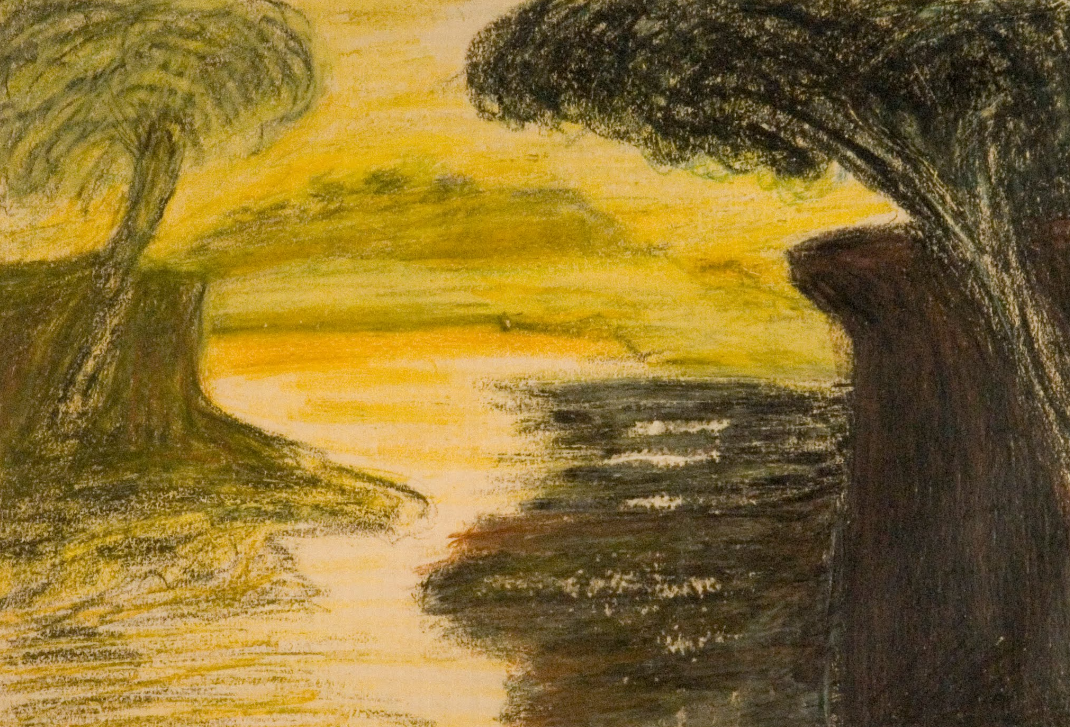
A landscape by Tagore using crayons, circa 1935. Courtesy: National Gallery of Modern Art, India.
‘The first day’s sun’
Rabindranath Tagore
Translated from Bengali by Amit Chaudhuri
- The first day’s sun
- put a question
- to existence’s new incarnation —
- Who are you?
- It got no answer.
- Year followed year.
- The day’s last sun
- addressed the last question
- from the ocean’s western extremity,
- the evening silent —
- Who are you?
- No answer came.
- – Jorasanko, Calcutta, morning, 27th July 1941