Courtesy: Wikimedia Commons
There’s No Moral Right to . . .
Paul Bové
For the editor’s note, see here. The essays by Paul Bové and Charles Bernstein are responses to the mission statement for the Literary Activism symposium on the ‘non-peer reviewed essay’.
Notwithstanding a sinfull opinion among many that Christians have right to Heathens Lands: but of the delusion of that phrase, I have spoke in a discourse . . .
Roger Williams, A Key into the Language of America (1643)
In October 1994, Bill Clinton invoked Operation Vigilant Warrior as a shibboleth fixing the display and use of military force in the Persian Gulf. Not only did this follow by just three years the first Iraq war but it came on just eight months after the enforcement of a ‘No Fly Zone’ over Serbia, Bosnia, and Herzegovina by F-16s.
In the same October, Rosmarie Waldrop published her redoing of Roger Williams’s book after looking into it for traces of a lost language, testing for the subsoil of a lost people, and wondering over how traces of that lost language, preserved only in the conqueror’s frames, irritated her eyes and ears so much. Puritans had banished Williams from their corporation because he had held up to them a mirror of their own moralizing and materialistic self-aggrandizement. Waldrop’s mirror of her own world is not a passive but a stringent reflection, staging clashes between persistent irritants of language and the powerful dominants of erasure and burial. From it all comes not practical advice or moral regret but words in lists, each and all of which ‘explore the language context (rather than the cultural context) of the chapter titles’. Waldrop’s name for poetic marginalization from the dominant is immigrant woman, formed as ‘war bride’. As a variable repetition on Williams’s own dissonance to his exilers, she creates ‘an immigrant’s take on the heritage and complex early history of my adopted country’.[1]
II
Peer Review
–commonplace
The Oxford English Dictionary says the first use of the compound noun, ‘peer review’, occurred in the United States in a 1975 New England Journal of Medicine editorial entitled ‘Charity and Peer Review in Publication’.[2] The same year saw the end of the American involvement in the Vietnam War, the founding of Microsoft, and the signing of the Helsinki Accords that eased the Cold War. All these incidents followed by one year Richard Nixon’s forced resignation from the US presidency concluding his part in the Watergate scandals and crimes. Starting then, publishers, editors, and professional societies borrowed the noun ‘peer review’ from recent practices demanding efficiency and accountability.[3] Ethics and cost (both forms of accountability) combined from bookkeeping and the professional search for legitimation within the constrained stagflating economy of the 1970s to set up a new technique for justifying and measuring the value of knowledge production and reproduction. Itself a borrowed and cobbled noun and verb, peer review extended normalcy as measure to specific kinds of method, means, and meaning inviting yet evading objection while solidifying, at least temporarily, claims to authority and security. In such a way, institutions of knowledge would become legitimate and cost effective, instructive and authoritative within American society and across international borders as trade in expertise and progress expanded. As the NEJM put it in 1975, ‘the reader will find reports that have passed the muster of peer review. Usually two, but occasionally three or four, experts on the topic of an article will be asked to evaluate its validity, originality, and presentation’.[4]
Georges Canguilhem, an influential teacher and a philosopher of science had published Le Normal et le pathologique in 1966.[5] More important, for our discussion, in 1978 Michel Foucault, whose doctoral thesis Canguilhem had sponsored, wrote a substantial introduction to the translation of Canguilhem’s book, giving an English-language push to a post-1960s critique of institutions, their authority, and their normalizing language function within Western societies.[6] Over a period of decades in the West, in the name of socially and politically displaced persons and groups, at times sporadic and at times sustained objections to systems of knowledge (and power) that regulated norms worked to toss aside or undermine the institutions and languages upon which normalcy’s authority depends. Foucault’s name, for a while at least, and often because of his work on law and discipline, signified means of resistance and delegitimation in many quarters, especially as his own death during the AIDS crisis of the 1980s added semiotic and emotional value to struggles for recognition and care carried out against an uncaring market-centered and class, race, and gender-biased rightist politics.
Foucault’s introduction both lent support to social and political struggles to alter enforced and enforcing mechanisms of normalcy and stepped away from the social arenas in which those struggles occurred, including academia and academic languages. Foucault did this by first noting that Canguilhem’s thinking developed along lines counter to the subjective, personalist, or even experiential line of phenomenology that, in France, Sartre epitomized and against which Althusser, for example, stood. Foucault characterizes Canguilhem as a modest thinker working in a narrowly specialized field of thought. Foucault’s irony, of course, has it that this modest field is nothing less than the fundamental question modernity poses to itself about thought, knowledge, and reflection that originated in the eighteenth century but haunts the long present of Foucault’s writing. Asking why Canguilhem’s modest work has such importance, Foucault answers that it is ‘profoundly tied to the present’. How so? Because in Canguilhem’s narrow field of specialization, the history and philosophy of science, ‘for the first time rational thought was put in question not only as to its nature, its foundation, its power and its rights, but also as to its history and its geography’ (x). And the link to the long present? ‘It was this form [of phenomenology] which played the most important role in the sixties, when a “crisis” began, a crisis concerning not only the University but also the status and the role of knowledge’ (x).
Did peer review provide a suitable guarantee of knowledge systems’ legitimacy and value or a confession of their fragility? Legitimacy is always a matter of belief and consent. In the US, in the period from 1968 until 2024, social and political forces of the Right and Left actively subverted belief and made belief into sometimes anger or sometimes . Political and moral motives for subversion and destruction had to sweep and then control the planes of power and society. Canguilhem’s careful study of life sciences’ internal binary logics of normalcy and divergence—the normal and abnormal—took new form in social protest against discriminatory social organization and linguistic inheritance and habituation. In other words, the crisis of the sixties, as Foucault calls it, not only assumed Canguilhem’s work as a motive for but as a weapon within the struggles against unreformed power formations embodied in the university, the state, and its extended apparatus. The liberatory promise of this understanding of Canguilhem joined up with aesthetic inventions and poetic creativities to, first, anarchize stability and, second, set up new cultures adapted to and emergent from the insecurity of knowledge and its extended systems, including especially the war-making-state.
Journalists and academic public intellectuals tell the story of the ’68 radicals’ movement into the Western university system as a defensive castellation from which forays into improper forms of ,[7] social practice, and persistent belief in the apparatuses of an extended democratic state hoped to get status so as to influence forms of power. Interestingly, this expansive defensive position coincided with a rise in academic professionalism embodied iconically by the still recognizable figure of Stanley Fish, a professor of Milton Studies who got status in legal studies, who defended the enclosed jargons of humanistic languages and (im)morals. The withdrawn, the publicly defeated, from within the terrain that hosted them would get status from esoteric knowledge claims, from tribalistic insight that made for prestige and security. One need only recall the obsession of the newspapers with deconstruction, negative as was the reporting, to understand the temporary success of this Fishian tactic.[8]
Peer review anew became a mark not of knowledge’s security but of admission to the fields and jargons that claimed and sometimes executed authority. The American Right bemoans and despises these developments, ending with the Trumpian assault on what the Right calls ‘woke’, that is, calls to reform culture and society away from racial and gender oppression, away from the seeming social equivalents of Canguilhem’s discussion of the binary forms active in structuring life science.[9] The American Humanities seem to be where this process plays out. Recent moves by the American Right against science and especially life sciences in the leading biomedical research universities—Columbia, Hopkins, Harvard, Pittsburgh, Duke—shows that for the Right ‘woke’ replicates, in all elite locations, for the production and reproduction of knowledge. Ending cultural studies by reducing support for medical research at universities is a desired but minor (if satisfying) consequence of the Right’s plans. In the face of power, peer review offers less than no protection since peer review errors have enabled assaults on the very system that invented it, especially as its institutional homes concede its failures.[10] The differences between, on the one hand, Canguilhem and Foucault’s discussion of contradictions internal to Enlightenment beliefs that subsume thinking to knowledge and, on the other, social, political, and moral strategies for weakening the institutional and linguistic systems that are home to those beliefs matter not at all to the politics of power. Foucault understood this.
III
We will serve our readers and not the profession.
J. Arac (1994)
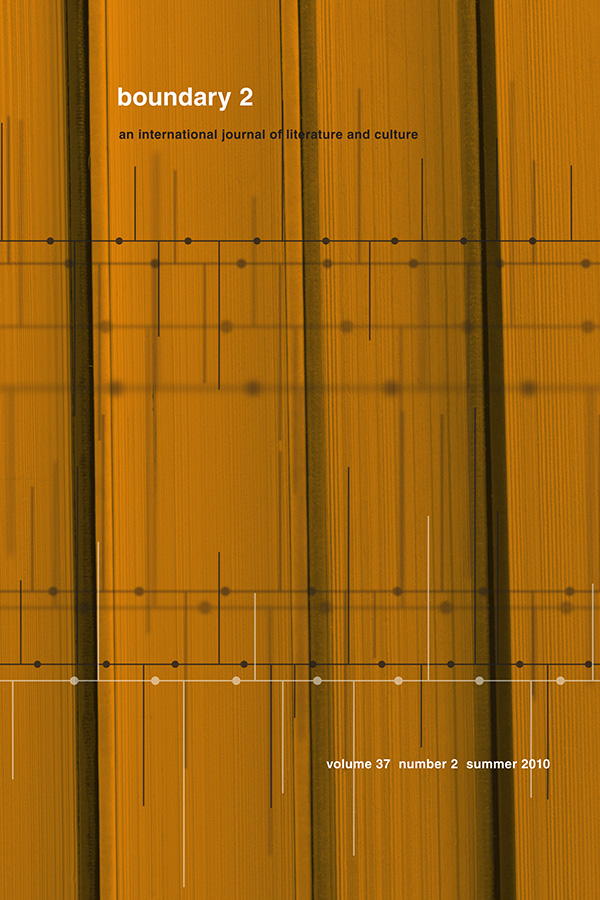
In 1972, William V. Spanos and Robert Kroetsch, both then professors of English at the State University of New York at Binghamton (USA), founded the literary critical journal, boundary 2. After Kroetsch’s return to his native Alberta, Canada, Spanos edited the journal alone, with the aid of young assistants, until the late 1980s, when funding and other problems forced a change in editorial leadership and publisher. Duke University Press acquired boundary 2 and is still its publisher. Editorial responsibilities rested in a newly formed collective of ten mid-career academics who negotiated the journal’s relation with Duke UP and shifted its intellectual focus. Originally a journal of ‘postmodern studies’, with an editorial emphasis on Heideggerean thinking and US English-language poetry, the journal, while keeping its commitment to poetry, internationalized its interests and secularized its critical commitments.
In 1994, the expanded editorial collective, to redirect the journal toward work of different value and more immediate interest in contemporary issues reflecting long term classical problems, left the US for an extended meeting in the British overseas territory of Bermuda. After long and heated discussion, the collective decided to reform the journal’s practice and principles.[11] b2 made what became the controversial decision not to consider unsolicited submissions for publication. b2’s editors had had the experience of reading and rejecting a substantial number of submissions for lack of quality or poor prose style. The articles’ claims were often transparent from their opening un-numbered footnote or their adopted jargon. The collective saw in these submissions ways of speaking and thinking defined and framed by terms fashionable in the profession at the time they came to editorial offices. We, the editors, recognized the normalcy of what we read because we were ourselves academics, often at major research universities, and involved in the day’s debates. The collective became intensely aware, aesthetically so, of how academic professionalism works. The collective appeared to academics as gatekeepers—and later colleagues would accuse the editors of closing b2’s gates too firmly—while it seemed to the collective that professional norms had anyway been shutting gates long before most writing came to its eyes. Closing the gates became an antidote to those who spoke in recognized ways, even or especially if those ways cast themselves as ‘oppositional’.
The 1994 Bermuda meeting came from a desire to overcome the purely negative gestures associated with closing gates to protect language spaces and conceptual possibilities from encroachment and by the Right. In a word, the collective decided to function as a publisher rather than as an editorial apparatus overseeing, selecting, and distributing the best that colleagues had already thought and said. Rather than function as repetiteurs, as mirror systems in which recognizable selves could converse, even if sometimes heatedly, the collective wanted to sustain forms of work not at home in the normalcies of professional . Of course, the collective and its members individually found interesting papers and writing everywhere. Open eyes were essential to its project. Encouraging such work and prodding others to work along needed lines became the collective’s purpose. Closed to the unsolicited, the collective worked to invite and publish the final equivalent of about one thousand printed pages per year with Duke UP as its publisher. The collective solicited essays, poetry, and research articles; it structured special issues; antagonistically criticized established notions; and persisted in defending its own values and projects, evolving over time as circumstances and a deeper understanding of the needed came about. In sum, the journal did not support professionalism’s presumptions about an intellectual and creative academic journal. Unattached to a defining professional association and exhausted by its reputation as a mainstream ‘avant-garde’ publication, it would intensify its own inquisitive, expansive, and attentive practices to reshape the consciousness, habits, and languages of its readers wherever they were—and whenever they might be.[12]
Courtesy: Wikimedia Commons
IV
‘porous, śƥongy: it, the poem, is aware of the erosion it exposes itself to’.
–Celan
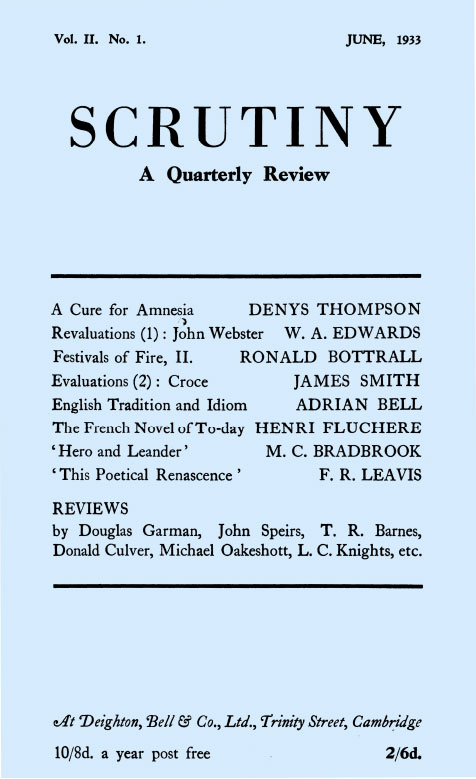
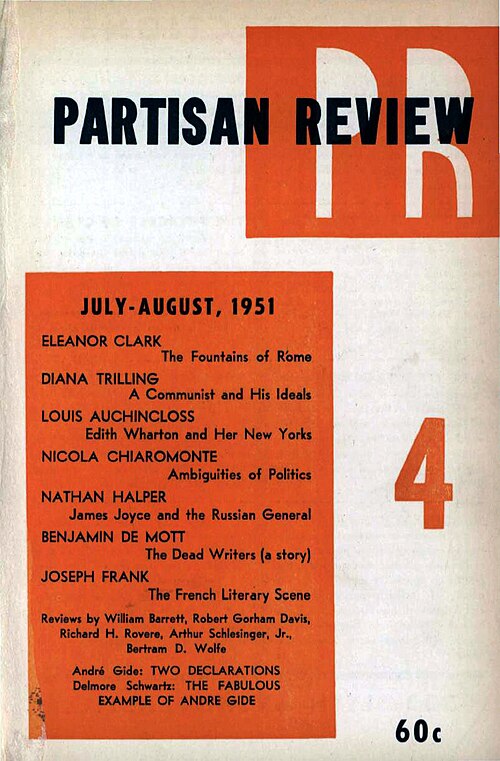
During and at once after the 1994 editorial meeting that relaunched boundary 2, members of the journal’s editorial collective pointed to literary history to justify its refusal of unsolicited submissions. Journals that intend an influence set up an intellectual agenda. Setting an agenda in motion means at least affecting the common sense of what is thought and said while aiming to set in motion an epistemologically and politically prior commitment to internal consistency of understanding and purpose. The collective needed to see, hear, and act to purpose. The historically minded pointed to such successful journal projects as Scrutiny: A Quarterly Review, which existed from 1932, when it was founded by F. R. Leavis and L. C. Knights, until its final number in 1953.[13] Readers sometimes compared the relaunched boundary 2 to the also relaunched Partisan Review that from 1937 to 1962 remained independent of academe and published writers and critics known as the New York Intellectuals.
More analytically and in a way typical of the collective’s concerns, editors pointed out that the time of ‘disinterested’ efforts to produce and reproduce knowledge had not only lost their luster but that truly active publishers understood that efficacy required purposive intent, a point of view, actively encouraged and sustained. Professionalism gave itself over to repetition so that journals became safe spaces for familiarity and conversation among the agreeable. Readers of King Lear had learned early on the inexplicable allure of a safety away from the safe spaces of conversational competition over authority, resources, and legitimacy. Lear, himself, would teach this truth to his only living love:
No, no, no, no. Come, let’s away to prison.
We two alone will sing like birds i’ th’ cage.
When thou dost ask me blessing, I’ll kneel down
And ask of thee forgiveness. So we’ll live,
And pray, and sing, and tell old tales, and laugh
At gilded butterflies, and hear poor rogues
Talk of court news, and we’ll talk with them too—
Who loses and who wins; who’s in, who’s out—
And take upon ’s the mystery of things,
As if we were God’s spies. And we’ll wear out,
In a walled prison, packs and sects of great ones
That ebb and flow by th’ moon. (V, iii, ll. 9 – 20)
Remarkably, Lear dreamt of grace within safe distance from the wheel of fortune. That Edmund’s insane diabolic cruelty made a fool of the old man’s vision and desire can efface the burden Lear would assume in his forced but blessed retreat. In exchange for the noisiness of succession and debate, he and his beloved would ‘take upon’s the mystery of things, / As if we were God’s spies.’ They would face a defaced world without the comforting conflicts of unburdened thoughtlessness and unreflected immediacy of purpose.
Whether for or against the status quo, in opposition or defense, these others are the objects of study for those burdened to face god’s mysteries. Of those competing for power and position, amid shifting aims, ways of speaking, and ever more secure values and beliefs—of all those who would Lear admit as a peer to the pair set-aside alone to study? Lear’s willingness to withdraw with his beloved into close study of the deepest problems invites political objections to its seeming privatism and ironic privilege, a state that is lost when the normal run of things ends the duration set aside for study, song, and reflection, as Lear is reduced to calling for a mirror hoping for the grace of a deferred breath, of animation. In a dreadful anticipation of Hamlet’s nihilistic, Beckettian ending of total catastrophe, loving observers can wish no more than that the heart crushed by love’s death and study’s impossibility should break.
More significantly, politically purposed historicist hermeneutics made the entire play allegorical of early modernism, so-called, choosing issues of sovereignty and the state as definitional.[14] Those hermeneutics belonged to the generalized critique of liberal state formations and its origins, which often depended on mid- and late-twentieth century Rightist thinking by Schmitt and others in his shadow. The critical agreement on the value of such an approach made light of Lear’s own desires and ambitions. Did they seem too ‘liberal’, too typical, that is, hoping to escape the partisanship of the political? The interplay of Lear’s frustrations and academic cohesion about the play strangely reproduced the dynamics of its tragedy and threatened their expansion. Was it too late to close the gates as clearly it was for Lear and Cordelia? Contemporary writing that returned regularly to the play is a mark that the poem predicted its erosion in the repetiteurs’ projection of their own desire for persistent relevance. The academics’ readings came, as they were, from the poem’s peers. boundary 2’s collective closed forces against that ‘as it were’ and faced the danger the poem’s persistence, its anticipatory knowing, invited. In that danger there is a resource to borrow and extend.
V
Although some measure of safety from other people is based on the power to fight them off and in abundant wealth, the purest security comes from solitude and breaking away from the herd.
–Epicurus
In Love’s Shadow, I followed Georgy Lukacs, Walter Benjamin, and others in setting the essay over and against the academic article.[15] Simply put, the essay is not a product of institutionalized knowledge systems and tribally accepted ways of speaking. The article, by contrast, is a form of official culture and politics. The ‘content’ of the article has no effect on the format’s status within established and often enforced structures of conceptualization and practice. Consider, for example, the unspoken insistence that articles publishing research results in well-regarded science journals that depersonalize and dehistoricize a specific piece of work but also the entirety of the knowledge project from which or to which the journal belongs. The rhetorical rules of such publishing require the passive voice in English and the absolute exclusion of the first-person singular or plural. The sentence should never read, ‘we divided the participants in this study’. Rather, always, the form must be, ‘the patients were divided.’ Erasing agency, subjectivity, and circumstantial situation would create legitimacy and necromancy of performance.[16] As invisible agents come into sight when journals retract publications and as they require investigators to name their conflicts of interest, the rhetorical veneer, enforced by the power to withhold publication, reputation, and funding—the rhetorical veneer cracks with two consequences. First, the anonymity of power and interest comes into the open, newly exposed to attack and discreditation; second, the supposedly irrelevant circumstances obscured by publication’s grammar requirements, once exposed, arouse suspicion of corruption and double-dealing as well as simple incompetence. For serious thinkers rather than mere opportunists, such double exposures show that institutions disrespect not ‘truth’, first, but judgment, and therefore, expose will or motive as a legitimate object of critique from all sides. In effect, then, the cracked institutions and practices bring about the opposite result of their avowed intentions while tossing yellowed spotlights on the impurities that must go with the purity of knowledge production and benevolent aims. Once yellowed, judgment relativizes. Expertise sours. All ‘opinion’ and ‘feeling’ become equally powerful. The scientific method expressed in the article or thesis form destabilizes within the money machine of research grants, corporate profits, professional speed-ups, and human error. In sum, the article form loses value. Professional consensus becomes defensive and, as it has always been, mildly aggressive. Meanwhile, this imperfect machinery, so virtuous in its invocation of anonymous, disinterested, expert peer review excludes, represses, delegitimates essays that speak and organize differently, calling for different readings, asking for influence on judgment, and hoping finally to create and investigate the ‘mystery of things’. That this system has existed for so long after Lukacs, Benjamin, and others proves the intellectual dishonesty of a system claiming intellectual rigor as the proper measure. Of the likes of Benjamin, for example, what does peer review say but leave the academy and write otherwise elsewhere. Hannah Arendt thought Benjamin killed himself because he could not leave German behind.
As professionalism advanced in American academic humanities, it borrowed the standards of natural science, often mediated by social sciences.[17] Humanities faculty often complain that science’s standards disrupt their tenure and promotion processes. Humanities, so the anecdotes say, are a book culture, not an article culture. Lukacs and Benjamin, of course, were especially critical of ‘thesis’ culture for its hostility to the essay. They understood the article and thesis as epiphenomena of an established European bourgeois positivist value-set riddled with anxiety and surety, empowered by state investments in technology and national cultural projects. Mainstream knowledge-culture’s mechanisms both embodied authority in peer reviewers and disembodied it in naturalized systems hidden, as such, from doubt and insulated from skeptical questions.[18]
Humanistic academics created ‘science studies’ that asked challenging questions of natural science on the heels of those sciences’ own instabilities.[19] During the middle of the twentieth century, especially, philosophers of science retheorized the foundations of natural science away from 19th century positivism. Thomas Kuhn, following Ludwik Fleck, thought of science in historical terms, refusing the idea that scientific knowledge production stood apart from human contamination. Kuhn’s 1962 arguments displaced Austrian logico-positivism and so ended the privilege it afforded to the results of scientific inquiry.[20] Kuhn displaced truth with authority, logically compelling the sciences to fall back upon expertise embodied in honest peer review as the embodiment of legitimating knowledge. This self-authenticating structure came to everyone’s notice not only in epistemological terms, as it had in Canguilhem’s work, but as with his work as an act of discrimination. The literary humanities’ training in the first decades of modernism rested upon training in discrimination, and they have had expertise in this process.[21] Discrimination’s etymology, a shared root with criminalization, brings Canguilhem’s demonstration of how enlightenment thinking shaped in the life sciences hierarchizes the normal and abnormal together with modern close reading techniques that trained judgment to hierarchize similarly, setting up some as poetry and the rest as failure or mere prose. In both cases, not only does power work through classification to material, that is, bodily and social effect, it works upon thinking, normalizing its forms as discriminatory, but it trains the will, that is, judgment as an activity that defends and criminalizes. The defense of the state and its apparatuses require discretionary criminalization everywhere, not only in objects and institutions but mind and motive. To police thinking and judging come the peers.
VI
This creates a third world without knowledge,
In which no one peers, in which the will makes no
Demands.
Wallace Stevens, ‘Esthétique du Mal’
In An Appetite for Poetry, Frank Kermode, an important English literary critic, a reader of modern poetry, the Judeo-Christian Bible, and of Shakespeare, worried about when a critic should alight upon peers’ judgments.[22] Kermode wants to know when a critic may or should divine a text or an interpretation suggesting that, when the critic has a ‘lively sense of the whole text’, it is righteous to minimize the relation between part and whole (171). So, in Coriolanus the critic divines that Martius (Coriolanus’s name), when coming bloodied from battle, looks like Marsyas, whom Apollo flayed alive. For an instant, then, the critic sees Marsyas, unnamed, there in Shakespeare. A small moment of insight, graced by the critic’s earned power of divination.
What if the critic will divine on a much larger scale? In his appetite for poetry, Kermode sees in Conrad’s Under Western Eyes occult visits that, in toto, make the novel something different, an entirely occult book asking for ‘divinatory activity’ (174) from the reader. As a good modernist, Kermode insists motive does not matter.
More important, the critic’s peers matter not at all. In other words, a reader graced with ‘a lively sense of the whole text’, who then divines a departure from norms and collective authority—such a critic refuses to hold hands and so breaks with the peerage and, more important, breaks the peerage itself. When after its Bermuda refounding, the boundary 2 editorial collective decided not to anonymize the review process, it did so in part to allow critics to break the peerage with the full force of name recognition. That Frank Kermode sees Marsyas in Coriolanus matters in at least two ways to his peers. First, Kermode’s reputation, his recognized seriousness and authority, earn consideration that peers might not concede to lesser-known quantities, to less valued interpreters; second, Kermode’s readerly skills and resultant claims shatter the consensus formation, the common sense of the peerage. The second of these underlie Kermode’s conclusion on the effect of poetic appetite upon the unsatisfied reader: ‘one must not be deterred by the skepticism, sometimes the ignorant contempt, of one’s peers’ (175). Kermode brings back to mind an older sense of ‘peer’, namely, to compare, which, as the OED suggests, is the iconoclastic counterpart to the standardized sense that ‘peers’ go hand in hand, joined together. At their root, peer and compare intertwine, with compare derived from comperer and ultimately from par, that is, equal (OED). Equals, who patrol the borders, do not alarm, frighten, or deter the divining reader/critic. Peers of the realm hold state positions and have a right to legislate. Classically, those with an appetite for poetry set skepticism, their particular grace, and their calm against the force a transactional culture sets in the thesis and article as means to produce and crucially reproduce knowledge. Knowledge against grace is a long Western struggle, marked from Augustine, at least, through the collapse of Catholic Europe, to modernity. This grace is no sign of virtue or goodness. Those with an appetite for poetry endure a grace that is an inherent power, one of those mysteries Lear would study that human systems give as an originating in a god. It is often an attractive quality or power.
VII
In dogma, this store of reserved energy is technically called Grace.
–Henry Adams, Mont Saint Michel and Chartres
The OED dates this sense of grace to thirteenth-century Old English. Adams reads Thomas Aquinas as the intermediary of the classical, the Christian, and the modern scientific spirits.[23] What Adams calls “reserved energy”, like what Aristotle called intellectus agens (νοῦς ποιητικός), is a secular human potentiality called various names, but which I call mostly poiesis. Kermode calls it an appetite for poetry, which is the critic’s version of that reserve.
Practicing reading to meet the persistent appetite for poetry may result in a single or singular moment of graced insight. The critic we must remember can read everything because everywhere is text and moreover the critic’s search is for the poiesis [24] might find anywhere. I have already explained that allegoresis, accounting for text according to a tightly held master story for which each and all is only an instance, is the opposite of the critic’s job of work.[25] Allegoresis douses any spark of poiesis that appetite might . Allegoresis can be highly idiosyncratic, but to achieve authority or legitimacy, it requires an institutional base, appropriately an established entity that lends active assurance to its reach, empowering it as a form of social formation. At its hegemonic best, allegoresis achieves consensus on the reading of any textuality that stands for itself. Conspiracy theorists and authorized Churches or academic doxologies aspire to consensus and ruling power. The consensus need not be all-inclusive. It needs only mass and effect. Its appetite is not for poetry but for digestion; it takes the textuality of the world as material to satisfy its own desire for priority founded on ‘explanatory power’. It does not have a lean look. From the conspirator or the expert in these cases, variance arouses contempt, calls for suppression, and gestures of moral disgrace. The variant becomes immoral, infectious, and abnormal. Allegoresis would always persuade, control culture and discourse, and become doctrinal. Hence allegoresis takes the form of commandment—’Always historicize’—precisely to offset the skeptic.[26] The combative nature of that commandment flows smoothly from the aphorism at the head of the book from which it comes, The Political Unconscious. Before the contents page we find this: ‘O ma belle guerrière’, a French translation of Othello, Act 2, scene 1, l 197, Othello to Desdemona: ‘O, my fair warrior’. A book about narrative begins before it begins by assuming the voice of Othello to the beloved he will soon murder in blindness, manipulated. This insight opens doors to an interesting but neglected reading of this dogmatic text (97).
Who said we must always historicize? Eve Sedgwick brought long needed attention to the ‘always’, as a ‘commanding, atemporal adverb’. I agree entirely with her sense that we must understand Jameson’s shield against history and words ‘as a mandatory injunction rather than a possibility among other possibilities’. While I see the phrase as Othello-esque, she sees it as the patrilineal transmission of male authority common to all so-called ‘hermeneutics of suspicion’.[27] While I see it as a race to the control of power, she sees it as privileging paranoia, to legitimate its own aggression. This is Othello’s opening line to Desdemona, uttered on first seeing her at home, waiting for him as the desired beloved following his military . Othello’s paranoia, if it is that rather than a tangible sense of his own fragility in a European principality, comes only after Iago has activated it to murder. Concede that in both cases, the Othello-like allegorizer seeks power, victory, and satisfaction. For Sedgwick such a crusade obscures multiple possibilities with one. Whereas for Lear, god’s mysteries know no number so that insight into only one is a particular value. Number and alterities, as Sedgwick would use them to offer a wider field of historicality, lock themselves in battle over number and thin the field of contest to one recognizable dualistic frame—the American and Modern problem of the one and the many. Quickly this contest recasts itself as a struggle over master narratives, over the common sense that unleashes repetition in professional and public speaking. From historicized allegories to accounts of paranoia one model succeeds the other, each useful and each combative. The love in Othello’s greeting to Desdemona, a quality like that in Lear’s speech to Cordelia, submerges within the ruling story once it has made room for itself. It can then, skeptically or with contempt, fall upon any divination full of grace that sounds love in its ambition.
In simple terms, all master narratives allow (require? demand?) a negative judgment of the aspirant graceful lover. The established, especially when it is a minor combatant in a struggle over justice and power, feels free to condemn the aspirant as self-centered, privileged, and gnostic. As Kermode said, though, in a moment of earned or gifted insight the critic may and should ignore the judgment and condemnation of those for whom being peers most matters. Responsibility for poeisis and its defense lies in standing against the skepticism that would-be-peers employ for self-assertion, to keep solid the common sense. Not only love and grace are at stake, as if this were not enough, but humanity itself in its anthropological and ontological senses. Ways of being human are at stake and so is what it means to be human: the human is a sort of creature antagonistic to and not reliant upon peerage and consensus.
Courtesy: Wikimedia Commons
VIII
Their purposes are related, at least to the extent that the purposes stand within the bargaining process and can be advanced by maintaining that process. But beyond this the relationship does not go. The bargainers have no enduring purpose that holds them together.
–James MacGregor Burns
I once published an essay critical of Stephen Greenblatt for his use of the word ‘negotiation’ to describe cultural, legal, and economic exchanges, as well as dispositions of power. I objected for the obvious fact that contra Greenblatt neither slavery nor marriage exists in or is a site of negotiation. I still believe a more insightful reader than Greenblatt would divine the presence of ‘neg-’ in the word negotiation.[28] Later, I objected to Richard Rorty’s defense of conversation. I see them as similar gestures of leading figures of mainstream academic and cultural politics who, as such, displace violence into rhetorical and verbal forms of moralized liberal practice. Now I stress that their world views are transactional precisely as learned from and successfully enacted within academic practice, values, and discourse. For what is peer review but transactionalism in MacGregor Burns’ originary sense? Greenblatt incredibly places racial slavery in a space of negotiation, a sentiment written as if by an historical illiterate.[29] Similarly, Rorty’s emphasis on conversation goes hand in hand with his determination to extirpate aliens and their discourses.[30]
Negotiation and conversation are transactional terms, concepts, and would-be practices—de-criminalized norms—in Burns’ original management sense. While each gets value for distinct reasons among those who follow along, each action involves a bargain dependent upon pre-existent conditions, which the deal supports. In a modern liberal sense, conversation and negotiation appear rationally to help thinking in that they show, in their success, the value of the system that allows them. The alternative, we understand, is war, power conflict, or irresolvable partisan struggle, albeit in academic frames a rather safe simulacrum of the partisan, at least until 2025. Transactional successes in conversation and negotiation—and each of these depends as much on system as it is an act—claim themselves as the reason for their value. Always, this value rests upon fear because the alternatives to these acts and their systems are anarchism and conflict, in extremis, an end to the very systems that allow these shadow partisanships to thrive. Critics of these models often point out that they neglect the uneven playing field on which these acts proceed and which, in their systematic aspect, they obscure, as they must because power, which is always uneven, even when reversible, makes frauds of negotiation claims to non-coercive outcomes. As Greenblatt forgets “neg-” so Rorty says extirpate.
The appetite for poetry has no place in systems of conversation and negotiation. On the contrary, when spaces for such appetite to develop and create appear, the liberalism of the many, of peaceful non-coercive review and respect moves to extirpate them, usually by a combination of moral and political rhetoric and institutional influence. When boundary 2 decided to serve its readers rather than the professional peer groups that controlled academic literary fields, predictably peer groups objected to the space, the motives underlying it, and the lines of motivation encouraged from within it. As the long-time editor of boundary 2¸ for thirty years after the decisions taken in Bermuda, I received letters and emails complaining that b2 denied equal treatment to all academics, that the journal made merely personal and career use of its resources, and that it hindered the publication of multiple possibilities that its own motives excluded. Often, these letters and emails were offensive and intemperate. Therefore, they think too little to be interesting. I thank Professor Nathan Hensley of the Georgetown English Department both for his email of October 3, 2022, to which I refer here, and for his permission to publish and comment on his letter.[31]
I have the greatest respect for Professor Hensley. With the approval of the editorial collective, I asked him to write a review essay for b2. As a matter of principle, which I respect, he declined. In the present context, I find this reason for his refusal most relevant and interesting. ‘I do not think’, he wrote, ‘that restricting the journal’s content to the perspectives of the already-established and institutionally-secure—or those select member of the “outside”, now including myself, that are invited by the elite to join in—is an adequate intellectual mechanism for diagnosing the present crisis.’ During the early years of this century, the open-source movement in computer science influenced the development of an ‘open access’ initiative throughout academia. This development had various sources, some of which were financial, others ideological, and most rested on cheap digital technologies. US journalists, academics, and publishers have debated the value and risk in removing gatekeepers from authorized positions in the publishing and media industries. In very recent years, Right-wing political activists and thinkers along with progressive thinkers and writers have debated the effects of open access media, especially social networks, upon misrepresentation, information circulation, and the development and exploitation of partisanship.[32]
Hensley’s email stands out for his recognition that gate keepers, editors, play an essential role in thinking, knowledge production, and effective politics. He recommends reform of a closed system, not to achieve openness to multiple possibilities of thought—a gesture we saw in Sedgwick—but to develop a more effective path to an agreed upon goal, namely, thinking about the then and still current crises. Hensley ended his email with this much appreciated statement: ‘If I can ever be of use in providing perspective on the shape and policies of the journal going forward, I hope you will keep me in mind as a fellow traveler and believer in its historic mission.’ Generosity and friendship are hallmarks of collegiality.
Hannah Arendt believed that Plato had done harm to philosophy by removing it from the peripatetic form of Socratic engagement in the city. Of course, Plato had seen that democracy could and would destroy uncomfortable questioners, especially those who broke the laws and more importantly the customs of a political society. In contemporary American life, before and after the events of January 2025, academic professionals were more integrated into political and social life than any professors accused of self-interested withdrawal into the disposition of prestige, membership, and safety. In keeping with Arendt’s worries about Plato’s academy, Aristotle created a lyceum meant to study areas of human activity and natural life forms because withdrawal into contemplation could not bear on the working of existing cities. Given boundary 2’s post-1994, post-Bermuda decision not to serve the profession but its readers, the withdrawn collective might easily appear to be self-chosen and if not elite then privileged contemplators of their own considerations and so vulnerable to Kierkegaard’s mockery of Euripides’ Socrates. Yet, dialectically, the professions are academic in just the Platonic sense, despite their much more Aristotelian interest in a diversity of knowledges and in actually existing politics.
Arendt’s objection to Plato’s ascesis holds only because Athens and Syracuse were cities rather than modern polities made spectacles and then remade as simulacra of political spaces by controlling interests and their machinic technologies. In a classic reversal, then, to be of the contemporary city is quite precisely to be an academic not in the Platonic sense of contemplation and reason, but in the Platonic sense Arendt worried. Namely, the contemporary academy exists as a colonized extension and instrument of an organized regime without freedom, memory, creativity, or democratic politics.[33] Over and against the academy as professionalized within ever-incorporating control systems, only a lyceum-like space of detached and directed intellectual work could see the world, stand against it when necessary, its established instruments, and defend if not embody the possibility of imagining alternatives. The inhabitants of that closed space would reject all recognized infections, extend themselves when possible, and offer a space for the kind of intellectual work it preferred.
The reformed post-Bermuda boundary 2 took great trouble to define itself as secular. It worried about the ever-increasing political religions closing more capacities of mind. b2 committed itself to criticism first and understood that criticism could not be itself unless it were secular and so stood against all established and repeatable dogmas of academic life—for example the ever-increasing corporatization of the university in ruins—as it did the often seemingly oppositional dogma of academically established stars whose establishment rested on dissemination (a purposive word choice) of mechanical methods of reading and historicizing. To keep open a space for creative secular criticism, over and against both corporatization and authorized thought-machinery within the academy, became a task requiring suspicion not in the sense that Sedgwick worried about—the hermeneutics of suspicion, themselves, as she knew, being completely normative—but of the developing and already emergent lines of force, forms of power, inflections and deflections of language that did not prevent the current crisis. Secular criticism intended its secondary position to secure the possibility of poiesis.
IX
We don’t suppose you are a cheat or liar.
Your words have grace. The tale you tell
is told with art, as by a poet.
–Charles Bernstein, translating The
Odyssey 11 362ff.[34]
Periplous and nostos, wandering close to shore, heading home. Fagel says, ‘You have told your story with all a singer’s skill, / the miseries you endured.’[35] Bernstein makes Odysseus a teller of tales, an oral witness within a traditional story-telling society, a people who use language for their purpose. Homer’s speaker is the King Alcinous whose attentive love for Odysseus’ graceful gift is his own extended gift of his people’s resources to send Odysseus finally home, to Penelope, to slaughter the suitors and hang their lovers.
Tradition makes it extremely hard to imagine Odysseus as a figure of safety for secular creativity, especially since he is so violent and so self-indulgent as a lover who endlessly betrays Penelope’s chaste patience. He need not be and cannot be either a safe figure or a safe space for creativity’s possibilities. Also, he cannot be the end of the game, the telos-carrier. The most powerful of gods hate him. He never settles safely at home but per secula seculorum must wander far and dry until his death. Yet, he tells his story in a haven where an honorable audience hears him as honest and as a poet. ‘Crowds of vagabonds’, Alcinous tells Odysseus the shape-changer, ‘frame their lies so tightly none can test them.’ Odysseus’s words might be a tightly woven web of lies but for, as Alcinous continues, “what grace you give your words”, that makes them for Bernstein “as by a poet.” Truth seems to matter to Alcinous who cares if lies can be tested. But grace makes the test immaterial and truth unaccountable. Is this an instance of what Kermode means by divination, by insight? By the suspension of skeptical suspicion, by its displacement to a secondary position? As Odysseus answers, ‘I’d never stint / on telling my own tale and those more painful still, / the griefs of my comrades, dead in the war’s wake’ (ll. 431-32).
This is an original scene of secular poiesis, of grace given, accepted, and thanked. Of grace as thanks, given in exchange for life and home, for the freedom to set mere moral judgment aside and skeptical views aslant. This leads to no repeatable normalcy. It has authoritative precedence over autofiction. Even such a contentious claim makes Odysseus’ poetry a graceful gift thankful to others who accept it. It cannot be that gift, however, unless thankfully heard. As a scene enacting such an ethic, it overlays the Iliad’s final exchange of gifts in which grace guides Priam through the Achaeans’ camp and remits Achilles’ rage. These moments have no peer. They hold contempt and skepticism in abeyance and show the importance of playing for other and higher stakes than peers’ approval.
Yet, while Odysseus has no peer as storyteller, he has Alcinous and an audience that keeps the gates, closed to liars, open to ‘what grace you give your words’. Neptune, second only to Jupiter’s power as the younger son, angry with all that Alcinous and Phaeacia hear, say, and do, closes off their island, destroys their harbor, so they can no longer welcome travelers to judge mere liars from poets. And so, the lyceum should yield to the anger of those whose way of life like the Phaeacians’ allows poets to sing, be heard, and earn a response. ‘The Phaeacians all fell silent, hushed’ (13, 1-2, 286). Neptune grows angry with the Phaeacians for hearing and helping Odysseus and they suffer an irremediably cruel fate as Neptune closes their harbor with a mountain, turns to stone the ship that escorted Odysseus to Ithaca, and so fulfilled an ancient prophecy. No more would they hear a castaway poet sing and then convoy them home. The gods would not tolerate their gracefulness. Punished, exiled, guilty, they fell instantly to prayer and sacrificed their best to the all-powerful and dominant gate keeper who acknowledged only one peer.
Paul A. Bové is the author of Love’s Shadow (Harvard UP), Intellectuals in Power (Columbia UP), and several other books on criticism and theory. He has also written a book on torture (HKUP). For thirty-five years, he edited boundary 2, an international journal of literature and culture for Duke UP. He retired and lives on the ridges of Southwestern Pennsylvania.
- [1]Rosmarie Waldrop, A Key into the Language of America. New York: New Directions, 1994, pp. xxiii.
- [2]F. J. Ingelfinger, ‘Charity and Peer Review in Publication.’ The New England Journal of Medicine, 1975-12, Vol.293 (26), p.1371-1372.
- [3]See OED ‘Peer review: Noun’, ‘Peer Review, N.’ Oxford English Dictionary, Oxford UP, July 2023, https://doi.org/10.1093/OED/1108930941. Last retrieved on November 7, 2025.
- [4]‘Charity and Peer Review in Publication,’ p. XXXX.
- [5]Georges Canguilhem, Le Normal et le pathologique. Paris: Presses Universitaires de France, 1966. This book was an expanded version of Canguilhem’s 1943 doctoral thesis.
- [6]Michel Foucault, ‘Introduction’, Georges Canguilhem, On the Normal and the Pathological, trans. Carolyn Fawcett. London and Boston: R. Reidel Publishing Company, 1978, pp. ix – xx.
- [7]There is a long history here, starting with Ehrenreich’s 1977 papers in Radical America on the Professional-Managerial Class. Vol. 11, no. 3: 7-24. From the then emerging Right came Peter Collier and David Horowitz, Destructive Generation: Second Thoughts about the Sixties. Encounter Books, 1989, rptd. 2005. Roger Kimball, Tenured Radicals: How Politics Has Corrupted Our Higher Education Uarper and Row, 1990.
- [8]Cf. Janny Scott, ‘Discord Turns Academe’s Hot Team Cold’, The New York Times, November 21, 1998, pp. A1 and B11, permanent address https://www.nytimes.com/1998/11/21/arts/discord-turns-academe-s-hot-team-cold.html. Cf. also David Yaffe, ‘The Department that Fell to Earth: The Deflation of the Duke English’, Lingua Franca 1999, http://linguafranca.mirror.theinfo.org/9902/yaffe.html, last retrieved April 2, 2025.
- [9]See ‘Peter Thiel and the Antichrist, a conversation between Ross Douthat and Peter Thiel’. June 26, 2025. Opinion | Peter Thiel and the Antichrist – The New York Times, last accessed June 27, 2025. Thiel like many others on the tech Right understands ‘woke’ to refer to the ‘socialization of society’, an obstacle to intellectual, cultural, and technical advancement.
- [10]‘The Pitfalls and Rewards of Peer Review’, The Lancet 372, Issue 9601, 2008, 447-48. Cf. also, ‘Authors, Elite Journals under Fire after Major Retractions’, Science vol. 368, no. 6496, 11 June 2020, pp. 1167–68; Melissa Davey. ‘The Lancet changes editorial policy after hydroxychloroquine Covid study retraction.’ The Guardian, 22 September 2020. https://www.theguardian.com/world/2020/sep/22/the-lancet-reforms-editorial-policy-after-hydroxychloroquine-covid-study-retraction, last retrieved November 7, 2025.
- [11]For a sense of the richness involved in the Bermuda debate over professionalism among literary academics, cf. Bruce Robbins, Secular Vocations: Intellectuals, Professionalism, Culture (London: Verso, 1993).
- [12]For the record of this Bermuda meeting’s results cf. https://paulbove.wordpress.com/wp-content/uploads/2025/04/principl.pdf, last retrieved November 7, 2025.
- [13]Richard Poirier (December 12, 1963), The Great Tradition | The New York Review of Books, last retrieved November 7, 2025.
- [14]Shu-hua Chung, ‘”The King’s Two Bodies” Encounter Machiavellian Philosophy in Richard II’, Microsoft Word – 20220104 Ex-position no.46.docx, last retrieved November 7, 2025. Cf. pp. 131 ff. for an itemizing description of the academic discourse that adapted Ernst Kantorowicz’s 1957 study, The King’s Two Bodies, not only to Renaissance (or Early Modern Studies) in general but Shakespeare studies.
- [15]Paul A. Bové, Love’s Shadow (Cambridge: Harvard University Press, 2021).
- [16]Administrators and experts often set a science model as a measure and goal for humanistic performance. Removing ‘opinion’ and ‘subjectivity’ from argument and analysis. The literary humanities have an old strain of this ambition in the standard schooling commandment to avoid speaking in the first person when writing about literature. For softening of this restriction in an era that stresses the importance of personal identity and autofiction, see Kandel, Michael. ‘Using “I” in Academic Writing.’ MLA Style Center, Modern Language Association of America, Using ‘I’ in Academic Writing | MLA Style Center, last accessed June 27, 2025.
- [17]Paul A. Bové, ‘Critical Failure in the New World Order’, Symplokē 29, nos. 1-2 2021: 493-519.
- [18]Charles Bernstein, Attack of the Difficult Poems (Chicago: University of Chicago Press, 2011), pp. 18 – 21.
- [19]Donna Haraway, ‘Manifesto for Cyborgs: Science, Technology, and Socialist Feminism in the 1980s’, Socialist Review, no. 80 (1985): 65-108; Haraway, ‘The Biopolitics of Postmodern Bodies: Determinations of Self in Immune System Discourse’, differences: A Journal of Feminist Cultural Studies 1, no. 1 (1989): 3-43; and Haraway, ‘Situated Knowledges: The Science Question in Feminism as a Site of Discourse on the Privilege of Partial Perspective’, Feminist Studies 14, no.3 (1988): 575-99.
- [20]Thomas Kuhn, The Structure of Scientific Revolutions, 50th Anniversary Edition (Chicago: University of Chicago Press, 2012).
- [21]Paul A. Bové, Intellectuals in Power: A Genealogy of Critical Humanism (New York: Columbia University Press, 1986), pp. 39-78.
- [22]Frank Kermode, An Appetite for Poetry (London: William Collins & Co. Ltd, 1989), hereafter cited parenthetically in my text.
- [23]OED grace, n. meanings, etymology and more | Oxford English Dictionary, last retrieved November 7, 2025. Thomas Aquinas’s birth was about 1225, the same date the OED assigns to the first use grace in English. On Aquinas’s assumption of Aristotle, see Reinhold Niebuhr, ‘Christian Realism’ (1966) reprinted in The Commonweal Interviews (New York: Commonweal, 2024), p. 23, where Niebuhr describes Aquinian Aristotelianism as antidemocratic in source and purpose, which ‘could justify feudal inequality’, a quality that made it relevant to its moment and the Church’s princely structure.
- [24]Old American word. Not common in British English. To ‘douse’ or ‘dowse’ is to search (often with a stick) for water, a kind of divination.
- [25]Cf. Love’s Shadow, ‘Preface’, for a summary of my position on allegoresis as an interpretive and rhetorical device, pp. ix-xi. See also pp. 6ff of Chapter 1.
- [26]Fredric Jameson, The Political Unconscious (Ithaca, New York: Cornell University Press, 1981), p. 9. The combative nature of that commandment flows smoothly from the leading aphorism, ‘O ma belle guerrière’, a French translation of Othello, Act 2, scene 1, l 197, Othello to Desdemona: ‘O, my fair warrior.’ A book about narrative begins before it begins by assuming the voice of Othello to his soon to be murdered beloved. This insight opens doors to an interesting reading of this dogmatic text (97).
- [27]Eve Sedgwick, ‘Paranoid Reading and Reparative Reading, or, you’re so Paranoid, You Probably Think this Essay is about You’, in Eve Sedgwick, Michele Aina Barale et alia, Touching Feeling (Durham: Duke University Press, 2002), p. 125.
- [28]See the foundational European law defining humanity in racial terms: Le Code Noir, ou Recueil des Réglemens rendus jusqu’a present, published in 1758 in Paris with the imprimatur of King Louis XV. The explanatory subtitle of this publication reads: ‘Concernant le Gouvernement, l’Administration de la Justice, la Police, la Discipline & le Commerce des Négres dans les Colonies Françoises.’ By digital calculation, ‘négres’ appears over two-hundred times in this declaration.
- [29]Stephen Greenblatt, ‘Culture’, Critical Terms for Literary Study, eds. Frank Lentricchia and Thomas McLaughlin (Chicago: University of Chicago Press, 1990), p. 229. See also Paul A. Bové, The End of Thinking (working papers). Eutopías, 2a época, Centro de Semiótica y Teoría del espectáculo, Universitat de València, 1994. The OED says that ‘negotiate’ stems from the negation of otium, that is, business, the negative of leisure. My contention is simple: a claimant to the title of critic should note the burden of ‘neg’ (in relation to otium) in association with slavery in America, racial slavery, attached through the long history of dehumanization to the French invention of the person who is not in ‘neg.’ French Code Noir of 1685 established by state action the verbal relation of noir and neg.
- [30]Richard Rorty, ‘Introduction’, Consequences of Pragmatism (Minneapolis: University of Minnesota Press, 1982), pp. xxx-xxxi. See also, Paul A. Bové, ‘Chauvinism and Neo-Liberalism: American “Left” Intellectuals’, Theory & Event (an electronic Political Science journal published by The Johns Hopkins University Press), 25 ms. pp. (Fall 1998)., in German translation as ‘Chauvinism und Neoliberalismus: Fortschritt bei Richard Rorty’, trans. Tilman Reitz; Argument: Zeitschrift für Philosophie und Sozialwissenschaftern, vol. 41, no. 2/3 (1999): 383 – 395. On Rorty and conversation see Paul A. Bové, ‘Critical Poetic Grace.’ The Acts of the Reappearing Pheasant. The Return of Experimental Italian and American Poets and Critics in New York (November 11–13, 2022) Ed. by Sandro-Angelo de Thomasis and Iuri Moscardi. Agincourt Press, 2025, pp. 117–130.
- [31]See Nathan Hensley October 3, 2022 at https://paulbove.wordpress.com/wp-content/uploads/2025/04/nathan-hensley.pdf, last retrieved November 7, 2025. See also Nathan Hensley, April 1, 2025 at Microsoft Outlook – Memo Style last retrieved April 10, 2025.
- [32] Pooler, Michael. ‘Brazil supreme court rules digital platforms are liable for users’ posts’, Financial Times June 27, 2025 at URL Brazil supreme court rules digital platforms are liable for users’ posts, last accessed June 27, 2025. Brazilian law declares Facebook, X, and other social media entities must function as gatekeepers ‘without a prior takedown order.’
- [33]Schmidt, Michael S and Alan Blinder, ‘Behind Closed Doors, Harvard Officials Debate a Risky Truce With Trump’, The New York Times June 24, 2025 at URL: Behind Closed Doors, Harvard Officials Debate a Risky Truce With Trump – The New York Times last accessed June 27, 2025.
- [34]Charles Bernstein, ‘Stein Stein Stein’, The Kinds of Poetry I Want (Chicago: University of Chicago Press, 2024), p. 237.
- [35]Homer, The Odyssey trans. Robert Fagles (London: Penguin Books, 1996), Book 11, l. 417 f., p. 261.