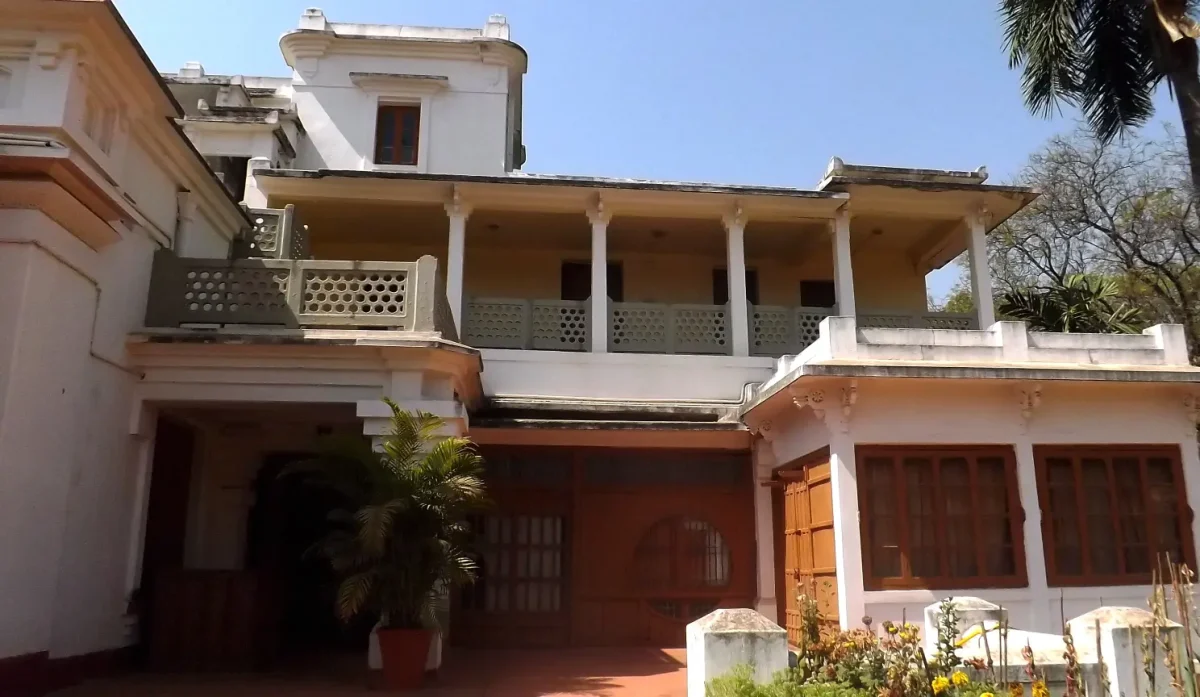
Udayan, one of the five houses that Tagore designed with the architect Surendranath Kar in the Uttarayan complex in Santiniketan, built largely between 1919 and 1928. Courtesy: Wikimedia Commons.
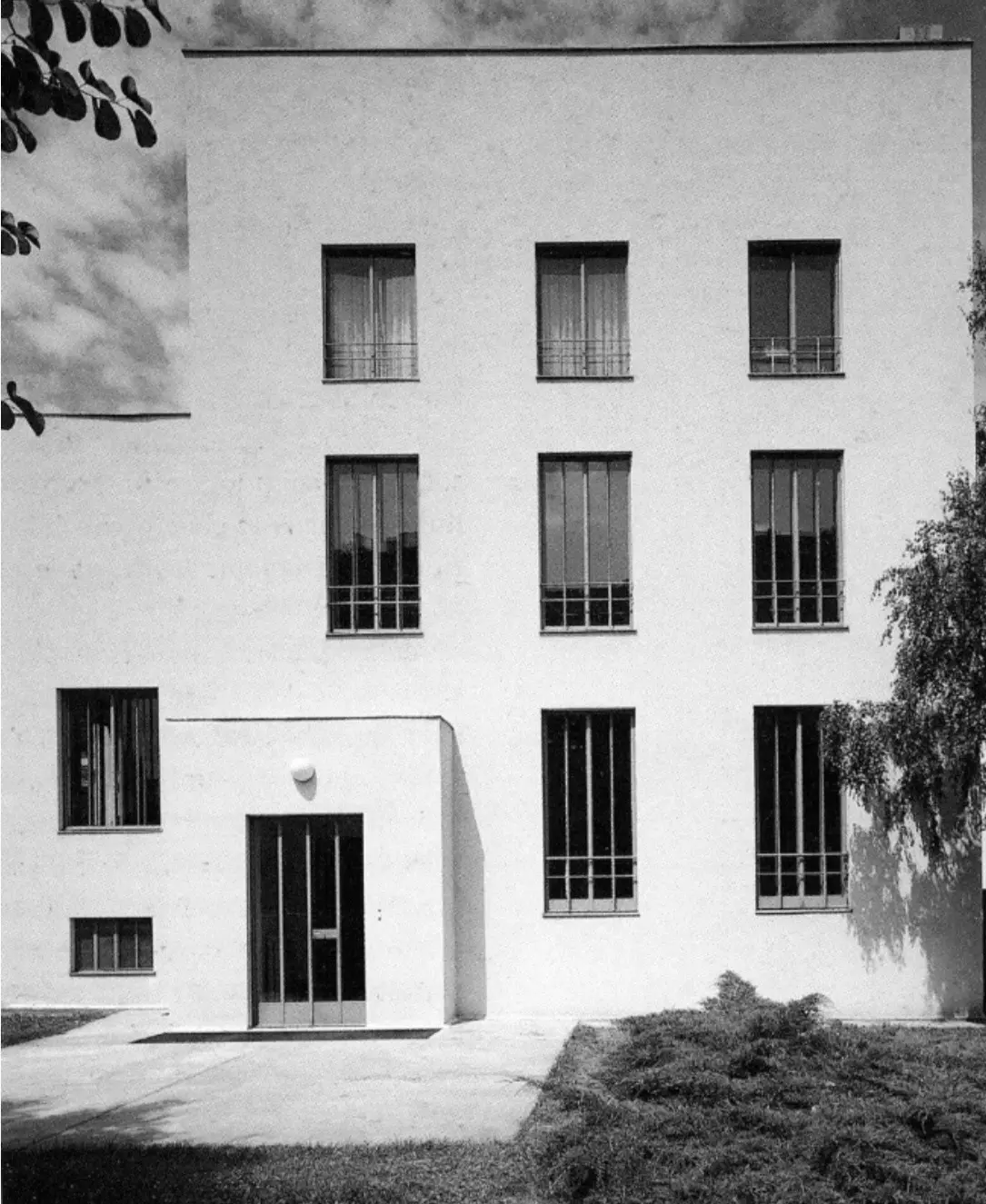
Haus Wittgenstein or Stonborough House, Vienna, designed in its early stages for Ludwig Wittgenstein’s sister Margaret by the architect Pail Engelmann, until its design was taken over by Wittgenstein himself. Built over 1926-28. Courtesy: Wikimedia Commons.
‘Unfenced Existence’: a mosaic on translation, Tagore, Wittgenstein, and Joyce (and Larkin)
Amit Chaudhuri, Rosinka Chaudhuri, Peter D McDonald, Arvind Krishna Mehrotra
Editor’s note: What follows is a conversation on email between friends: Peter D McDonald, critic and professor of English at Oxford; Arvind Krishna Mehrotra, poet, essayist, translator, and critic; Amit Chaudhuri, editor of this website; and the ‘Rinka’ mentioned in the emails, Rosinka Chaudhuri, critic, translator, and professor. The emails, set in motion by Peter on 25th July 2025, begin with him wanting a better translation of the first poem of Tagore’s English version of Gitanjali (‘amare tumi ashesh korechho’ in Bengali) than those offered to him by AI; he’s also presumably looking for an alternative to Tagore’s own English version. His request to Arvind to translate the song is prompted by thoughts he’s been having on Wittgenstein for a book he’s writing. All this is self-evident from the exchange below.
Each email has the name of the person who wrote it on the top, as well as the date and time (sometimes in different time zones)at which it was sent. They follow each other fairly linearly. The punctuation in the emails has, where possible, been left as is.
The email threads happen to contain two hitherto unpublished translations of the Tagore song, by Arvind Krishna Mehrotra and Amit Chaudhuri.
To listen to a live performance of the song by Subinoy Roy, click here.
Peter D McDonald 25th July 2025 10:02:18 pm IST
Dear Arvind,
Your ears may have been burning on Wednesday—for which, my apologies! Rinka (copied here) very kindly came for a working lunch in college to help me with a Tagore poem I am planning to use in my next book. It is the first in the English Gitanjali, and so probably one of the most widely read in various European languages.
My plan is to use it in one of the main chapters briefly—it forms part of an unlikely but real historical scene where Wittgenstein read some Tagore poems to the logical positivists in the Vienna Circle, sometime in the early 1930s. We don’t know what he read exactly, so by proposing this poem, I am fictioneering with, I hope, some plausibility.
But I would also like to return to the poem in one of the later ‘reading lesson’ chapters for the book, which will be about translation. This is why we began thinking of you and why I started to fantasize about approaching you for a new translation. I have attached to this email my brief account of the poem and reading scene from the current chapter as well as the Bangla original with Rinka’s literal rendering in the hope that you might say yes, and be able to use this as a prompt.
Any chance I could twist your arm? It would be wonderful to have your version, not least because I plan to use the short Ishwar Gupta poem you and Rinka translated last year in the translation chapter as well, so this would be another way of getting you into the book.
In hope, with much love,
Peter
Peter
* * *
Editor’s note: Peter’s attachment is reproduced below, containing an excerpt from a work-in-progress by him. Also in the attachment is the Tagore song in the original Bengali, with a line by line unpolished literal version (never meant for the public domain) dashed off by Rosinka to Peter in a previous email for him to get a rough sense of the Bengali. Arvind worked on his own translation both from this very preliminary literal version as well as from Tagore’s translation in the Gitanjali.
Peter’s attachment: on Wittgenstein and Tagore
Wittgenstein reaffirmed his commitment to this other language in his conversations with the Vienna Circle, reportedly refusing, on some occasions, to discuss philosophy, and instead choosing to read aloud from the poetry of the Bengali polymath Rabindranath Tagore. ‘As if to emphasise to them,’ Monk comments—and ‘as he had earlier explained to von Ficker’—that ‘what he had not said in the Tractatus was more important than what he had’ (243). Exactly what he read is unrecorded but, given his thinking at the time, he could well have chosen some poems from the 1914 German translation of Gitanjali—though, such was Tagore’s popularity, an eight-volume Collected Works had also been published in German by 1921. Tagore himself was responsible for the translation and selection of the English Gitanjali (1912), the book that established his reputation in Europe as an Eastern mystic and contributed to his winning the Nobel Prize in 1913—it also served as the German translator’s source text. Read with Kierkegaard’s Climacus and Dostoevsky’s Alyosha in mind, it is not difficult to see why Wittgenstein might have thought the poems instructive—not just as an object lesson for a group of European logicians and scientific rationalists in the late 1920s but as a clarification of his own contrarian commitment to the poetic as a powerfully expressive form of nonsense and alternative to the Tractatus’s concluding call for silence.
The first poem, rendered in Tagore’s recast prose form and elevated biblical (King James) English, is characteristic and telling given Wittgenstein’s views on the ‘gallons’ of human experience no ‘teacup’ of knowledge can contain. Yet it is also indicative of some difficulties he did not anticipate by choosing Tagore as his example:
THOU hast made me endless, such is
thy pleasure. This frail vessel thou
emptiest again and again, and fillest it
ever with fresh life.
This little flute of a reed thou hast
carried over hills and dales, and hast
breathed through it melodies eternally
new.
At the immortal touch of thy hands
my little heart loses its limits in joy
and gives birth to utterance ineffable.
Thy infinite gifts come to me only
on these very small hands of mine.
Ages pass, and still thou pourest, and
still there is room to fill. (1)
Considering the many challenges of translation—across languages, cultures, and expectations—and the ‘enveloping facts themselves circumstantiating’ Tagore’s otherworldly reputation in 1920s Europe, which his own hasty, often deforming translations fuelled, Wittgenstein might have been surprised to discover that his chosen mystic of the East was not quite the expressive poet with a Kierkegaardian ‘passion of the infinite’ he imagined but rather more like the earthly Joyce of the Wake. Far from being a transcendent guarantor of absolute value, the ‘THOU’ Tagore’s speaker invokes is an avatar of ‘Annah the Allmaziful, the Everliving, the Bringer of Plurabilities,’ a devotional addressee firmly of this world or, rather, of the always unfolding, not-yet-conceptualized world to come. Unlike Joyce’s composite Christian-Islamic-Secular figure, however, Tagore’s Anna Livia Plurabelle (ALP) blends elements of his own idiosyncratic humanism—or ‘Religion of Man,’ as he later called it—with two distinctively Bengali traditions: the elite Brahmo Samaj, the secularizing Hindu reform movement in which his family played a leading part, and the popular, anarcho-humanist folk songs of the itinerant Baul singers. Tagore also drew on the Zen Buddhist tradition, making his enlarging and endlessly generative ‘THOU’ not only closer to late Tolstoy-Joyce than to Kierkegaard-Dostoevsky, but to Kant’s notion of the beautiful as a non-conceptual, koan-like opening to experience.
—————————————–
আমারে তুমি অশেষ করেছ, এমনি লীলা তব–
ফুরায়ে ফেলে আবার ভরেছ জীবন নব নব।।
You have made me endless, this is how you play –
You empty me out and fill me again, and give me new life, anew.–
[THOU hast made me endless, such is thy pleasure. This frail vessel thou emptiest again and again, and fillest it ever with fresh life.]
কত-যে গিরি কত-যে নদী -তীরে
বেড়ালে বহি ছোটো এ বাঁশিটিরে,
কত-যে তান বাজালে ফিরে ফিরে
কাহারে তাহা কব।।
How many mountains and how many river banks
Have you travelled with this small flute,
How many melodic variations did you play as you walked
Who shall I tell?
[This little flute of a reed thou hast
carried over hills and dales, and hast
breathed through it melodies eternally
new.]
তোমারি ওই অমৃতপরশে আমার হিয়াখানি
হারালো সীমা বিপুল হরষে, উথলি উঠে বাণী।
Your sweet touch, and my small heart was
Lost in the immense joy it brought, and utterance spills over.
[At the immortal touch of thy hands
my little heart loses its limits in joy
and gives birth to utterance ineffable.]
আমার শুধু একটি মুঠি ভরি
দিতেছ দান দিবস-বিভাবরী–
হল না সারা, কত-না যুগ ধরি
কেবলই আমি লব।।
You give enough to fill my fist, that’s all
You give every day and every night –
Yet it is not enough, and over the years
I will keep taking.
[Thy infinite gifts come to me only
on these very small hands of mine.
Ages pass, and still thou pourest, and
still there is room to fill.] (1)
End of Peter’s attachment.
* * *
Arvind Krishna Mehrotra 25 July 2025 9:24:08 pm BST
Dear Peter
A short one for now. It’s getting on to 2 am.
A Tagore Gitanjali I can do with my left hand in my sleep, not that the version
I send (Exhibit 2 in attachment) was done with my left hand or when not fully awake.
All I mean to say is that as a 17-year-old I started out as a Tagore disciple (Exhibit 1)
but I also had bits of Dowson, Edna St Vincent Millay and e e cummings floating in my head,
all got from the much derided Oscar Williams. of the famous anthology.. That’s
where the ‘small hands’ (Exhibit 3) comes in, linking e.e. to Tagore, and
Tagore to e.e.. It’s part of the amusement park of poetry. In this case, what is
amusing is that in cummings the hands belong to the giver, the Thou;
in Tagore, they are the hands of the one receiving the gift. It’s all powerfully
expressive, and all quite nonsensical.
Love
Arvind .
* * *
Editor’s note:What follows, below, is taken from Arvind’s attachment referred to in the email above – an excerpt provided by Arvind from his essay ‘Partial Recall’(Exhibit 1); and his response to Peter’s request for a translation of the Tagore song (Exhibit 2). Exhibit 3 is the cummings poem, added to the document by Arvind as an element in a mosaic still forming.
From Arvind’s attachment: On being Tagore, and translating him.
Exhibit 1:
Perhaps not so surprisingly, the ineffable longings of Rabindranath Tagore and Kahlil Gibran—and not the profanities of the Beat generation—prompted my first published work. This was a group of five poems, titled ‘The Soundless Flute’, in the March 1965 issue of the Allahabad University Magazine.
Let not the cloud remain and dirty the sky, let it not shade the sun, let it not be tossed about by the wind or be pecked by the birds. Let it merge into the bigger cloud that will carry it with its own strength, or else let it rain and die.
I wrote about twelve such poems in all, and learnt a few things about poetry I didn’t know before. I came to know that you could say the most trivial things in it, but they would still come out sounding like profound truths, or at least to my ears they did.
From ‘Partial Recall’ in Partial Recall: Essays on Literature and Literary History (Permanent Black, 2011)
Exhibit 2:
You’ve unfenced me, it’s what
you always wanted. You’ve made
a barren patch flourish again.
Playing your frail lute, you crossed
rivers and mountains.
Coming closer with each step,
you breathed new life into me.
The merest touch of your hand
and I lose myself in a sensation
I’d not known. I started to sing.
My hands are small. What you give
measureless. And yet you keep
pouring and yet I receive,
my hands spread before me, unfilled.
Exhibit 3:
[somewhere i have never travelled, gladly beyond]
BY E. E. CUMMINGS
somewhere i have never travelled, gladly beyond
any experience, your eyes have their silence:
in your most frail gesture are things which enclose me,
or which i cannot touch because they are too near
your slightest look easily will unclose me
though i have closed myself as fingers,
you open always petal by petal myself as Spring opens
(touching skilfully, mysteriously)her first rose
or if your wish be to close me, i and
my life will shut very beautifully, suddenly,
as when the heart of this flower imagines
the snow carefully everywhere descending;
nothing which we are to perceive in this world equals
the power of your intense fragility: whose texture
compels me with the colour of its countries,
rendering death and forever with each breathing
(i do not know what it is about you that closes
and opens; only something in me understands
the voice of your eyes is deeper than all roses)
nobody, not even the rain, has such small hands
Source: Complete Poems: 1904-1962 (Liveright Publishing Corporation, a division of W.W. Norton & Company, 1994)
End of Arvind’s attachment
* * *
Editor’s note: Amit Chaudhuri’s translation below of the Tagore song was sent by him to Arvind after a telephone conversation; the email had no other text in it except the translation.
Amit Chaudhuri 27 Jul 2025, 18:07
You’ve made me infinite: such
is the consequence of your play.
Emptying me out, you’ve
filled me with new life again.
You carried this flute across so many
riverbanks and hills
playing so many melodies –
who can I say this to?
At your touch, redolent
with eternity, my heart
loses its boundaries in joy –
utterance brims; spills over.
Day and night, you give enough
to accommodate within
these cupped palms; your gift hasn’t
run out, though ages pass –
I’ll take endlessly.
Arvind Krishna Mehrotra Sun, 27 Jul 2025, 22:56
Dear Amit
That’s very nice — particularly the last stanza, the unexpectedness of ‘to accommodate within’. I placed the two translations side by side and was struck by how close they are to each other, as though made from the same mould, which they are, and yet they are different, because of the different linguistic materials poured into the mould.
Love
Arvind
Amit Chaudhuri Sun, 27 Jul 2025, 23:19
Thank you, Arvind. By the two translations, do you mean Tagore’s and mine? I guess the similarities come from following the original – the mould. Of course, it’s difficult for me to be happy with it – which is why it lay in my inbox for fifteen years – but it will have to do!
Arvind Krishna Mehrotra Mon, 4 Aug 2025, 10:03
Dear Amit
No, I meant yours and mine. The mould being the original, there were three linguistic materials poured onto it, each different, which accounts for the different outcomes. The three materials are Rinka’s, yours, and mine. We could call the exercise, after Eliot Weinberger (https://en.wikipedia.org/wiki/Nineteen_Ways_of_Looking_at_Wang_Wei), Three Ways of Looking at Tagore.
I don’t have Weinberger’s book but have known of it for a long time. Have now ordered it.
You’ve barely returned to Calcutta and it looks like you’ll be up in the air again.
Love
Arvind
Love
Arvind
* * *
Editor’s note: Here, the email exchange (which has not been reproduced in its entirety, and alongside which there were face-to-face or mobile phone conversations) ends. The only thing that remains to be said is that I had a brief discussion on the phone with Arvind about his use of ‘unfenced’ for ashesh – ordinarily ‘infinite’ or ‘limitless’. The only other time this word occurs in a poem is, as far as I know, in the last stanza of Philip Larkin’s ‘Here’, where, having taken us into and beyond an English seaside town with its ‘cut-price crowd’, the poet confronts what lies at the edges of the town, the villages on its periphery, and even the ‘wheat-fields’:
… Here silence stands
Like heat. Here leaves unnoticed thicken,
Hidden weeds flower, neglected waters quicken,
Luminously-peopled air ascends;
And past the poppies’ bluish neutral distance
Ends the land suddenly beyond a beach
Of shapes and shingle. Here is unfenced existence:
Facing the sun, untalkative, out of reach.
‘Unfenced’ is another word, in ‘Here’, for ‘existence’: it is what runs through both poem and town, but only becomes nakedly itself at land’s end. This language of the unfenced – a secular language in that it refers not to God or eternity but to ‘existence’ or ‘life’ (Tagore’s jiban nabo nabo) – is part of an artistic and philosophical shift that has produced the Tagore song, probably Wittgenstein, the Larkin poem, and Arvind’s translation.
Peter D McDonald is Professor of English at St Hugh’s College, Oxford and author of, most recently, The Double Life of Books: Making and Re-making the Reader (Edinburgh, 2024).
Rosinka Chaudhuri‘s latest book, India’s First Radicals, came out last year. She is editor of Derozio, Poet of India; A History of Indian Poetry in English; and, in 2026, co-editor of The Cambridge Companion to Rammohun Roy. She is Director and Professor of Cultural Studies at the Centre for Studies in Social Sciences, Calcutta.
Arvind Krishna Mehrotra is a poet, translator, and essayist. His last book of poems is Of Least Concern (Literary Activism and Westland Books).