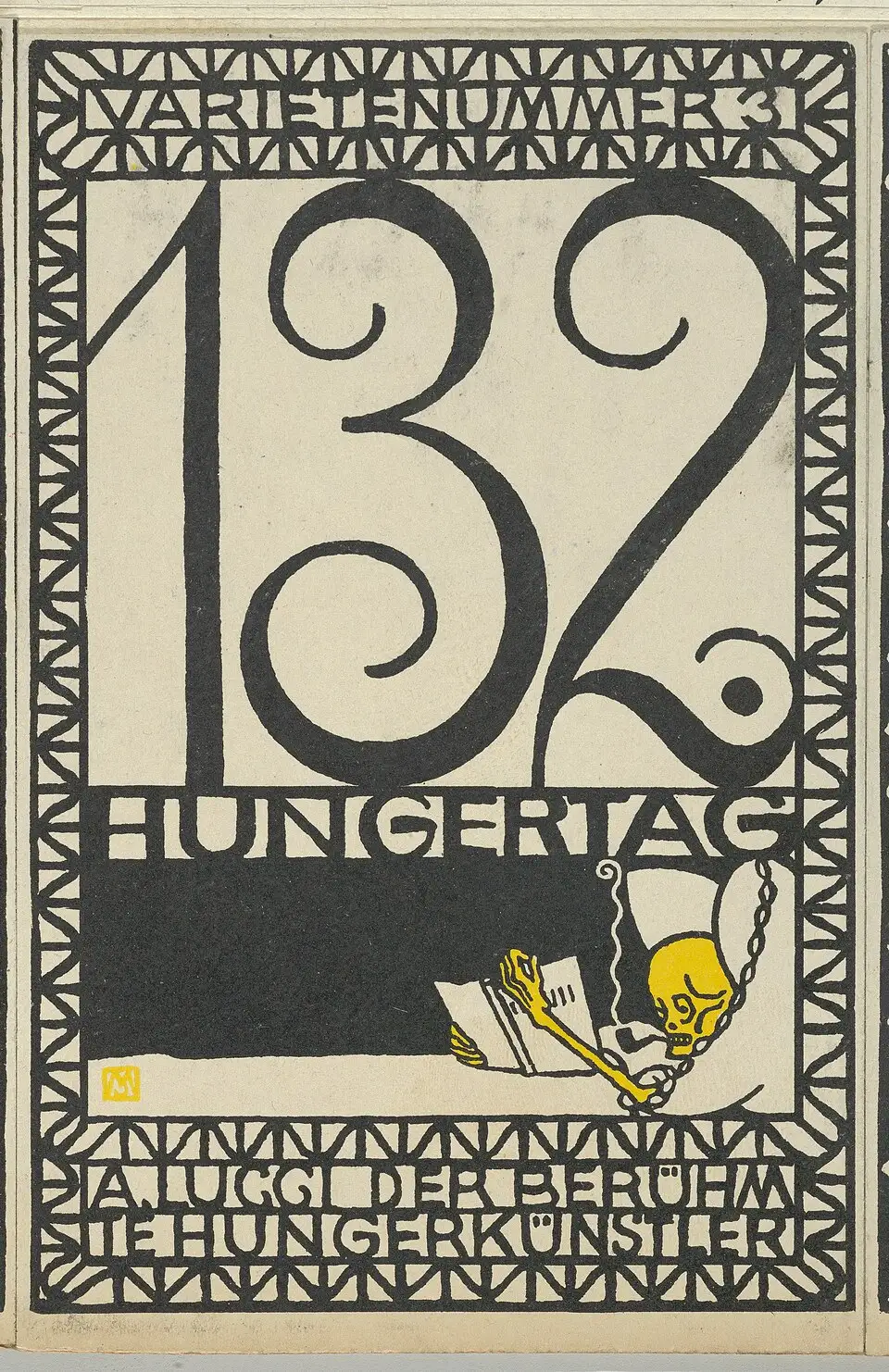
Moriz Jung, Variety Act 3 – 132nd Day of Fasting, A. Lucci the Famous Hunger Artist, 1907. (Courtesy: Wikimedia Commons)
Description of a Poet’s Failure
Ranajit Das
‘Go on failing. Go on.
Only next time, try to fail better’
Only next time, try to fail better’
—Samuel Beckett
Some small wonders of life are its ironic surprises. My participation in this symposium is just such a surprise for me. At first, I was taken aback when my dear friend Amit Chaudhuri, whose writings I greatly admire and who is perfectly aware of my utter ineligibility to take part in any scholarly discourse, suddenly made me an offer to deliver a talk in an august symposium to be held on the theme of ‘Failure’. But then I quickly realised that it’s an offer I cannot logically decline, because, being an elderly and obscure Bengali poet who has failed in his pursuit to achieve fame in his long poetic career, I can at least claim with some dignity that failure is my forte. Thus I agreed with a chuckle at myself, after making a quick mental calculation that my poor English might also go well with the drift of the subject itself.
So here I am, ladies and gentlemen, and here are some bare facts about myself. I have been writing poetry for the last fifty years, having published twelve books of poems, along with two collections of literary essays and one novel to my credit. And in the bargain, I have received some awards too. But in spite of such seemingly impressive biodata, not a single cultured and literature-loving Bengali bhadralok, outside the small literary circle of Bengali poetry, has heard of me. If you think it’s an exaggeration, ask any respectable Bengali gentleman in Kolkata whether he has heard of a poet called Ranajit Das and you are sure to meet with a sceptic frown and a glum response, ‘Ranajit who?’ Please don’t think I am concocting stories to project my image in a comical light. Listen to this. Very recently, a journalist friend of mine, who is a senior assistant editor of a leading daily, did me a great favour by commissioning a short feature from me, no, not on any literary topic, but on film star Rekha on the occasion of her umpteenth birthday for his newspaper, and he published it with a prominent photograph of mine at the top corner of the feature.
My wife was elated to see her poor old husband’s photograph at long last in a newspaper, and treated me to a sumptuous breakfast with my favourite cheese omelette. But my excitement was shortlived when a neighbour of mine met me at the bazaar and said, ‘Hey, Mr Das, I have read in today’s newspaper an interesting article on Rekha and Amitabh Bachchan! I forgot the writer’s name, but the guy looks like you!’ I stood crestfallen, as I realised that even photographic evidence in a prominent daily could not dispel my obscurity
But there is an interesting fall-out. As you know, any longstanding obscurity of a poet gradually becomes a kind of fame in itself—a very stubborn, cultish, underground fame, which is always dreaded by celebrity-poets! Because this kind of clandestine fame is rumoured to have a direct link with immortality in the world of art. (It’s a sinister and haunting rumour that tends to make the dead poets alive and the live poets dead!)
In any case, my own enduring obscurity has endowed me with a little bit of this dubious fame, and a group of young poets have become my loyal admirers. They believe that I have been deprived of my due share of fame by a literary culture dominated by aggressive self-promotion. One young poet admonished me with these words, ‘Dada, you are such a powerful poet, but nobody knows your name. It’s all your fault, why didn’t you take care of your PR seriously?’ I instantly replied, ‘Listen, kid, being a genuine poet, I never had any interest in making PR, as I am only interested in making love!’ But the boy was not amused, and he hit back, ‘Dada, it’s not a matter of your ghatia joke, because even God cannot survive without constant PR in this world.’ And then he delivered his punchline with a sarcastic smile, ‘By the way, dada, could you find much success in your pursuit of love either?’ This was a real hit below the belt, literally, because with my looks and my obscurity, I was a damn flop in that field as well. I sacrificed fame for the sake of love, and love ignored me for my lack of fame. I have got the worst of both worlds!
This, in short, is the description of my failure as a poet. Now the question is, leaving comedy apart, how do I view this failure myself? Am I okay with this failure? Or do I resent it? What kind of a failure is this? Until now, I have implied that this is only a failure to earn literary fame, and is totally unrelated to the question of quality of my poetry. It might even be surmised from my foregoing account that I have been taking a hidden pride in this failure, and covertly flaunting this failure as a feather in my cap of self-respect. And here comes the hard question. Did I actually fail to earn fame because I failed to write good poetry?
This question lies at the heart of the matter and opens up the whole issue, calmly indicating that an impartial judgement from the literary community about the quality of my poetry should be the deciding factor in the matter. For my part, I always dream of such a trial, in which the verdict is finally out that my poetry is indeed poor and therefore my failure is justified, and I accept this verdict with a humble and grateful heart. I almost feel relieved to get rid of a tormenting poetic ambition which is beyond me. I bow to the jury and step down from the dock. And then I politely recede from public view, never to be seen again. Conjuring up this image of myself as a failed and forlorn poet silently receding into literary oblivion gives me a strange catharsis from my fervent desires to achieve literary fame. I find in this image the faint prospect of a strange resurgence of a poet who has met, for the first time, the hard truth of his poetic failure, has been cast out of the garden of poetry, and retreated into a solitude of utter desolation from which he might still emerge as a true poet in his second birth. Because this solitude, like the proverbial ant-hill of the jungle-bandit Ratnakara, might prove for him the real creative solitude in which he might at last acquire the heart and the art of poetry.
And talking of failure, I must now recall the tragic life and majestic poetry of our ‘Nirjanotamo kabi’ (the most lonely of poets) Jibanananda Das (1899–1954), the poet who was almost unknown during his lifetime, lived in utter misery, but wrote incredibly great poetry, and is now universally regarded as the greatest Bengali poet since Rabindranath Tagore. He was ‘a painfully private person’ (in the words of his American biographer Clinton B. Seely), who failed miserably in almost all spheres of his personal life, except his poetry. By profession he was a teacher of English literature, but he frequently lost his jobs owing to various reasons, including his own diffidence and reclusive nature, and serial cruelties of fate. He had a slight stammer, for which he faced occasional ridicule from his colleagues and students. Afflicted with a profound poetic indolence, he remained jobless for long periods, lived in abject poverty, and bore the brunt of an extremely unhappy family life, with a bitter and disgruntled wife and two children. All along his hapless life, he frantically looked for means to earn his living, mostly without success. Even a couple of years before his death, he went to the Writers’ Building—the seat of the state government in Kolkata, in the hope of procuring a government permit to start some petty business, where he fainted and fell ill. Finally, he died in a tram accident in Kolkata in 1954. Speculation is still rife in the literary circle of Bengal that this accident might actually be an act of suicide.
I feel inclined to quote the touching description of the poet’s death in Mr Seely’s heartfelt words.
Jibanananda had been in the habit of going for a walk, often by himself … On the fateful evening, Jibanananda was returning home, heading north. Rashbehari Avenue, a major thoroughfare, had to be crossed before he could proceed the hundred yards or so back to his flat. Down the centre of Rashbehari run two tram lines. Of just such tram lines he had written some sixteen years earlier:
- It is late—so very late at night.
- From one Calcutta sidewalk to another,
- from sidewalk to sidewalk
- As I walk along, my life’s blood feels the vapid,
- venomous touch
- Of tram tracks stretched out beneath my feet like
- A pair of primordial serpent sisters
- A soft rain is falling, the wind slightly chilling.
- Of what far land of green grass, rivers, fireflies
- Am I thinking?
- Where are the stars?
- Have those stars been lost?
- Beneath my feet the slender tram track—
- above my head a mesh of tangled wires
- Chastises me
A tramcar approached from the west as Jibanananda began to cross the road, and, for some reason oblivious, he stepped in front of it. Taken by taxi to Sambhunath Pandit Hospital, Jibanananda was treated for several broken ribs, a fractured clavicle, and one shattered leg. While at the hospital, Dr Bhumendra Guha, then a medical student and some of his fellow students from the Medical College were constantly at Jibanananda’s side … Dr Bidhan Chandra Roy, then chief Minister of West Bengal (was requested by a prominent well-wisher of the poet) to see personally to Jibanananda’s care; Dr Roy came to the hospital the following day. Every effort was made to save his life. But Jibanananda contracted pneumonia, and on 22 October 1954, eight days after the accident, he died.[1] [Italics mine.]
This is how the tragic life of the great poet ended.
During his lifetime, only 162 of Jibanananda’s poems were published. And even on the strength of these meagre number of poems, he was posthumously able to change the entire course of Bengali poetry from the hallowed mystic world of Tagore to the fractured psyche of modernity. Needless to say, he is now hailed as the true founder of modernism in Bengali poetry, and the presiding poet sovereign after Tagore.
In this regard, I always remember some graffiti I saw in one of Godard’s films. The graffiti read: ‘Poetry is a game in which the loser takes all.’ Jibanananda’s life seems to be a perfect example of this epigram. Likewise, I also remember the memorable words of Walter Benjamin regarding the life of Kafka: ‘To do justice to the figure of Kafka in its purity and peculiar beauty, one must never lose sight of one thing: it is the purity and beauty of a failure … One is tempted to say: once he was certain of eventual failure, everything worked out for him as in a dream.’
This amazing insight of Benjamin in envisioning ‘the purity and beauty of a failure’ in the fateful course of Kafka’s life sheds an altogether new light on our idea of ‘failure’ itself. For one thing, both Kafka and Jibanananda created great art, in spite of severe failings in their personal lives. In other words, they did not fail in their works, they only failed in their lives. So we are faced with a paradox. Resisting the obvious temptation to utter the popular cliché that an artist has to suffer a lot to produce great art, how else do we try to resolve this paradox?
In my humble view, a part of this problem of failure lies in a crucial psychological factor of the artist’s inner life. It’s the factor of a robust creative solitude that an artist desperately needs to produce good art. This solitude serves as his creative workshop, his inner sanctum, his spiritual abode, which combines the characters of a temple and a castle. This solitude resonates with the meditation of a monk, the serenade of a lover, the kindness of a mother, and the anger of a revolutionary. It’s therefore obvious that building up and buttressing this abode of creative solitude in an artist’s mind is a matter of relentless struggle against the forces that drive our ordinary social lives. There comes the conflict between life and creativity. For me, this idea of creative solitude is of supreme importance in the nursery of art. Because I guess that this solitude is the extension of the solitude of nature itself that an artist acquires with much effort. It resembles the solitude of a forest in which endless forms of life are born at every instant.
An artist can acquire this mental solitude only through his intense and passionate contact with, and contemplation of, nature—the actual natural reality around him. The moment an artist loses touch with actual reality, he starts losing the power of his creativity. And here I must express my grave concern, though it may be a little out of context, about the dangers of digital invasion and distortion of our mind spaces by the internet and its social media. Excessive addiction to the digital, which operates on binary logic and propagates virtual unreality, is bound to cripple the creative faculties of man. Because it is plain to see that the binary logic of the computer is a deadly virus for the visionary magic of art. The creative mind of an artist is like the tender seed bed of a farmer, and exposing this mind to the prolonged onslaught of the digital is like suffocating the farmer’s seed bed with plastic garbage. Risking the ridicule for sounding like a cave man in the age of computers, I would nonetheless appeal to all concerned to seriously think about this impending digital disaster threatening human creativity and find ways to combat it.
Having said that, I would now sign off by invoking the supreme image of an artist who epitomises this creative solitude that we are concerned with. It is the story of a trapeze artist written by Kafka shortly before his death in a sanatorium near Vienna in 1924, the same one that was included in his book A Hunger Artist which was published in Germany in the same year after his death. Let me quote an extract from the story:
A trapeze artist—this art, practised high in the vaulted domes of the great variety theatres, is admittedly one of the most difficult humanity can achieve—had so arranged his life that, as long as he kept working in the same building, he never came down from his trapeze by night or day, at first only from a desire to perfect his skill, but later because custom was too strong for him. All his needs, very modest needs at that, were supplied by relays of attendants who watched from below and sent up and hauled down again in specially constructed containers whatever he required. This way of living caused no particular inconvenience to the theatrical people, except that, when other turns were on the stage, his being still up aloft, which could not be dissembled, proved somewhat distracting, as also the fact that, although at such times he mostly kept very still, he drew a stray glance here and there from the public. Yet the management overlooked this, because he was an extraordinary and unique artist. And, of course, they recognized that this mode of life was no mere prank, and that only in this way could he really keep himself in constant practice and his art at the pitch of its perfection.[2]
As all of us are very familiar with Kafka’s style of creating authentic allegories of the human condition in his works, we will easily recognise in the above passage not only his self-image projected in the image of the trapeze artist, but also his firm conviction about the compelling necessity for an artist to have an extremely ascetic and solitary life for the perfection of his art.
And yet, as I said earlier, in the digitally invaded privacies and sensibilities of our time, we are sure to dismiss this story as a mere literary construct coming from the almost psychopathic sensitivity of a writer, which has no bearing on the realities of our age. Thus we may smugly go about strolling in the high-vaulted shopping malls of art, glued to the smartphones in our hands.
But I, for my part, will continue to cast stray glances at the high vault of the mall, to see if the trapeze artist is really sitting there, on his invisible trapeze, very still and meditative, patiently waiting for the centuries to pass before he can start performing his high and sublime art all over again.
Ranajit Das is a Bengali poet who has published twelve poetry collections, two collections of literary essays and one novel. Among the many accolades he has received is the Rabindra Puraskar. He has a B.Sc, worked in the state civil service, now retired. He lives in Kolkata.