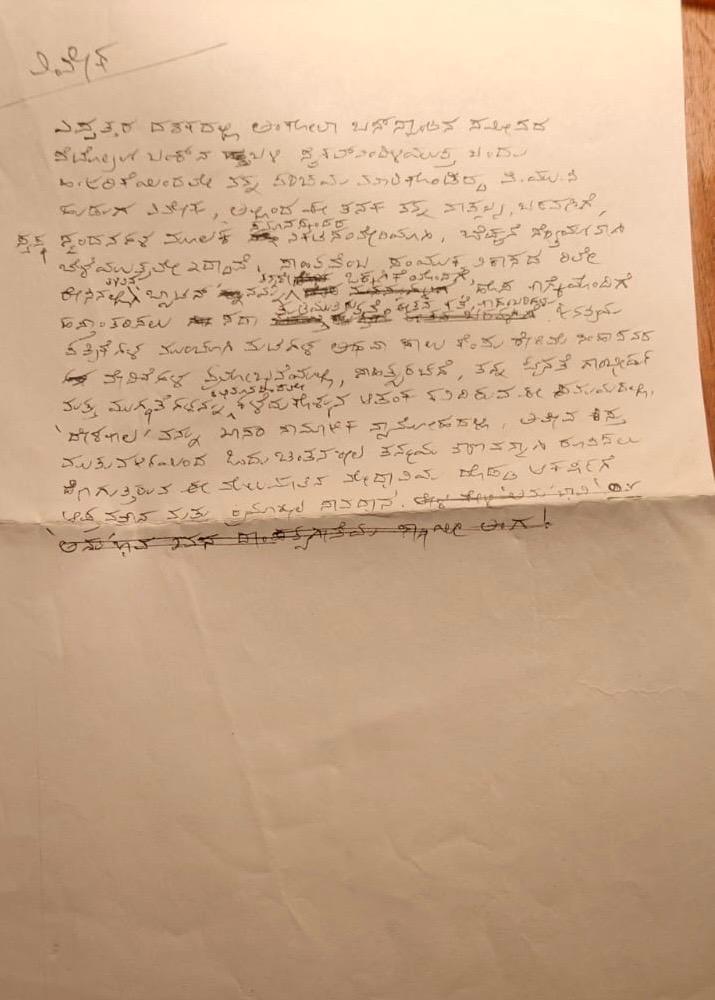
A photograph of the page-length draft of Vivek Shanbhag’s bio note (which was finally never used) by Jayant Kaikini, in his own handwriting, written sometime in 2010, recovered recently this year from boxes of Deshakaala material in Vivek’s attic in Bangalore.
‘Friendlier When He Removes His Glasses’: Bio notes from the special issue of the trimonthly magazine Deshakaala, 2010
Jayant Kaikini
Translated from Kannada by Vighnesh Hampapura
See further below for the translator’s note. For Adil Jussawalla’s bio notes for his 1974 anthology, New Writing in India, see here.
U. R. ANANTHAMURTHY
When he wrote a preface that was as indispensable as the poem he wrote it for—Gopalakrishna Adiga’s Bhoomigeeta—Ananthamurthy was about twenty five years old. And, before thirty, he had written stories as illuminating as ‘Prashne’ and ‘Karthika’. Not being preoccupied with only his own work, Ananthamurthy involved himself in writing (alongside his stories, poetry, and novels) criticism about every contemporary writer with great affection and consideration, and he remains the most fearless voice of Kannada identity and consciousness. He is the kind of free and approachable spirit who hunts for the address of a new, unfamiliar writer and shares with them the debt of the discoveries he’s made with their writing. His sensibility, expanding extensively and indomitably within and outside the frames of fiction, beats with an unprecedented urgency for the foundations of democracy that seem to have been reduced in this boom of growth and development to cut-rate yardsale objects. Nothing he says or writes is mundane, for his gaze on the condition of human existence is always tender and unbridled. That he translates the great poems he’s admired over these years even now, in order to hone his sensitivity as well as his language, as though he were perpetually sharpening a pencil, comprises, for us, a satisfying and instructive lesson.
GIRISH KARNAD
Opening new doors for not only the Kannada but the Indian theatrical world through his plays, Girish Karnad also associated himself with Satyadev Dubey, Vijay Tendulkar, and Shyam Benegal to become an architect of India’s most important cinema movement after Satyajit Ray (Samskara, Kadu, Ondanondu Kaladalli, Bhoomika, Nishant, Manthan…). And as the ethical champion of the publishers Manohara Grantha Mala, he played an important role in the development of Kannada literature. The chit-chat between Kirtiknath Kurtkoti, G. B. Joshi, and Karnad in the Grantha Mala’s attic is so famous as to have become a kind of mythology. The collection of his rare, sundry essays, Agomme Igomme, is testament to his range, concern, and astonishment. His one and only story, ‘Alida Mele’, stands tall among the greatest stories written in Kannada.[1] His most recent play, The Wedding Album, a whole discourse on the politics of marriage, throws a dare to all the labourers and workers of theatre: ‘Come, try and stage me,’ it says, temptingly.
K. V. AKSHARA
I’m one of those who has grieved over all the Akshara poems that remain unwritten after a set of his extremely fresh and subtle poems appeared in the anthology Hadihareyada Kavitegalu twenty five years ago. I even teased his wife Vidya about it when they were newly married: ‘If you don’t make him write poetry again, you will have the great good glory of stealing poetry from him.’ All those protestations seem so stupid now that I look back. Rather than bring us a few blades of healing poetry, this solitary hero is holding up that entire mountain of a comprehensive educational environment that is Ninasam.[2] Weathering all the troubles that no doubt come with running an institution in a small town, he labours day and night to sustain its voracious school of ideas and its theatre activism with as much verve as detachment and dignity. A distinct cultural critic, he has fashioned a new form of thought-provoking writing that concentrates on two or three heartrending anecdotes or subsections of a text or episode. Like a boy looking at the same sunrise and sunset from different parts of the mountain, he seems to always be running around the house, from one window to another, looking at the world, examining his responses and sharing them with us. This activity is shaping its own kind of prose, quietly.
K. SATCHIDANANDAN
Having drawn from the ponds of almost all languages of the country and being able to speak about them like a modern Indian structuralist, Satchidanandan is by origin a Malayalam poet. Having lived in Delhi for several years as the Secretary of the Sahitya Akademi, he is a scholar who knows by heart the pulse of almost all Indian poets, not to mention their poetry. A lover of poetry who in a single breath can cite Vinda Karandikar, A. K. Ramanujan, Mahashweta Devi, Shankar Pillai, Tukaram, Kabir, and Da. Ra. Bendre. Friendlier when he removes his glasses.
YASHWANT CHITTAL
‘We’re not born as humans, but are born to become humans’; ‘We don’t write what we know, for it is through writing that we get to knowing’; ‘Experience really presents itself through reflection’; ‘The leap from mere information to understanding is possible only through this distinct instrument of knowledge called literature’: this genius, who raised us these past few decades on such parables, who paved an invisible two-way street between Hanehalli and Mumbai, a polymer technologist by profession, has a handwriting that is as sharp as his dispositions.[3] Among the five who unprecedentedly shaped Kannada narrative worlds — Chittal, Tejaswi, Ananthamurthy, Lankesh, and Shantinath Desai — Chittal’s writing is an eternal search for the values of empathy. He was presenting us with unique ideals when he wrote such characters as Purushothama, who demystifies money, and Shikari’s Nagappa, who rejects the seat of power. The same Yashwant who says, ‘After writing the section in which Nirmala dies in Mooru Darigalu, I was depressed for weeks as though deranged by the death of a daughter of my own house’, also says, ‘I will live until I can write’: for him writing is a feature of existence. A simple and sincere man who made Bandra Bandstand an address in the world of Kannada literature.[4]
PRAKASH BELAWADI
This boy was born in the green room. Must one even enquire about his talents? Literature, acting, directing, teaching, journalism, television, and cinema: playing roles in all these fields with as much love as wildness, Prakash Belawadi then can be seen at the corner waiting for a new bus, like a pedestrian with very little luggage, a fine example of the figure of the wise, gay, courageous, and untethered spirit that we call a chalta phirta. A gentle but vigorous smile, which seems to say ‘What you say is right, but listen to this too’, has never faded from his face. He has written for Lankesh Patrike. He wrote and directed the famous TV series Garva like he were serving fast food, a bit here and a bit there, and with it changed the very grammar of Kannada television serials. He made a film like Stumble, which lent an ear to the sighs and sorrows of today’s Bangalore. He wore a towel around his neck and appeared in front of the camera in new, contemporary films, mouthing a characteristic, ‘Enla!’ Just as one was wondering what he would get up to next, he stood for the Bangalore municipality elections.
VASUDHENDRA
Beginning his innings with that heart-rending story, ‘Namma Vajinu Aatakke Karakolro’, Vasudhendra is a new-generation ‘reader-friendly’ writer who emerged in the past ten years. He also writes in the personal essay genre, and has indeed become family to his readers with his collection Nammamma Andre Nangistha. The sounds of Bellary’s Sandur resonate pleasingly in his stories.[5] Whenever feelingful memories pervade his fiction, and especially when they grow beyond their author’s intentions, the work shimmers with his kind of kindness. And as they move closer to Electronic City, they grow fainter, perhaps because of its traffic congestion.[6] He brings new talent to readers through his publication Chanda Pustaka, and invites kilograms of foot-dust into his publication’s pop-up stores at literature festivals, in the end celebrating big with his writers. It was he who introduced me to an artist like Srijan when I edited the magazine Bhavana. And it’s he who organises cover-page design contests, unheard of before in Kannada literary circles. Instead of metal plaques and other useless mementoes, he does the virtuous thing of offering his guests a fine tote bag at events and activities. He is able to render an argument with the passion of a school debater. And even while listening to the opposing party he maintains a disappointed smile.
SHRINIVAS VAIDYA
Stripping oneself of both the extremities of writing, where it is either an open and intentional intellectual exercise or an extremely private, self-introspective compulsion, Shrinivas Vaidya prefers instead to leap into the entirety of his experiential ocean and swim in it with his checkered shorts. It is he who swims and exercises, but it is us, readers, who gain muscle and stamina. Without drawing such imaginary distinctions as interiority and exteriority, individual and society, the writing of this being, who lived in the world finely and with wonder, captures life with all its shadow and light. He shows us the path to reach an awareness with which one does not ask, ‘Why is this so?’ but instead exclaims with astonishment, ‘Oh, is this so!’ If one says, ‘Knowledge is our real teacher,’ he quips, ‘Yes, but even that’s a bit torn here and there,’ and laughs, with a humour that is absolute. Beginning to write only after his retirement, without any anguish or haste, he writes those kinds of stories and novels that seem like long-lost kith and kin that we are finally meeting again.
ABDUL RASHEED
Twenty years ago I found Rasheed in the special issue of the weekly Suddi Sangathi. A certain freshness that I saw in those lines, about a girl with soft legs walking on a narrow path towards the pond, brushing against wet grass, still emanates from all his writing and is also his real strength. Constitutionally he’s a poet. Indeed, whether in his writing from Shillong, wearing the red sweater Lankesh got him, or in a story or a poem, or perhaps in a clever blurb for the new writers he nurtures at the online magazine Kendasampige, what affects me every time is a dreamy, picturesque freshness. Once near Mumbai’s Flora Fountain he bought a pair of bermuda trousers and told me how good they are to wear while writing.[7] Rasheed’s writing comprises an intense love letter addressed directly to life.
GURUPRASAD KAGINELE
For Guruprasad, who looks like a near relative of Vasudhendra, literature is, like the medical profession he’s chosen as his day-job, a life-nourishing activity. Even while labouring day and night in America, his mind is at work beyond his own writing, intensely responding to the many daily affairs of the Kannada literary world. Whether he chooses to write a story, novel, or an essay, each form becomes for him a new endeavour. Pursuing his preliminary inklings, he apprehends the unexpected that pervades those intuitions and which seems to always throb on tiptoe in his first impressions. Guru is also a cinema enthusiast. So the balance in his writing between close-ups and long shots is never skewed. What distinguishes his work is an attention that is never lost in detail.
VAIDEHI
Capable of revealing to our eyes what is otherwise imperceptible to vision with just a stroke or two of a line, Vaidehi constructs a narrative that holds together a compact and distressed world. Her inner warmth, which begins at the centre of two crackling coals in the kitchen stove, gradually ripples its way out, and dissolves all veils that come between two things. With the same kind of responsibility that marks her own poems and stories, the other work she produced as she turned more accomplished (whether the genre-defying Jatre, or B. V. Karanth’s autobiography Illiralaare… or the translation of Bhaskar Chandavarkar’s music lectures) contains an essence at once delightful and nurturing. There we will be, sitting and chatting on the steps, and Vaidehi will say, ‘I’ll just be back,’ suddenly disappearing, returning only with fresh, hot pages that she is in the habit of adding to the schedules of our life.
PRAHLAD AGASANAKATTE
After Dhoni took centre-stage, several social commentators on the national media spoke at length about ‘small-town talents[8]. The truth when it comes to literature is that most of it is composed by people raised in hamlets and small towns. And yet what is written with gritted teeth about city life and village life invariably emerges as a fantasy, a story built on cliché. Between the extremes of idealized village and city, it has become truly rare to encounter stories of small towns toiling away for life and livelihood. Prahlad Agasanakatte’s stories pulsate with the fates of our small towns caught between rural nostalgia and urban fantasies. Attending to the strange hotchpotch of middle-class dreams and disillusionments, through objects that families under the spell of change and development hold dear in their showcases, or through the deceptive trappings they put on while ordering a manchurian in the place of their favourite mirchi bajji, the voice in Prahlad’s stories is dangerous only for its very honesty.
RAGHUNANDANA
For Raghunandana, who discerningly absorbs the essences of diverse schools of thought without being adherent to any of them, theatre is neither play nor show. It is the site of endless, everyday examination. Nothing on the stage is a prop for him; it comes forth then and there as a vital organ of the mind. Why, he’s ready to believe (and so be spoilt by) the idea that, with sufficient faith, it’s possible to imbue the masks we wear on stage with life. While a theatrical experiment may feel sufficient unto itself, Raghunandana’s project is to attempt to shape it into something else, an internal joint between a yesterday and a tomorrow.
S. G. VASUDEV
Known first as the creator of the picturesque crooked lines on the book cover of the poetry collection Hokkalalli Hoovilla, Vasudev came to occupy the stature of an unparalleled artist amongst us via the Vriksha series. His art has a placental relationship with literature. His sketch-responses were published alongside A. K. Ramanujan’s and Pratibha Nandakumar’s poetry. The mural outside Santosh Talkies in Bangalore is his. Also having experimented with textile art, Vasudev has played an invaluable role in making Bangalore one of the most important art centres of India. This artist of innumerable shows is also an enabling commentator on art and culture.
PRATIBHA NANDAKUMAR
In the truest sense, she is Kannada’s modern poet. And a poet as significant as she is modern. And perhaps for that reason a poet not much discussed. Those vibrant poems Pratibha wrote all those decades ago, with so much life and force, and with a resolution that proclaimed ‘This is how I write,’ using the similes, metaphors, language, and rhythms of everyday life, are so much more forward-looking in their perception and illumination than most contemporary poetry today. Screenplay, collage, music — she has so many enthusiasms, and has moved forward by writing in heaps everywhere, without either being indulgent or self-important. An entire generation of poets that only began writing after being inspired by Pratibha now forms the main recitation panel at our poetry festivals. The life-force of such rare poems as ‘Coffee House’ and ‘Aha Purushakaram’, not remaining within the bounds of the written word and reaching out towards the inexplicable, is simply unparalleled.
SUNANDA PRAKASH KADAME
Without taking on the study of arguments, ideologies, and theories, Sunanda writes as though she’s crossing a flowing river with a little bit of fear and a little bit of delight. The strength of her stories lies both in how she stitches those threads that are visible to all of us, and how she reveals to our comprehension those that are not. These are threads that will be lost before one can say, ‘Look, look,’ and before their existence is revealed to others. Always it is what is not already literary that is the lifeblood of literature. The delight in her stories is this. Simple details mingle with rare experiences without her deliberation and assume a new meaning. The more incognisant she is of the mystery of this process, the better she writes.
B. T. JAHNAVI
Literature is as much a medium of emotional transformation as Hindustani music is for Jahnavi, who appears at once like she hides within her a naughty boy and a sweeping smile. Her narrative curiosity comes alive when she puts to test the intrinsic qualities of human behaviour. And whenever she attempts to see with compassion the episodes that acutely test the fates of all those who play their customary, assigned roles in the daily serial that is life, her storytelling pulsates with a raw energy.
LAKSHMISHA TOLPADI
With the look of an enlightened guru who has long abdicated his seat happily and has now taken to wearing civil attire, Lakshmisha Tolpadi has in him the patience of an agriculturalist, the resolve of a truth-seeker, the anguish that emerges out of the solitude of a thinker, and a pure excitement that has neither reason nor purpose—all in desirable measures and ways. So even the swiftest whirlwind encounter with him constitutes a pleasing engagement with his mind. If he were to engage in a talamaddale performance around the Vedas, Puranas, Da. Ra. Bendre, Satyakama, M. Vyaasa, and philosophy, it would become apparent what a self-sufficient arthadhari he is.[9] His scholarship is both radiant with his youthfulness and soaked in generosity.
JOGI
Stitching together a Kannada non-fiction form with a certain charm and tenderness in his ‘columns’ for the past ten years, Jogi has also been responsible in shaping several new writers under him as a journalist. His commentaries are such that they time and time again prove that unfettered reading, without a syllabus or an agenda, is the mainspring of the literary field. His writing is such that his private reading becomes a public event, a conversation with the like-minded. The way the memory of reading emerges as an experience in his commentaries is intriguing. His stance that ‘life is itself the big plot, all our stories are but subplots’ yields momentum to his stories and novels, and has no doubt instigated him to experiment beyond the spatial limits of the newspaper column.
M. S. SRIRAM
Sriram, who mixes inks of different colours with red to create unique combinations in which to write his beautiful letters, is in equal parts an absolute admirer of K. V. Tirumalesh’s poetry and Y. N. Krishnamurthy’s humour. The expanse of his concern ranges from the poultry businesses in the villages around Hyderabad to the fates of the extremely lonely elderly wrinkling like yellow leaves in the city’s crannies and corners. I’m among those who feel that his distinct humour, so much a considered part of his non-cynical contemplation of urban organisation, should have more presence in his stories: they would make his writing quite something else. Reading Sriram’s stories and columns, including his detective novella, is like taking a trip luggage-free, easy and breezy — very much like his companionship. Always in that trip he makes us take the window seat, making us face all the new light and air.
RAGHAVENDRA PATIL
Writers who belong to a time usually write in mutually complementary ways. One writer’s perspective may add a dimension to a related enquiry into human forms that another writer undertakes, and the link between them both may well be another writer’s work… The ultimate joy of writing and reading is in the complex unfolding of this dynamic and one another’s reciprocal development. A fellow writer of much significance to me is Raghavendra Patil. His ‘Putagola…’ ‘Kathigola…’ stories are invaluable for me. I’m mainly attracted to the unhurried construction of his writing, and to the sensitive hesitation he has about digging up what’s unsaid and announcing them in loud letters. After reading ‘Kathiya Huchchina Karitopiya Raya’, a story I most admired, I’d written a letter to him: ‘Why did you take a sharp turn from such realistic narration and arrive at the most unrealistic destination in the end?’ For which he gave no explanation or justification and simply wrote back with a single line: ‘How would you have ended it had you written the story yourself?’ This pure, artisanal, thrilling, sincere curiosity touched me. The resonance that the ellipses in his writing gives his stories is to be experienced only by reading them.
S. R. VIJAYASHANKARA
When criticism is increasingly taking the shape of a half-hearted six-inch gloss in the weekend sections of popular dailies, Vijayashankara is among the few critics writing with serious intent and great responsibility for such modest journals as Gandhi Bazaar, Sanchaya, Deshakaala, and Ninasam Matukate. He never turns reviewing into an exercise of endorsement but one generating discussion and conversation. His practice of always measuring a book by its own standards has turned out to be a productive lesson for his readers.
MOGALLI GANESH
First winning the Prajavani Short Story Prize for ‘Ondu Chaddiya Prasanga’, Ganesh made a habit of winning awards (for ‘Buguri’, etc.) in his journey of words, becoming Kannada’s representative writer as the past two decades went by. So that there be no obstructions to communicability, he intentionally developed and nurtured a distinct tender prose style for his narration, which, in relation to the many distressing faces of humanity that are his subject, creates a kind of dramatic tension, and is both particular and special.
KUM. VEERABHADRAPPA
Kum. Vee. is such a solid and bewitching storyteller that anyone who reads him wants to be discovered as his character. Whatever his fresh, glinting eyes fall on will no longer remain itself, but becomes an odyssey of life. His is a world in which verisimilitude slowly becomes caricature, and what seems like caricature turns into verisimilitude, one becoming the other’s reflection as in a salon’s hall of mirrors, a world of human shapes and figures rising and falling and struggling in a thousand strange forms. And his trump card is his humour, unreachable by analysis and inimitable by paraphrase. A long thin sheet of paper with the eight akshohani warriors of Kum. Vee.’s inked letters are sufficient to take on any kind of darkness.[10] Never (even today) boarding a night bus without watching at least one Telugu release film in the theatre, he remains through his writing a tireless ringmaster, cane in his hand, directing the many human animals in his pen, even as he has long retired from being a transformative schoolmaster.
K. SATYANARAYANA
For Satyanarayana, who is non-partisan in experiencing cricket, home-cooked food, and literature alike, reading and writing are a part of an everyday journey that attempts to realise life through situated, contemporary details. When most writers play sport with short stories, he is a braveheart who has ventured into building a family with long narratives in novels like Rajadhaniyalli Srimatiyavaru, Gauri, and Sannidhana. Hankering for new features of communal kinship, and thinking about different forms of intimacies again and again, he is a prose artist who keeps shuffling the scattered forms of contemporary human life and living like they were playing cards in his hands.
IQBAL AHMAD
Besides seeming like an indefinite outline who has leapt out of the very inkbrush lines he himself commits to paper, Iqbal makes the world of theatre seem like the progeny of the gift of his own kind of vision. In the process of showing to others what he sees, he becomes unfamiliar to himself. He believes that experience is the real meaning of art. And he acknowledges its ethical power in celebrating the world. As he carries his entire theatre, all bedecked and beautiful, on the pillion of the two-wheeler his student admirer got him, he slowly negotiates the scooter forward, the forms of theatre following after him.
S. DIWAKAR
Once upon a time the composer of Bapco Publisher’s book covers and impeccable cartoons, and forever a connoisseur of world literature, Diwakar is a near relative of B. G. L. Swamy. An editor who brought cover stories into circulation while at the weekly Sudha, and who urged Yashwant Chittal to write non-fiction and Kirtinath Kurtakoti and Giraddi Govindaraj to write columns at the monthly Mallige. A Bakasura-like reader who had devoured Singer, Pirandello, Garcia Marquez, and Faulkner before their Nobel wins and, in talking about them, filled us with fearful and astonished curiosity.[11] The director of a film like Itihasa; the art director of the film Ghatashraddha. Practising music too under Balamuralikrishna, he suddenly disappears into the cave of his letters now and then, and comes out with stories like ‘Kraurya’, ‘Male’, ‘Dari Noorarilla’. He gave us all-encompassing word-pictures like ‘Gramophone…’ Becoming a true representative of Kannada sensibilities, he brought world literature to Kannada through translation. Diwakar is another name for the capacity for eternal wonder at human absurdity and for the throbbing aspiration for new ways of being in this world.
AMARESH NUGADONI
What is sparked in me while reading Amaresh’s stories, written by him with the complete belief that they — and the act of storytelling — are the truest arenas for philosophical enquiry, is the distress of a communal prayer. ‘Philosophy’ as a concept comes alive only when it includes the human world; that is, when it transgresses the specific indulgences of the artist, for whom, otherwise, the entire world may just be his private thing. His immanent selflessness, therefore, makes transparent mediums of Nugadoni’s characters and situations, which become all of ours. The reality he unveils is one that vanishes as soon as one takes up a privileged position. Ameresh continues to write like a musician who surrenders to the raga every time he sings, freshly, innocently, and half-knowingly, with the range of his wavelengths only becoming denser and tauter.
Contributor bios by Vivek Shanbhag, translated from Kannada by Vighnesh Hampapura
JAYANT KAIKINI
To impersonate any aspect of Jayant is impossible, for the quality of his perception is as unique as it is rare. Making use of just those details that at the outset seem unremarkable, he conveys all that is deep within. Those who think this as some form of easy, self-indulgent play, and attempt to follow him will appear silly, like they know a joke but not its timing. In his stint as the editor of the magazine Bhavana, he struck young readers like a lightning bolt and imbued them with love and inspiration for writing. Four decades worth of stories and poetry, newspaper columns, play adaptations, the editorials at Bhavana, the interviews with Bendre, Karanth, and Kuvempu for the Namaskara series on television, and the most popular and admired of his cinema lyrics have firmly and intimately rooted him in many landscapes of heart. Each of these achievements has been so deeply important to the relationship he shares with people that not one can be cited independently; it is a relationship of unsullied love and pride.
VIGHNESH HAMPAPURA
To cohabit with literature and be involved in its many activities, reading and writing, discussions and debates, is to be a bit neurotic. Only those touched by such an intoxication can truly grasp the intricacies of writing. It is out of this infatuation for literature that it has become possible for Vighnesh to neglect a few of the world’s materialistic pleasures. By accepting the challenges of translation, he is constantly wrestling with diverse and varying worldviews. He may very well abandon whichever conventionality he chooses to at that moment for the sake of a fulfilling literary experience.
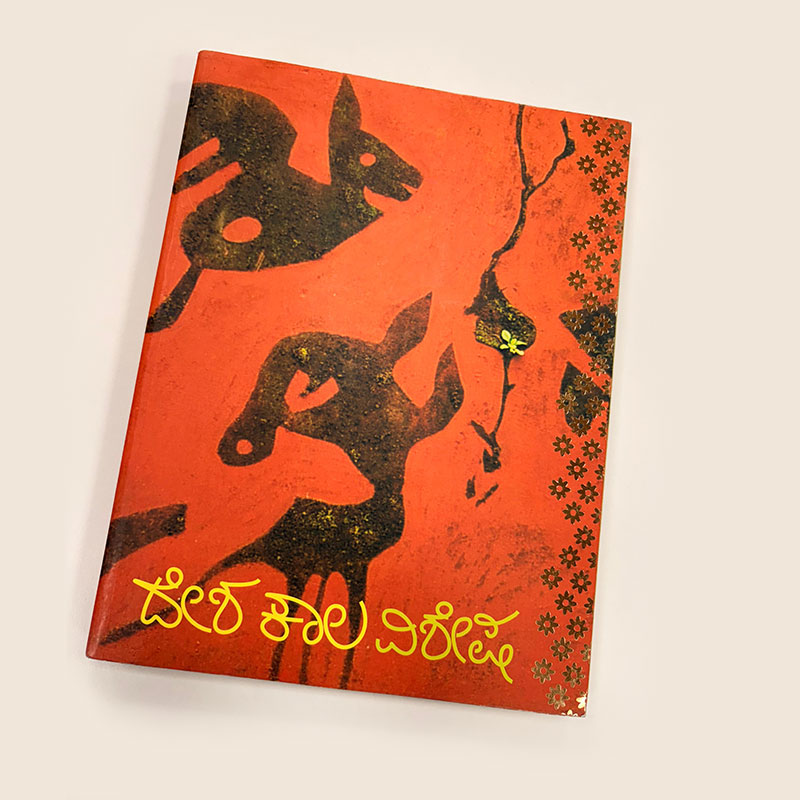
A photograph of the special issue of the trimonthly Kannada journal Deshakaala, published in 2010 to mark its five year anniversary, its cover featuring a part of the painting made on the walls of Heggodu’s Shivaram Karanth Rangamandira by Manju Kodagu and his friends.
TRANSLATOR’S AFTERWORD
In the same essay that Virginia Woolf coins the word ‘life-writing’, she agonises that the empirical details she’s able to furnish about herself, namely her name, privilege, class, parentage, and educational background, don’t ‘describe [the] human being’ that she is.[12] Filled with such details, life-writing itself seems to her ‘futile’, unable to even consider, among other things, ‘instincts, affections, passions’ of the subject, catching the fish in the end without its stream, lifeless.[13] Not only has the contemporary bio note reduced every person to such empirical details, it has as a genre induced a privileged sense of what life is and means. Especially ironic for a writer, who in their practice of literature might be groping their way towards flashes of intelligence that really see (a) life, the bio note trades in a streamlined set of elements, the birthplace and the education, the publications and the awards, such that it makes writers resemble one another and readers revere them with fear.
Intentionally or not, when Vivek Shanbhag asked Jayant Kaikini to write introductory notes for all the major contributors that were to be featured in the special issue that would mark the fifth anniversary of Deshakaala, the trimonthly Kannada literary journal he founded and edited from 2005 to 2012, and when Jayant Kaikini accepted the task and lodged himself at Vivek’s to complete twenty-eight bio notes in about forty-eight hours, they were both responding to this somewhat amusing situation of the calcified, success-driven, insecurity-inducing biographical genre.
Appearing here in translation in the order of their appearance in the special issue (except for Jayant’s, which Vivek wrote himself, part of the contributor bios here), this set of bio notes is described in the editorial as ‘the first of its kind of attempts in Kannada literature, an experiment’ of having a single writer pen everyone else’s bio notes.[14] For that single writer to be Jayant Kaikini means that every bio note bears the fingerprints of his touch: observations that come out of his acquaintanceship and his personal engagement with his subjects’ work, reminiscences that supplement the character of a person, characteristic sentence compositions that are tenderly loving, no doubt co-operating with a gaze that attentively and wantonly locates the miraculous amidst the ordinary. These qualities don’t make this simply an exercise of idiosyncrasy; they also experiment with what the genre can be and do.
Vivek rightly conjectures that ‘perusing only these introductions could itself become a readerly experience.’[15] So self-sufficient the bio notes are that they form a separate collection, as though having transgressed their original intention as ‘introductions’ to the writers to whose piece they came as accompaniments. Stripping the bio note of its contextualising responsibility, Jayant gives it a literary function. In his hands, the bio note becomes an examination and redescription of life, not only of those particular individuals, but of all that can constitute ‘life’, of the varied styles of being amidst us and within us that we pay no heed to, as we hurtle on and on towards the next goal and the next to make our own bio notes possible.
It’s to highlight this intervention, out of the many literary experiments from that 320-page bound issue of Deshakaala, that I’ve long wanted to publish in translation only the bio notes, independently, without the ‘main’ texts that escort them.
This should only seem appropriate as these bio notes seldom appear like they belong to ‘a writer’. Very few of them include a list—or at least the main texts—of the writer’s oeuvre. Imagine Ananthamurthy’s bio without the mention of Samskara. But what Jayant does try to trace is the sensibility that informed Ananthamurthy in all his work, whether his everyday contemplations, his public political stances, or his relationships. Where a standard bio note gives us a few what-s, Jayant reaches out to the why-s and the how-s, which go beyond the writing even as they include it. And when he does furnish a list, as in the case of Vaidehi, it isn’t a catalogue of her renowned fiction, but her off-beat and lesser known work that highlights her other-centered labour.[16]
Indeed, in most of Jayant’s sentences, the work writes the writer/creator: Diwakar is ‘the director of a film like Itihasa’; Pratibha Nandakumar gives us ‘such rare poems as ‘Coffee House’…’. It’s a syntax in which the destination of the sentence is not the work, as is the case in the informative bio, but the person. Instead of the writer’s biography helping us make sense of the text, the work and its co-ordinates become an exemplifying instrument to understand the writer’s imaginative world anew. The bio note is truest, as it were, to the person that also happens to be a writer than to the writer alone.
No wonder, then, that when he ends Abdul Rasheed’s bionote, Jayant writes, out of nowhere: ‘Once near Mumbai’s Flora Fountain he bought a pair of bermuda trousers and told me how good they are to wear while writing.’ It is a sentence without a head or a tail, not an anecdote, only a random memory whose consequence is not spelt out. And yet Jayant deems it necessary to be inscribed, like he thinks M. S. Sriram’s multi-coloured ink-pots must begin their owner’s biography.
Such undirected concentration is a hallmark. In ‘Kutani Kulavi’ (‘Soft Satin Cap’)—a story I translated from the 2021 collection Anarkaliya Safety Pin—in the middle of a tense and busy plot, with one of its protagonists literally running as though for life, we stand still to hear of the mother’s ‘haggard hands’, ‘wringing clothes’ as though it would ‘drain the dregs of the gut away’. Never again is either her laundering clothes or her hands mentioned. It’s a detail that is insignificant to the rest of the plot, but what it reminds us is that the mother’s life is also beyond that particular story for which she is an accessory, and there, in that space, there is a particularity to the way she washes clothes, and a particularity in how she takes her tea ‘just for herself,’ making her evening ‘a seemly time’.[17]
Insignificant only to the accepted story of a person’s life, such moments gesture at the uncircumscribable multiplicities that make up a person but may always lie outside any story about that person. Jayant ensures that the bio note is never a story, and can be made up of the fleeting acts that are signposts to the pulls and senses of a particular life.
Various attributes of a person thus inhabit the space of a single sentence: one’s handwriting is adjacent to their dispositions (Chittal), another’s trivial obsession next to their life’s large enterprise (Kum. Vee.), linked not by chronology or logic but by the synaptic interconnectivity of a human being’s activity. Various kinds of knowledges similarly populate the space of a single bio note; the factual, the anecdotal, the emotional, the close-reading of an offhand remark, literary criticism, the metaphorical, the impressionistic (and my favourite—‘friendlier when he removes his glasses’—purposelessly true), and even the hypothetical — whatever works, that is — come together to arrange the ‘splinters and mosaics’ of a person in some illuminating shape.[18]
If there is a feature that some of these bio notes share, it is the repetition of the verb ‘hanker’—variously rendered as ‘hapahapisu’, ‘tudi’, ‘midi’, etc. in Kannada, or hidden in the cognisance of someone’s principal beliefs and questions. It’s as though Jayant is always attempting to apprehend those invisible magnetic needles we call ‘desires’, ‘aspirations’, that without our own awareness may be directing us this or that way. It makes the circumferences of our desires …as indispensable as — or perhaps more than — the effect of our actions.
Such attention means that every bio note has to be written afresh. There is no formula that can be derived out of these twenty-eight sketches, no template to what a life amounts to, no claim to wholeness, and no predetermined standard by which to measure life. The writing facilitates a discovery of the diversity of life and the minute colourings of a life, even within the size of a bio note. Silently transforming how we look at people, it goads us to acknowledge that everyone has this kind of a bio note already.
*
All that’s left to say, a lot of it, is thanks. To Shree Thaarshini, who has that faculty in her that made her appreciate each bionote, as and when it was translated, as much as its translator. To Amit Chaudhuri, for the vision that makes possible the freedom and the space for himself and others to execute such a strange project, and for the faith despite all my delays.[19] To Jayant Kaikini, who is perhaps the only Kannada writer that my father, his namesake, has met and I still haven’t, and who is the source of all these words. And to Vivek Shanbhag, after meeting whom too many windows have opened in life, whose brainchild is Deshakaala and (the idea of) these bionotes, and who indulged the publication of this translation by generously supplying a bionote for me, to go with the one for Jayant that he’d written for the special issue. Among the notes Jayant wrote is one for Vivek, too, which never made it to publication, probably because Vivek decided he ought to remain in the wings. There he can remain as he chooses, and we can remember that among the theatre’s crew that stands in the wings is also the play’s very director:
Alighting his cycle at the petrol bunk near Ankola’s bus stand in the seventies, and introducing himself with great hesitation, Vivek, then a pre-university student, has kept growing as a close perceiver and warm interlocutor of his peers through his affection, writing, and his bracing responsivity. A runner in the relay race of this comprehensive world of literature, he’s constantly looking out to hand over his baton, made of his unique understanding and fresh consciousness. When what pervades the atmosphere is an anxiety about literary activity losing its integrity, seriousness, and ingenuity, what with the temptation to take over the front pages of popular dailies or occupy comfortable seats on red-carpet daises, he strives, with intense discipline and care and with personal social regard, to shape Deshakaala as an absorbing and thought-provoking environment. The main attractions of this soft-spoken intellectual are his intimate silences and enterprising caution.
- [1]Interestingly, this bio note was written for the publication of Girish Karnad’s only other short story in Deshakaala’s special issue: ‘Musalamana Banda! Musalamana Banda!’
- [2]Ninasam, both the acronym of (Sri) Neelakanteshwara Natyaseva Sangha and a coupling of the words Nee (you) Naa (me) and Sam (joining together), is by turns a theatre, cultural, and educational institution and oftentimes all of them together, in the village Heggodu in Sagara, Karnataka, founded by a group of friends who were led by K. V. Subbanna, Akshara’s father. Among its many activities today are a theatre school, a theatre repertory (Tirugata), a film society, a journal, and an annual symposium, which does its own kind of literary activism.
- [3]Hanehalli: A picturesque village along the coast of the Arabian Sea and the shores of the river Gangavalli, most famous in Kannada literary circles as the birthplace of Yashwant and Gangadhar Chittal (Yashwant’s brother), whose poetry is so distinct as to construct an ancestry or ascertain a legacy.
- [4]Outside the world of Kannada literature, Bandra Bandstand’s address is, not unexpectedly, Bandra, Bombay, where it is a promenade along the coast of the Arabian Sea; it is also an address in the world of several Hindi films, which feature multiple locations of the promenade in scenes so iconic that the spots have then become photography haunts for locals and tourists alike.
- [5]Sandur is a town in Bellary, Karnataka, known by most people for its depressing heat and sovereign scorpions, both owing to Vasudhendra’s writing about his hometown.
- [6]Electronic City is the technological headquarters in Bangalore that attempted to make an appearance most notably in stories and essays by Vasudhendra.
- [7]Flora Fountain in Bombay is where you find used books and clothes of all shapes and sizes, and in Niranjan Bhagat’s poem, translated by Rita Kothari and Suguna Ramanathan, is a tragic figurine with ‘a dream of spring in her matchless eyes’.
- [8]Mahendra Singh Dhoni, captain of the test side of the Indian cricket team, 2008-14, was born in Ranchi, Bihar in 1981. He was a ‘travelling ticket examiner’ in the Indian railways before becoming a full-time cricketer.
- [9]Talamaddale is a traditional verbal performance art, in which, beyond the tala (cymbals) and the maddale (drums), beyond the musical compositions, and beyond the dialogue that is centred around a plot from mythological stories, all of which are almost supplementary, the mainstay is the improvisatory and impromptu discussion and debate between the arthadharis — ‘meaning-bearers’ — of the performance, whose task is live literary, linguistic, cultural, social, and political criticism.
- [10]Akshohini is the measure of an army described in The Mahabharata as consisting of 21870 chariots, 21870 elephantry, 65610 cavalry, and 109350 infantry; basically, a very large army. The Kauravas had eleven; the Pandavas had seven; Kum. Vee.’s readers have eight (all in the form of words).
- [11]Bakasura is one of The Mahabharata’s many characters, an antagonist according to traditional interpretation, an eternally hungry demon from one angle and a great food connoisseur from another: he terrorises a village to offer him a daily cartload of food, which he devours along with the one who wheels him the day’s stash. When he is a metaphor, he is the epitome of insatiability.
- [12]Virginia Woolf, ‘A Sketch of the Past’, Moments of Being, edited by Jeanne Schulkind (London, Harcourt Brace and Company, 1985), 65.
- [13]Ibid. 79.
- [14]Vivek Shanbhag, ‘Samakalina Spandana’, Deshakaala Vishesha, edited by Vivek Shanbhag (Bangalore, Deshakaala, 2010), 6.
- [15]Ibid. 6.
- [16] Last year, Vaidehi published Nenapu Ekatari (Bangalore, Abhinava, 2023), a collection of miscellaneous portraits and memories of other people, writers and musicians and anonymous Mrs. Browns she met on the way—its own kind of life-writing experiment.
- [17] Jayant Kaikini, ‘Kutani Kulavi’, excerpted from Anarkaliya Safety Pin (Bangalore, Ankita Pustaka, 2021), Kendasampige, 2021.https://kendasampige.com/ಜಯಂತ-ಕಾಯ್ಕಿಣಿ-ಹೊಸ-ಪುಸ್ತಕ.
- [18]Virginia Woolf, Entry 15 September 1924, The Diary of Virginia Woolf: Volume 2, 1920—24 (London, Granta, 2023), 392.
- [19]Before coming across these notes in Deshakaala, I had begun rewriting bios for people when I had to introduce them to an audience, as disillusioned by the bio note as I appear here. Incidentally (or co-incidentally), Amit Chaudhuri was the first person subjected to these antics, in 2019. I wish I had the scrap of paper in which I’d scribbled that note to reproduce it here.