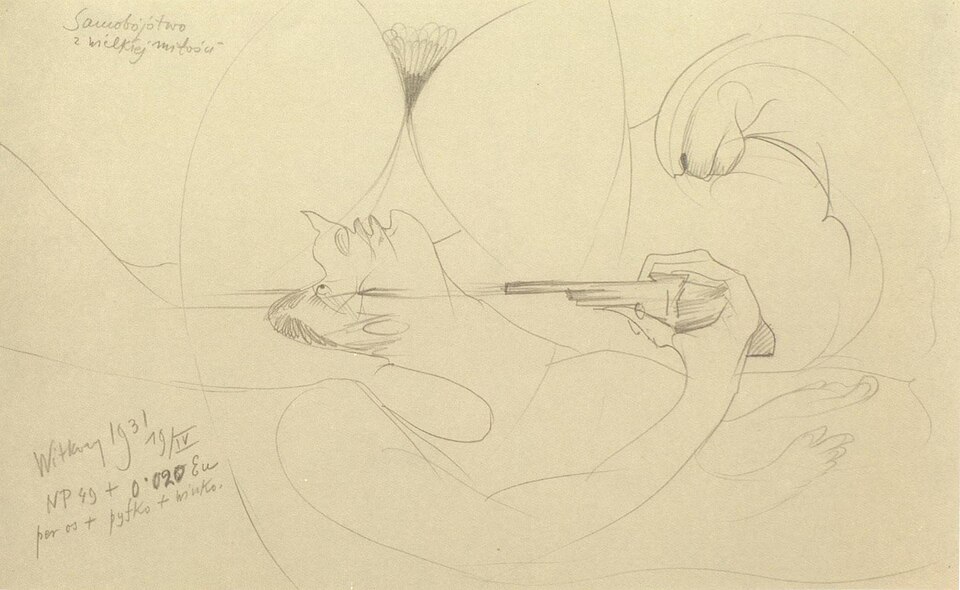
Stanisław Ignacy Witkiewicz, Suicide because of great love, 1931. (Courtesy: Wikimedia Commons)
Suicide as a Sort of Failure
Clancy Martin
‘You know what’s funny? Your jail anklet saved your life. They should put that in an advertisement! They should get a testimonial from you. If it weren’t for that anklet, you’d be dead right now.’
I came to in a hospital bed with a sore head. I reached into my hair and felt the staples in my scalp. A handsome, young, dark-haired doctor with a bushy moustache and brightly lit, amused eyes, was standing by the side of my bed conversing cheerfully with me. I didn’t know how long he’d been talking or if I had been talking back. I seemed to be joining the conversation midstream, but that may have been his manner. Perhaps he simply launched into conversation with his patients and let them catch up when they were ready.
I was very thirsty and still nervously fingering those metal staples.
I reached with my free hand for a large plastic cup of water that was on a bedside table. Then I realised that I was handcuffed to the bed.
‘Here, let me get that for you.’
He tucked the bottle between the bed rail and the pillow, and bent the plastic straw into my mouth.
I drank the water and then spat out the straw. My throat was burning.
‘Did I have an operation?’ I asked.
‘No, you were very lucky. Two minor procedures.’
He reached over to gesture at my head, where my staples and my fingers were.
‘You must have fallen at some point. Your head was bleeding. Quite a nasty cut.’
‘My throat hurts more than my head. My voice—’ I said ‘—I sound awful. I don’t feel sick.’
‘We had to pump your stomach, but basically, you’re fine. I’m so sorry we have to shackle you. They’ll transfer you to the psychiatric ward tomorrow and then the security won’t be necessary. You ruined your fancy anklet.’
He laughed. He was a very likeable doctor.
‘It seems to have short-circuited, but not before it sent off its alarm. Modern technology.’
I wanted to explain about my anklet, but I realised that any extra details from me would sound defensive and anyway were superfluous.
‘Next time, don’t get in the bath. Better yet, don’t have a next time, would you? We’d like to keep you around. And if you want to kill yourself don’t use pills. Nobody dies from overdosing on pills anymore. The best way’—this is my doctor talking—‘the best way is to duct tape a plastic bag around your head. There is even a book you can buy that tells you how—then tie up your hands before you run out of air. That’ll do it. But you know, you were very lucky, and most people wise up after one attempt. So maybe this can be your get-outof-jail-free card. That’s how I’d approach it.’
I knew the book he meant. It’s called Final Exit and I don’t recommend it.
‘You take care, try to behave yourself. Things will get better.’ The doctor grabbed my foot, shook it gently, even affectionately, shrugged his shoulders and left the room.
I thought, well, that was kind of nice. That was a much more pleasant encounter than you expected with a doctor after you’d tried suicide. That guy ought to be training others on how to deal with the situation.
I had an IV in my arm, and while there was a phone by the bed, I couldn’t reach it because it was on the handcuffed side. I had a nurse alert button by my hand but I didn’t want to beep a nurse to help me make a phone call.
‘Three weeks ago I was in bed at home with my girlfriend,’ I said out loud theatrically to the empty hospital room. I wouldn’t have done it if I weren’t alone. ‘Three weeks ago, everything was normal,’ I said.
But it wasn’t the truth. My life had been abnormal for a long time.
They woke me up in the middle of the night to transfer me to Research Psychiatric. It was quiet in the ward. Everyone was asleep. In 2009, 2010 and 2011, during the three worst years of my adulthood (thus far), I had had extraordinarily vivid dreams, and I loved to dream because I often dreamt of my children and other good things that were no longer real in my waking everyday life.
This particular suicide attempt was in the winter of 2010.
‘Can’t we go in the morning?’
They took the handcuffs off my wrists but stood very close to me as I got out of bed.
‘We don’t decide when you get transferred. Your ambulance is here. You’re going to the psychiatric ward.’
‘Why an ambulance?’ I asked the ambulance fellows downstairs at the doors. ‘Can’t we just take a car?’
Despite the frigid winter air, the truth was that it was walking distance, maybe two blocks. It’s all on the same hospital campus.
‘It’s a liability thing—you’ll get a bill for it. You’re not going to try to run on us, right?’ the EMT said.
I was in my hospital robe, in slippers and shivering. It was very cold outside where the ambulance was waiting. They wrapped a strange padded vinyl silver blanket around me. I was hot immediately.
The field beyond the parking lot was covered in snow. The stars were bright. I thought: That’s what I’d like to be; as far away and indifferent as something in the night sky.
‘Run where?’
‘You can sit up here with us,’ the other EMT said. ‘It’s not strictly according to regulations but what the hell.’
It was a bench seat and I sat in the middle between the driver and his partner.
‘It’s like Bringing Out the Dead,’ I said. ‘Did you guys ever see that movie?’
‘Uh-uh,’ the driver said. The other one said, ‘I think I saw it.’
‘If you saw it you’d remember,’ I said. ‘It’s about an ambulance driver. Nicolas Cage.’
‘And he sees ghosts, right?’ the driver said. He had a beard and looked about twenty years old.
‘That’s it! You did see it.’
I paused for a second. We were pulling up to the psychiatric building.
‘You guys ever see any ghosts?’ I asked.
I think suicidal people can see into the world of ghosts in a way that sturdier folks cannot. The Canadian addiction expert Gabor Maté describes alcoholics like me as ‘living in the realm of hungry ghosts’: people who have become ghosts while still alive. And I think you can almost see when a deeply addicted person who is killing himself with his drug of choice is making the transition into the ghost lands.
‘Not Scorsese’s best,’ the driver said, ignoring or avoiding my question. ‘I always thought Goodfellas was his real masterpiece.’
‘Or Raging Bull,’ I said. ‘That’s one of the saddest movies ever made.’
‘I’ve seen a couple of ghosts!’ the guy on my right said. ‘People see them. It’s a real thing. My aunt once had a ghost ask if it could kiss her. A female ghost.’
‘No one wants to hear that bullshit,’ the driver said briskly, interrupting his buddy. ‘We’re here. At the psychiatric hospital,’ he said, giving the ghost guy a pointed look.
They put me in the tiny claustrophobic office just off the main waiting room. It was I’d guess four or five in the morning.
A thirty-something slender, pale intake nurse asked me: ‘Are you feeling suicidal right now? Are you having suicidal thoughts?’
I don’t know why but I was honest with her. Maybe I was still high from the Benadryl they’d given me at the hospital to keep me calm, or maybe I was at the end of my rope.
‘Well, glad you asked. If you leave me alone in here, I will slash my wrists with your scissors, I will hang myself with the blinds, I will electrocute myself with a fucking fork. Yes. What do you think?’
‘If you’re feeling violent … are you threatening me? Are you thinking of attacking me?’
She picked up the phone. I noticed she had chubby hands and fingers that tapered down like pyramids. She had a no-nonsense expression and an all-American appearance, with clean nicely brushed brown hair. She was young and looked like she could have been one of my oldest daughter’s friends, and I regretted what I had said. She was just doing her job.
‘No, I’m not feeling violent. I apologise. I’m not having suicidal thoughts.’
I had forgotten to lie about what I was thinking, which is the cardinal rule of intensive psychiatric care. It’s like the ‘deny, deny, deny’ rule for adulterers; with psychiatrists, ‘lie, lie, lie’ is the only way to survive. The only hope is of getting out of there.
‘I just want to sleep. I’m freezing. Are you cold? It’s freezing in here.’
I still had the too-hot silver blanket from the EMTs but it was cold in her office, and I was in the mood to complain. I was in the hospital robe. I’d lost the slippers and was barefoot.
‘I’m sorry about the temperature, sir, but I would appreciate if you would try to use civil language with me. What have they done with your clothes?’
‘I need some socks. I don’t have any clothes. They found me in a bathtub.’
‘Oh, I see.’ This did not dismay or even surprise her. In fact, it seemed to reassure her. Like now we were making some progress. She typed it into her computer.
‘Well, there’s a bed opening in the morning in the annex. I think you’ll have to wait for a few hours. Here, we’ll finish your paperwork and you’re welcome to take a nap in the waiting room if you like. I’ll find you a real blanket. You should have someone bring you down some clothes.’
‘Can I make a phone call? I’m sure I can have someone come right away. That would be really helpful actually.’
The white office phone sat there on her desk. Her cell phone was beside it.
‘No.’
‘No?’
‘I’m afraid not.’
Unlike when you’re arrested, when they whisk you off to the madhouse there is no guaranteed right to a phone call.
‘Okay. I guess I’ll wait in the waiting room.’
She went to get me another blanket and I heard her lock the door behind me. She took her cell phone with her and when I tried to dial an outside line on her desk phone I couldn’t get through. They requested a security code. I sat back down in my chair when I heard her at the door. She gave me an irritated suspicious look when she came into the room.
‘There’s a camera right there,’ she said, and pointed to the corner above her desk.
She handed me a red cotton blanket, and some blue cotton slippers that looked like they had been left behind by another patient. They were too fuzzy to be institutional slippers.
‘You’re going to have to wait in here.’
I watched the door closed behind her and immediately regretted not making a run for it when they were putting me in the ambulance. Those guys were bigger than I am, and no doubt faster, but I could have found a place to hide. Dejected, I put the red blanket around my chest like a towel under the silver blanket, so that I’d be more comfortable, and then on impulse I stood up abruptly and tried the nurse’s office door. It was locked.
I startled her. She started to rise from her desk.
‘Do you need to go to the restroom?’
‘Yes,’ I said, ‘please.’
Okay, this was my chance. There were a few chairs in the little waiting room and a security guard was talking to a nurse or orderly who sat behind a desk behind a counter with a sliding glass front like a doctor’s office. The door out had a big metal push bar.
It was a frozen Kansas City winter night, but if I were free, there would be opportunities. Something would present itself.
This is how I thought at that time. Everything was one second to the next. I couldn’t conceive of tomorrow. Things were just happening; and they were either good or bad. I wanted to get away from the bad things and find the good things. Or, if there were no good things to find, kill myself. To get away altogether. It was like the opposite of what William Blake and Søren Kierkegaard might have been talking about when they wrote about the bliss of immediacy and mystical experience. I had a kind of immediacy of despair, I suppose. Or I just couldn’t bear to think more than a few minutes ahead because I knew what was coming.
I twisted away from her and ran for the door
She said ‘Sir’ and the security guard turned, but I was too quick for them. He didn’t have time to get up.
I’ve made it! Bang! Hit the metal bar, dropped my silver blanket.
The door was locked. I pushed against it again with my whole body, for a moment imagining liberty. I rested my forehead on the cold glass.
Then I turned around, shrugged and tried to act like it was their fault.
‘Why did you do that?’
‘I’m sorry,’ I said. I knew I had betrayed her trust. Plus, I was stealing her slippers.
‘Do you still need to use the restroom?’
They didn’t say anything else about it. I expected some kind of formal reprimand, and even perhaps a punishment or restraints, but it was like it never happened. I supposed it must happen more often than you think.
‘Yes, I need to use the bathroom,’ I said.
There was a door with a men–women–wheelchair sign on it. I went into it and saw there was no lock. They had everything figured out: there was no air duct you might climb into like in a movie, just a sturdy looking fluorescent light panel in the ceiling and nothing I could use to kill myself.
I sat on the toilet and cried.
I stopped and looked in the mirror.
They had a normal mirror, not a stainless steel one like you find in many institutional settings. It was the one thing you might use to kill yourself with. I could smash the mirror and slash myself with a shard of glass. If I had been a different person, I could perhaps have used a shard of glass to menace someone into an escape, but all of my fight was exhausted by my useless dash for the door.
I was defeated, and anyway, I doubted I could break the mirror if I tried. In the mirror to myself, in my great self-pity at that moment, I looked like I was about twelve years old.
I wiped the tears off my face and for a moment, relaxed the armour of irony about my ridiculous situation. I let myself feel very, very sorry for myself. My eyes were large and red. My face was still pink from the cold and I wanted my mom. My hair was freshly washed for my stitches and my bangs were tousled and boyish. I was momentarily inspired and reassured by the childishness of my own desperation.
And there I was. I walked back out of the bathroom to try to face whatever was coming my way next.
II
One of the reasons that suicide makes us uncomfortable is that it is a very public confession of failure.
In fact, there may be no more complete confession of failure that a person can make both to herself and the world than trying to take their own life. It’s kind of like a last desperate shout-out to the world: ‘Okay, I admit it, I’m a failure! You beat me! You won!’
Even among the philosophers who allow suicide as a legitimate and even noble means of escaping evil, such as Cicero, it is generally recommended to those who either find themselves in the midst of failure or as a desirable action given the failures that were to come.
In fact, on Cicero’s account, as obsessed with the problem of failure as he is, you’ve failed both yourself and your friends by failing to kill yourself in circumstances of failure, but failed even worse if you choose to live and fail to properly anticipate the failures to come. Suicide is not only an entirely appropriate response to failure, it is a sensible method of avoiding it.
Thus the worst paradox the suicide encounters if he attempts suicide and fails, he finds that now he has failed even in that. As the eventually successful David Foster Wallace remarked in an interview with Rolling Stone: ‘I knew that if anybody was fated to fuck up a suicide attempt it was me, but if he succeeds at his suicide and shows everyone that finally he is not the fuck up everyone supposed him to be, well, no one looks at the suicide and thinks thank goodness, he got one thing right! And even if they did, he’s not around to enjoy it!’
III
‘Later, none of the guests at the party believed when they heard what happened. They were already thinking of suicide then.’
At this point in his novel Suicide, Levé’s hero has not killed himself yet. He is at a party with old friends and for a change he seems to be genuinely happy.
If you don’t know the story of the magnificent French writer and photographer Édouard Levé, he was born in 1965, studied business at an elite school in Paris, became an abstract painter, then burned all his work, took a transformational (as he described it) twomonth trip to India and then took up his mature and robust career as a photographer and writer. His last book was the novel Suicide, which he wrote in 2007, gave to his editor and then promptly killed himself.
I recently had a friend visit from Los Angeles who had read an essay of mine about suicide and was interested in the question of why I am suicidal. We were driving around Kansas City together. I was showing him some of my old stomping grounds and he was interested in the city generally. As we passed the Nelson–Atkins Museum of Art heading towards the campus of University of Missouri-Kansas City, he said: ‘Either you’re really happy now, happy to be with Amie and your kids and a very long way from wanting to kill yourself or you’re the best actor I have ever met.’
I agreed that I was happy and that I was a long way from killing myself (which, most days, I think I am) although I also told him that it was all very fragile, that Amie could leave me or something else could go wrong in my life and suddenly I’d be back on the edge, which is also entirely true, I think.
The point of course is that being happy and thinking of suicide then as Levé writes above are not at all incompatible. That’s not only because one might see one’s happiness as an exception to the rule, a pleasant but surely brief surprise. It’s also not only because there seems to be for a lot of us a deeper underlying happiness that persists even in cheerful psychologically stable times.
Once you have the habit of thinking you are going to kill yourself, that habit doesn’t necessarily go away. A Buddhist Lama I study under, Dzongsar Khyentse Rinpoche, writes in his book Living Is Dying that suicide is habit-forming through lifetimes and that the urge to kill oneself is often just the expression of having killed oneself in a previous life. You don’t want to do a reductio ad absurdum on that one, but anyway, it had to start somewhere. Therefore, he teaches, it is important to break the habit now, rather than reinforcing it again.
Of course, for Buddhists any habit breaking—even the breaking of good habits—is generally encouraged. Some Buddhists argue that the suffering that comes from our confusion about reality is primarily a consequence of our habits. For me the habit of suicide was mentally ingrained years before I actually, sincerely, physically tried to kill myself.
So when I think of killing myself now, it’s a lot like thinking of taking a drink, it’s not attractive, it doesn’t have the allure but it feels both familiar and real. And I suppose it’s fair to say that it somehow even feels natural.
I have an email friend who writes to me sometimes about her desire to kill herself, and she says that suicide feels inevitable to her. When I push back, she agrees that it’s not inevitable, but I know just what she’s talking about. It’s that same feeling of naturalness, of the ease of the thought. If I think about taking a jog it sounds more troublesome, more psychologically difficult or irritating to me than killing myself does, and this despite the fact that I really love jogging, though I still have not formed the habit.
On the car ride to a conference in 2020, just before COVID broke out, I was discussing suicide with Amit Chaudhuri and Sumana Roy, and Amit said: ‘I think it would be so upsetting not to have the thought of suicide go through your mind from time to time. Then there would be no way out!’ And it’s true that when friends or students or readers of mine come to me to talk about their suicidal feelings, I almost always give them a variation of what I will now always call Amit’s consolation: ‘Look, everyone feels that way sometimes, and if you can just keep going today you can always still kill yourself tomorrow.’
Of course, sometimes the sheer pressure of the thought of suicide, the claustrophobia of the walls of that thought coming ever closer to you, is itself part of the panic that leads to the suicide attempt.
When Levé considers the familiarity of the thought of suicide, his narrator describes himself as a biological failure. ‘You were perhaps a weak link, an accidental evolutionary dead end, a temporary anomaly not destined to burgeon again.’
Which reminds me of the line from the CIA agent Dan who tortures detainees in the movie Zero Dark Thirty. ‘It’s cool that you’re strong and I respect it, I do,’ he tells his victim, ‘but in the end everybody breaks, bro. It’s biology.’
IV
There are lots of ways in which Levé’s nameless hero and suicide seem familiar to me and will be familiar to other suicidal people. Perhaps most intimately, he doesn’t expect to be happy, but looks for ways to suffer less and makes his decisions using this criterion. He tells himself, ‘You directed at yourself a violence that you did not feel toward others.’
I’ve often asked my students: ‘Imagine what your life would be like if you had the same contempt for others that you have for yourself.’ This to help them see that others do not have the contempt for them that they might suspect, and also to see hopefully that their own selfcontempt is unjustified and probably unnecessary.
Certainly, we don’t judge other people as harshly as we judge ourselves.
I also worry that the desire to kill myself is an expression of my anger at other people, that it is a lashing out against the people I love. Certainly, most suicides are interpreted that way, at least in some measure, and of course Freud’s analysis of suicide is that it is just a displaced murder. We want to kill someone else but we dare not, and so, like the drive for cruelty turning back upon itself in Nietzsche’s story about the creation of human consciousness, the murderous hand becomes a sélbstmord, the poetic German word for suicide.
But if I think of the times I actually tried to kill myself, or even of the wistful worry I have now that it might be better off to, that I might be better off dead, I see that the violence of the idea—if indeed it must be violent, which it somehow doesn’t seem that way in imagination— is in fact not directed at anyone else at all, or if it is an attempt to punish someone else, it is more like the punishment enacted on Shia LaBeouf by his father in the autobiographical movie Honey Boy, when his dad tells him, ‘Nobody is mad at me anymore, that’s all I ever wanted.’
Yes, it’s a model of self-pity, but we understand this feeling sorry for ourselves and wanting other people to feel sorry for us too, and if we aren’t murdering someone else when we kill ourselves, at least hurting them because they don’t feel sorry enough for us, might be part of our motivation.
‘Your mother cried for you when she learned of your death,’ Levé writes. In this very lean novel, the hero’s mother gets a full paragraph of crying over her dead son. She cries and cries and cries, and which one of us thinking of suicide hasn’t shamefacedly dared to hope for that. One of the consoling thoughts about dying (and at times, some of the motivation for suicide) is the hope that our mothers, at least, will cry. This is not just Levé’s wish-fulfilment, it also gives us one of the keys to the text, which is that Levé is telling us something about the psychology of the suicidal person; showing us not the world the way it really is, despite our wish as the usual job of the novelist, but the way the world is dreamt of in the fantasy of the suicidal person.
His paragraph about the mother’s tears, coming very near the end of the novel as it does, is a mockery of the suicide, but it is a melancholy, sympathetic mockery, and of course also a self-mockery, the kind of self-irony at which the suicidal person perhaps excels. We can both make fun of the fact that we want our mothers to cry at our funerals, and very much want our mothers to cry at our funerals, and even kill ourselves just so that we can be assured of our mothers crying at our funerals, which otherwise is not very likely to happen. (It’s a funny paradox about being a parent that despite protesting sincerely that we would do anything for our children, none of us would be willing to live longer than them.)
‘Years later,’ Levé writes, ‘there are many like her whose tears flow whenever they think of you.’ Exaggerated, dramatic and just the kind of sentimental flourish that the suicide engages in when thinking about his own demise. It sounds a little like our hero at the beginning of this talk who looked at himself in the mirror and cried tears over the piteousness of his own situation.
The final paragraph of Levé’s book strikes a different tone and is a powerful counterbalance to the teary self-pitying paragraph that precedes it.
‘Regrets? You had some for causing the sadness of those who cried for you …’ (it’s worth remembering that this is all being written by a man who was about to kill himself and has tried to kill himself before) ‘… for the love they felt for you and which you had returned. You had some for the solitude in which you left your wife and for the emptiness your loved ones would experience, but these regrets, you felt merely in anticipation, they would disappear along with you. Your survivors would be alone in carrying the pain of your death. The selfishness of your suicide displeased you, but all things considered the lull of death won out over life’s painful commotion.’
It’s true that his suicide is selfish, as indeed are many suicides. In some ways suicide is the most selfish act one can perform. It is a kind of wholly taking something that belongs to many people, and making it entirely yours alone. It’s burning down a house in which many people live just because I don’t want to live there anymore. There’s no point trying to hide from, or gloss over, the selfishness of suicide.
He wasn’t trying to hide from his selfishness. Every verse in the poem that concludes the novel ends with ‘me’ or contains ‘my’, ‘this’, ‘me’, ‘me’, ‘my’, ‘my’, ‘I.’
I is both the suicide’s refrain, and one reason we are suspicious of the suicide and perhaps angry with him after the fact. Angry at him whether he tried and failed to kill himself, and angry at him if he tried and succeeded. But it might also make us suspicious of people who try to hide from their own selfishness. We are right to rebuke the suicide ‘you were unforgivably selfish’—but that also means ‘You are much more selfish than I am.’
When Mary Carr heard the news of her friend and lover David Foster Wallace’s successful suicide she wrote, ‘Every suicide’s an asshole. There is a good reason I am NOT God for I would cruelly smite the self-smitten.’ But on whose behalf are we self-righteously indignant? Who is feeling sorry for who now, and who’s better off— the dead suicide who was in too much pain to go on living, or the living one who is in more pain now that the friend is gone?
When David Foster Wallace writes that the suicide is like someone jumping from a burning building, he is perhaps not so much trying to excuse the suicide, as explain the action he is taking, and perhaps to reply to those people who would accuse the suicide of monstrous selfishness. Of course the person leaping from a burning building is doing something selfish, Wallace might tell us, but she is doing a selfish thing any of us would do if our suffering were similar to hers. It is a selfishness we have to be able to understand, and even sympathise with.
The problem with the metaphor of course is that the person in the burning building dies either way, it’s just one death is less painful than the other. And it’s true that we all die either way but the family and friends of the suicide can reasonably reply, ‘You didn’t have to die yet.’
‘Couldn’t you have endured the suffering for us and perhaps we could have even found a way to help with the suffering, because after all, you weren’t always suffering like that, and there is a reason to believe that maybe you wouldn’t always have to?’
But it’s also hard to get past the recognition (or the hope) of the lull of death when you’re dead. Yes, the ones behind will have things a bit harder, a bit worse than they do now and you will have caused that, but they are still in life’s painful commotion and you’ve exited.
In killing myself, were I, especially as a parent, to do it, I have to accept that the ones I leave behind may do as I have done. Which reminds me of my psychiatrist Grace Kellerman’s admonition to me: ‘Don’t not kill yourself because of your children, your children will miss you but in the end they’ll be fine. Don’t kill yourself because of the example you’d be setting for them.’
That’s a very good reason not to kill yourself, if you have children: one of the best reasons I’ve ever heard. Wallace, who had no children, understood this point. In The Pale King, the novel which was interrupted by his suicide, several of the characters are considering suicide and one of them, Lane Dean Jr., always manages to stop himself by looking at a picture of his newborn child.
On 12 September 2008, David Foster Wallace hanged himself on the patio of his home in Claremont, California. His first suicide attempt that we know of was about twenty years before, at his parents’ home in Urbana where he grew up. He overdosed on a tranquiliser, followed by a stay in a psychiatric hospital in the course of ECT treatments for depression. He made one more suicide attempt that we know of for certain; also an overdose before his death.
It started early for Wallace. He was already writing about suicide as a teenager and his first attempt was in his early twenties. In a letter to his lifelong friend Jonathan Franzen when he was twenty-eight, he writes that suicide is ‘a reasonable if not at this point a desirable option with respect to the whole wretched problem’. In a story from around the same time, he writes:
You are the sickness yourself. You realise all this when you look at the black hole and it’s wearing your face. That’s when the bad thing just absolutely eats you up or rather when you just eat yourself up. When you kill yourself. All this business about people committing suicide when they’re severely depressed, we say holy cow we must do something to stop them from killing themselves, that’s wrong, because all these people have, you see, by this time already killed themselves where it really counts. When they commit suicide they’re just being orderly.
But all this is just theory, Professor Wallace, what about when they try to kill themselves for real and fail?
One of the paradoxes of the failed suicide is that he starts feeling like an imposter—a pretender—a joke. People want to ask him: ‘You’ve tried repeatedly, how come you haven’t managed it yet? Get your act together!’ But of course the struggle isn’t killing yourself so much as not killing yourself !
Wallace summarises it this way: ‘So cry all you want. I won’t tell anybody. But it wouldn’t have made you a fraud to change your mind. It would be sad to do it because you think you somehow have to.’
We’d be lying if we failed to acknowledge the theatrical character of the kind of self-pitying person the suicidal person is. Wallace signed his letters to Mary Carr ‘Young Werther,’ the most famous fictional suicide in Western literature. Andrew Solomon wrote of his approach to suicide that he knew he was in real trouble when he could no longer distinguish between his drama over his depression and his depression itself. (It’s something to remember if you’re wrestling with depression: when you’re at that point where you can no longer distinguish between your depression and your drama over your depression make sure you get some help.)
The summer before David Foster Wallace finally succeeded in killing himself he tried and failed again at overdosing on pills. And those of us who have failed at suicide through overdosing on pills (it is in fact the most common way of failing to kill yourself) know the secret that we don’t like to admit, which is that suicide is scary. And we might be a bit cowardly. It’s scary to think that now it’s time to die, and it’s also scary to think of ways of doing it that might be really painful. If suicide is the coward’s way out, as people angry over a suicide like to say, failing at suicide is cowardice squared! Too cowardly to live but also too cowardly to die.
But then David Foster Wallace found his courage. His partner said at the time that: ‘Saturday was a really good day. Monday and Tuesday were not so good. He started lying to me that Wednesday.’ Two days went by but she was a little less worried than usual because on that Monday this difficult fellow—who hated to go to the doctor despite having spent much of his adult life in the care of various doctors—had been willing to go to the chiropractor.
‘You don’t go to the chiropractor if you’re going to commit suicide,’ she said. That is probably true, and probably, on Monday, Wallace still didn’t know that it would be his last week with his wife. He was still fighting against suicide then, still going through the motions required of life. He had courage enough to live on Monday, and by Wednesday he had courage enough to buy the rope that he would use to hang himself on Friday.
In the previously mentioned interview with Rolling Stone, Wallace described a time when he successfully stopped himself from killing himself. ‘I got really worried I was going to kill myself.’ He walked across campus to health services—this was when he was at Harvard— and told a psychiatrist: ‘Look, there’s this issue, I don’t feel real safe.’
‘It was a big deal for me because I was so embarrassed,’ Wallace said, ‘but it was the first time I ever treated myself like I was worth something.’ They checked him into a psychiatric hospital, the same one where the failed suicide Robert Lowell once stayed, and then the failed and then successful suicide Sylvia Plath also stayed.
‘When that happens to you,’ Wallace went on, smiling at the interviewer, ‘you get unprecedentedly willing to examine other alternatives for how to live.’
The writer Sumana Roy once asked: ‘When is failure ever expected?’ And when trying to kill ourselves, though we may paradoxically hope to fail, if we are trying at all, we are expecting to succeed.
I was recently talking to a philosopher friend of mine about a suicide attempt he’d made when he was eighteen. He said you know all that about how if you tried it but didn’t actually manage to do it, how everybody thinks you didn’t really mean it?’ ‘A cry for help,’ I said. ‘Yeah, but I don’t think that’s true at all. Because when I woke up and realised I had failed, I was absolutely gutted.’
If you talk to people in psychiatric hospitals immediately following their suicide attempts, as I have done many times, you know that this is a common report. No one in there is celebrating the gift of being alive.
And yet when you realise that at every moment, you could kill yourself, if you chose to, then in a funny way every moment you are alive becomes this astonishing triumph. This is a thought that is so obvious that we fail to appreciate its importance: you don’t have to be here.
It’s so hard to be here, and yet here you are! You grossly underestimate yourself. You might remember in Philip Roth’s prophetic novel The Human Stain, perhaps his best novel about failure and wilful self-destruction, the existentialist imperative Roth offers us in the words of his hero is the simple plea repeatedly made to his lover: ‘Keep on dancing.’
I think of Pratap Mehta’s work and his idea of the redemptive power of spontaneous action, which is so well and frequently expressed through the metaphors of music and dancing. I think of those unjustly vilified forms of the aesthetic: disco music and disco dancing, and especially the Bee Gees. Also, I couldn’t resist the appeal of putting Pratap Mehta and the Bee Gees in the same paragraph.
You know when they teach you how to sustain or resuscitate a person in a CPR class, they teach you to palpate the chest to the beat of the Bee Gees song Stayin’ Alive? And I think in this way we might try to understand and forgive the suicide who simply didn’t have any more disco in him, and had to get off the dance floor to take a rest.
But also, we could congratulate ourselves and recognise that it’s a victory every day we succeed in Staying Alive.
Clancy Martin is University of Missouri Curators’ Professor of Philosophy and Professor of Philosophy at Ashoka University. He writes essays, memoir and fiction. His most recent book is a new translation of and commentary on Nietzsche’s Thus Spoke Zarathustra.