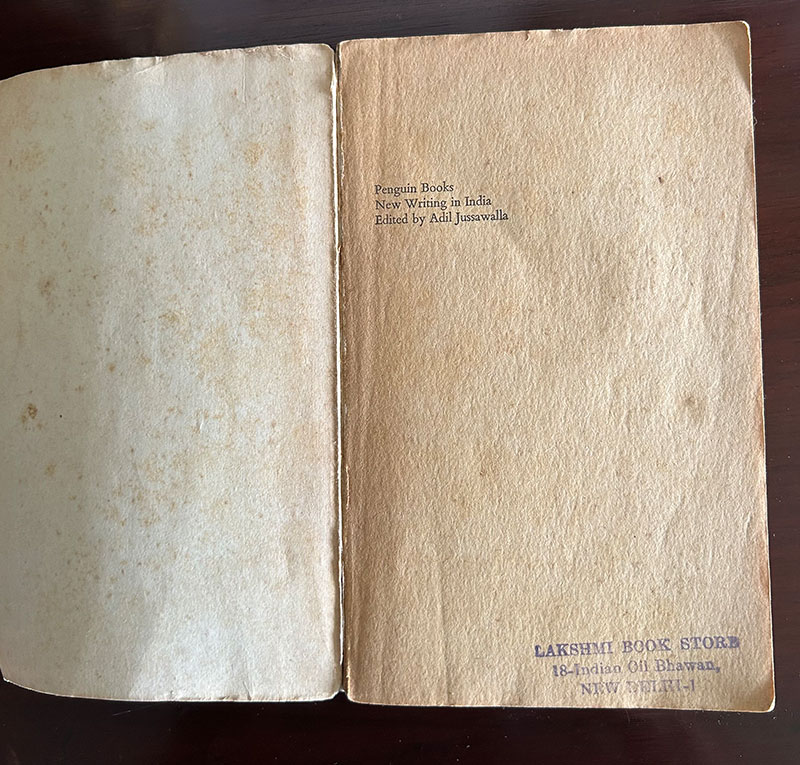
Opening page, New Writing in India.
Perfect Lives
Adil Jussawalla
For Jayant Kaikini’s bio notes from the special issue of the trimonthly magazine, Deshakaala (2010), see here.
Editor’s note: Adil Jussawalla’s anthology, New Writing in India, published by Penguin in 1974, is being reissued in August 2025 by Penguin Random House India. Among the surprises the book holds even after more than half a century are the biographical notes on contributors, which appear where they usually do in anthologies—right at the end of the book. It’s as if Jussawalla, like builders of houses and temples who make it a point to delegate some intricate carvings or sculptures to where the onlooker’s eye can’t access them, decided these bio notes shouldn’t be read; they should be noticed, or discovered. And they are a discovery. I paid them little attention when I got myself the book in 1979 or 1980, when I was seventeen or eighteen years old. Now, fifty-one years later, they seem like a unique form of condensed critical essay and abbreviated biography, more akin to—but briefer than—critical headnotes in poetry anthologies than the typical bio note. Much is left out, and yet everything is there, especially the impress of life and thought which contributors’ notes, as a form of artifice, ignore in favour of location, publications, and awards.
I once found the writer Allan Sealy sitting by himself in the authors’ lounge in a building in New York, studying a piece of paper. It contained the biographical notes (including mine and his) of participants in an ongoing literary festival. ‘Perfect lives,’ he said, chastened. ‘Such perfect lives…’ Jussawalla’s notes are a departure from that genre. They introduce us not to achievement—or, at least, not only to achievement—but to a sense of how the interstitial and the unfinished contains the imaginative life.
Notes on the Authors
GOPALAKRISHNA ADIGA: Born in 1918. Regarded as India’s greatest living poet by his admirers, there is mounting evidence in the English and Indian language translations of his work to suggest this is so. The early Marxist phase of his poetry was abandoned for a more subjective exploration of the individual and his place in society and the work he is represented by here is from this second phase. Propelled by a kind of Whitmanesque energy, his poems are able to suggest transcendental levels of experience while remaining robust and of the earth. He has published five books of poems, a collection of essays and has translated some of Ibsen’s plays and Leaves of Grass into Kannada. More English translations of his work are available in The Song of the Earth and Other Poems (Writers Workshop, Calcutta, 1968). He is Visiting Fellow at the Institute of Advanced Study, Simla.
AKHTAR-UL-IMAN: Born in 1915 into a priestly family and brought up to become a priest, he ran away from home and was later educated in an ‘orphanage’ (in reality, a reform school) with the help of an uncle. Absorbed into India’s film-world like a number of Urdu poets, he has twice won the Filmfare award (India’s Oscar) as the best writer of dialogues. With the poets Faiz Ahmed Faiz (now in Pakistan), M. M. Rashid and Miraji, he was associated with the ‘Modern’ movement in poetry as opposed to the leftist Progressive Writers’ movement in the late thirties and forties. He has published five books of poems and a verse drama. One of his books won him the Sahitya Akademi award in 1961.
ASHOKAMITRAN: A pseudonym for J. Thyagarajan who was born in 1931. Having left university without taking a degree, he worked for a number of years in the public relations department of Gemini Studios, the biggest film studio in south India. He gave up his job to write. Many of his sixty or so short stories and his highly praised novel called (in translation) Dissolving Shadows (1969) are set in the world of south Indian cinema and though he has scrupulously avoided subjects which may be termed ‘unmentionable’—his strength lying in his compassion, irony and close attention to detail—it says something about Tamil orthodoxy that his writings have been called both ‘degenerate hippie writing’ and ‘unadulterated Communist propaganda’. He interviews smokers for an advertising agency, is executive editor of a Tamil little magazine and lives in Madras.
L. P. BANTLEMAN: Born in 1942. Has already published four volumes of verse, his most ambitious being Kanchenjunga (1967), a poem of 472 lines. Orphaned at the age of fifteen and dissatisfied by a couple of jobs in Calcutta, he went to New Delhi and became literary editor of the Krishna Menon-owned weekly, The Century. He went to Canada on a Canada Council scholarship in 1967—the first Asian student to do so—to study the theatre, but does not see himself actively participating in theatre in the West. An Anglo-Indian, he feels an unspoken prejudice against his community in post-Independence India, was not at home in Britain where he spent more than a year (1969-70), and would like to settle in Canada.
SANDIPAN CHATTOPADHYAY: Born in 1933. Has published three volumes of short stories, the first a much-discussed series about a young man called Bijon and a story in the last beginning a series on a man called Rajmohan. Trying to develop a transparent prose-style to which a reader gets stuck ‘like an inspired fly on a panel of glass’, he believes he has achieved this in the story he is represented by here, his ‘finest literary achievement’ to date. It was originally published in Bengali as the first of Calcutta’s mini-books (little bigger than a packet of king-sized twenties, often not more than thirty pages thick, and selling at less than 3 new pence each)—an idea to break the monopoly of the publisher, which originated with Chattopadhyay and which has swept through Calcutta since. He was also responsible for starting the Hungryalist literary movement in Bengal, along with Shakti Chattopadhyay, the poet, and Utpal Basu, a writer now living in London; but he disowned it in 1964. He was a member of the Communist Party till he resigned in 1955.
SHAKTI CHATTOPADHYAY: Born in 1934 and educated at the Presidency College. Darkly introspective and romantic elements in his work have been given the label ‘Baudelairean’ by some Bengalis. A prolific writer, like many of his Bengali contemporaries, he has published at least seven volumes of poetry, six novels, a translation of the Rubá’iyát of Omar Khayyám, and an anthology of Bengali poetry. He works as a reader and adviser for a publisher and, like his contemporary Sunil Gangopadhyay, for the leading Bengali daily, Ananda Bazaar Patrika. Allen Ginsberg called him ‘probably the finest’ of the Bengali poets he met in 1964, and found him the most untranslateable. He was a founder member of the Hungryalist movement (see under SANDIPAN CHATTOPADHYAY).
DILIP CHITRE: Born in Baroda in 1938, an early acquaintance with several Indian languages and English enables him to translate from a number of them and write in two, Marathi and English. Bringing to bear a wide-ranging intellect on problems of criticism, translation and contemporary social problems, his outspokenness has aroused some hostility against him in his state and yet, paradoxically, he has carried off two state literary awards. The first was for a book of poems published in 1960 and the second for a collection of short stories published in 1969. An important book, An Anthology of Marathi Poetry, 1945-1965 (Nirmala Sadanand, Bombay) with almost all the poems translated by himself, was published in 1967. He writes a regular feature for Quest (a journal of ideas) and has written a novel in English. He taught in schools in Ethiopia between 1960 and 1963 and now lives in Bombay.
KAMALA DAS: Born in 1934, though she wishes it were 1938. Daughter of a well-known Malayali poetess, Balamani Amma, she was married when she was fifteen. Has published nine volumes of short stories in Malayalam under the name of Madhavi Kutty. One of them, Thanuppu (The Cold), won the highest literary award in the state of Kerala in 1969. She is also one of India’s leading writers in English. She has published two volumes of poetry in English and has appeared in two previous anthologies published in England: Young Commonwealth Poets ’65 (Heinemann, 1965) and Commonwealth Poems of Today (John Murray, 1967). Two of her poems, ‘The Testing of the Sirens’ and ‘Summer in Calcutta’, won the PEN award in 1963. Her frank and outspoken autobiography, serialized in Mathrubhumi (see under M. T. VASUDEVANNAIR), has created something of a sensation in Kerala.
KISHORI CHARAN DAS: Born in 1924. Cynical about his upper-middle-class background and his respectable job of accountant general, he is at the same time a very sharp observer of members of his class and has written several strong satirical stories about them. He says he has a passion for social justice and also wishes to have his intellectual freedom; but that, if there had to be a choice between the two he’d ‘let the freedom go hoping it would come back on a more auspicious day’. He has published four collections of short stories and says he is trying to live down his reputation of being ‘a powerful modern writer’, that is, of being ‘a dealer in the nasty merchandise of frustrations, alienations and what not’. He is married and has four children.
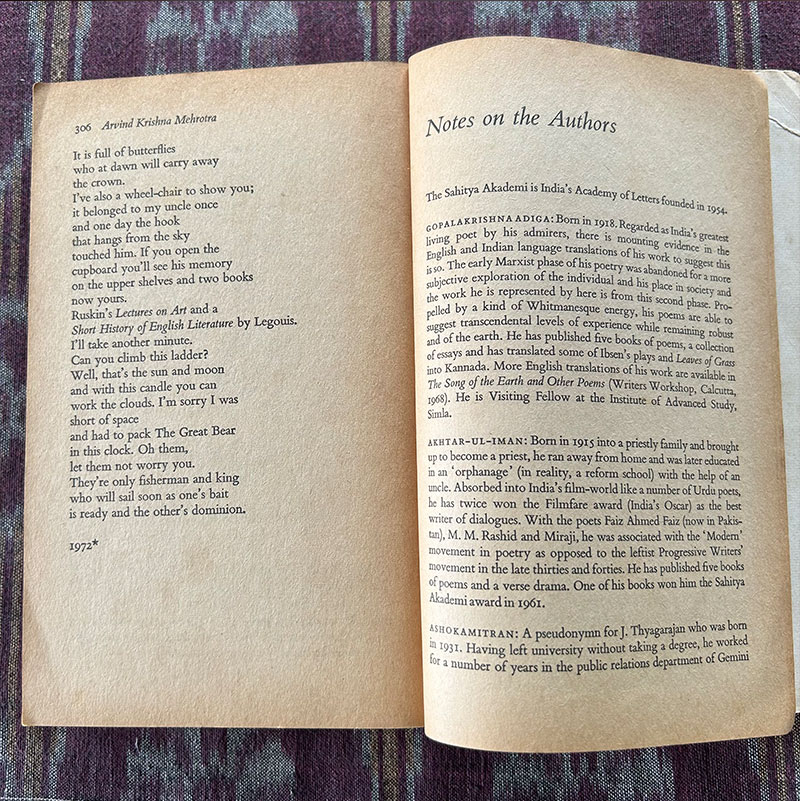
New Writing in India, bio notes.
DHOOMIL: Pseudonym for Sudama Pandeya, a new anti-romantic voice in Hindi poetry. Born in a village near Benares, he takes a committed ‘purposeful’ view of literature, strongly against the ineffectual lyricism of ‘the flower and vine and petals’ tradition in Hindi and Urdu poetry. His work combines two aspects of modern Indian sensibility—the rural and the urban industrial. He says he needs poetry as much as he needs food. He teaches electrical engineering at an industrial institute in Benares.
NISSIM EZEKIEL: Born in 1924. Widely known as a poet in India, he might reasonably claim the right to be known as anything else: first editor of Quest (then sponsored by the same freedom-loving family that gives us Encounter), associate editor of Imprint, a condensed books monthly, till 1967, editor of his own Poetry India, art critic, art lecturer, professor of English, frequent seminarist, playwright, advocate of a disciplined use of LSD. The fine quality of his prose has not got the attention it deserves. He was visiting professor at Leeds in 1964 and gave a series of lectures in the United States in 1967. He has published five books of poems—the first one, A Time to Change, being published by the Fortune Press, London, in 1951—and a volume of three plays. He recently edited A Martin Luther King Reader (1969) and is working on his Selected Poems, Old and New. His poems have appeared in Encounter, the London Magazine and a couple of Commonwealth anthologies. His experiences with LSD in 1967 and after have drawn him away from rationalism towards Hindu and other forms of mysticism.
SUNIL GANGOPADHYAY: Born in 1935, he is the most prolific and best known of young Bengali writers. He has already published eleven works of fiction, six books of poems and two collections of essays. Both as editor of the magazine Kritibash and as a writer, he has exercised considerable influence in Calcutta and can be said to belong to that line of radical humanist writers that runs through Bengali writing from the thirties onwards. He was a member of the Creative Writing Programme at the State University of Iowa for some time but has spent most of his life in Calcutta. His work has been translated into Hindi, English and several European languages, and two of his novels, Aranyer Din Ratri (Days and Nights in the Forest) and Pratidwandi (The Adversary) have been filmed by Satyajit Ray. He works for the Bengali daily Ananda Bazaar Patrika.
GYANRANJAN: Born in 1936. A distinctive new voice in Hindi, he has published two volumes of short stories and has succeeded in capturing the small-town lives of the north Indian lower-middle class in a cool clear way. A graduate of the University of Allahabad, he now teaches Hindi at a commercial college in Jabalpur.
QURRATULAIN HYDER: Born in Aligarh of literary parents—her father was the Urdu writer Syed Sajjad Hyder Yaldirim and her mother a novelist—Qurratulain Hyder began writing early and while still in her teens, published her first novel, Méré Bhi Samakhané (My Temples Too) on the partition of India, considered to be one of the ten best modern Urdu novels. This was followed by several collections of short stories, novellas and novels, and River of Fire became a best-seller both in India and Pakistan through innumerable pirated editions which gave the author wide recognition but no royalties. It is now being translated into fourteen Indian languages by the National Book Trust. She was given the Sahitya Akademi award for a collection of short stories in 1967. Passionately interested in history, she numbers Sufi missionaries who came to India from Bokhara in the twelfth century among her ancestors. Her greatgrandfather fought against the British in the Mutiny in 1857 and her father participated in the Young Turks movement and translated Turkish writing into modern Urdu. She is at present engaged in writing a history of her own family and a history of West Asia.
SURESH JOSHI: Born in 1921 and now Professor of Gujarati at the University of Baroda. As a critic, he is responsible for the important revaluation of literature and theories of literature in Gujarati in the fifties. He was largely responsible for making Gujarati writing a good deal more precise than it was before, accurately charting out inner states of being as well as external realities, and he shifted the base of literary criticism from the heavily Gandhian ‘social’ to the ‘aesthetic’, compelling his readers to question existing theories of form and badly conditioned responses to works of art. He has written on writers as separate as Tagore and Kafka and among his most influential essays are those on The Country Doctor, Death in Venice and Crime and Punishment. He has published two collections of poems, four collections of stories, two collections of critical essays, a collection of general essays and a novel. Another of his short stories in English translation can be found in Mahfil, vol. II, no. 4 (University of Chicago, 1966).
VINDA KARANDIKAR: Born in 1918. One of the key figures in the revitalizing of Marathi poetry in the fifties, he believes that poetry has to be experimental if it is to respond to the challenges of a continually changing human situation. As a result, his poems bristle with new techniques and devices. He has won fifteen literary awards in India and among his published works is a translation of the first part of Goethe’s Faust. His own poems have been translated into various Indian languages, Russian and English. A further selection in English can be found in Dilip Chitre’s anthology (see under DILIP CHITRE). He was visiting research scholar at the University of Chicago in 1968 and is at present head of the English department of a college in Bombay.
ARUN KOLATKAR: Born in 1932, he has acquired an extraordinary reputation as a poet for one who has not yet published a book. Equally gifted in the two languages he writes in, Marathi and English, his poems feed on darker, more subterranean sources of poetry than are commonly tapped in India. An inspired translator, his translations of Tukaram, the seventeenth-century poet-saint, were published in Poetry India (vol. I, no. I, 1966). Paradoxically at work in the far-from-subterranean world of Bombay advertising, he is also a gifted graphic artist and has regularly won the top Commercial Artists Guild awards in India. More of his poems can be found in Dilip Chitre’s anthology (see under DILIP CHITRE).
P. LANKESH: Born in 1935, he has published eight books so far: three collections of short stories, three plays, a novel, and a collection of poems. As a poet, he is considered to be one of the few who have succeeded in breaking away from the overshadowing influence of Gopalakrishna Adiga. Concerned with the problem of ‘conscience’ in his writings, he now feels he needs something deeper and wider—something that combines social consciousness with an awareness of the individual human being that borders on the religious. He feels the paradox of being a democrat in a country unsuited to democracy and a writer at a time when the importance of writing is universally in doubt. He teaches English at a college in Bangalore and has recently compiled an anthology of modern Kannada poetry.
BALRAJ MANRA: Born in 1935, he is one of the many Urdu writers embittered by the systematic destruction of their language by politicians who deliberately misrepresent it as solely the language of Muslim Pakistan. Born in a Hindu family himself, he believes his is the last generation of writers which will be able to write in Urdu. He has written thirty-five short stories and most have been published in Hindi, Punjabi, Gujarati and English translations. One of them was published in Short Story International, New York. He believes in writers who come into the streets to fight for a cause and sees hope in the extreme Left. He has been working as a lab. assistant in a TB hospital since 1956 and has a son named after Dostoyevsky’s Myshkin.
BAQAR MEHDI: Born in 1932 into a prosperous feudal family which he left when he was twenty, he has since lived in different cities in India, refusing to make use of his University of Lucknow degree in economics and refusing to take another from the University of Bombay. Among his published works are three books of poems, a collection of critical essays and translations of Rilke, Eliot and Voz-nesensky. He belongs to that post-Progressive group of writers who called themselves the ‘Poets of the New Generation’ and while he feels he is too old to join a political party now, his sympathies, like Manra’s, are with the Left.
ARVIND KRISHNA MEHROTRA: Born in 1947, he began writing early and, what is also significant, began promoting other young writers at the same time. At the age of twenty he was running three magazines and was responsible, with Alok and Amit Rai, for starting the first Indian little magazine in English, damn you. A romantic longing to get published in London before he was twenty was fulfilled when the now defunct Gallery Number Ten brought out a small volume of his visual poems, Woodcuts on Paper, which he describes as ‘a cross between cummings and Tagore’. Though the success of his long poem Bharat Mata (Mother India) tends to disprove that there is no audience for English writing in India, he feels he has moved on from there to the poems he is writing now. In 1969 he married the girl who caused a cycle of love-poems, Bachchichakra, to be written. He was a lecturer in English at the University of Allahabad before going to the University of Iowa to take part in the International Writing Program there. Vrishchik (see under GULAM MOHAMMED SHEIKH) published his Collected Shorter Poems in 1971.
BENOY MOJUMDAR: Born in Burma in 1934, Mojumdar and his family followed the retreating British army into India in 1943. Studying in Calcutta, he got a first-class degree in engineering, but unable to land a job, supported himself by translating from Russian for the publishing house of the Communist Party of India. He then worked for a couple of years at the steel plant in Durgapur before a severe mental collapse. He spent eight months of 1962 in a mental hospital and the poems he’s represented by here, published in his Phire Esho Chaka (O Wheel, Come Back), were written before and after this internment. He still writes and his present incarceration in the hospital is his third. He was one of the signatories to the Hungryal-ist Manifesto of Poetry in 1963.
MOWNI: A pseudonym for S. Mani, born in 1907. Something of a legend to young Tamil writers—a group are said to have come to Madras where he lives all the way from Sri Lanka, mainly to verify his existence—he seems to have lived up to his pseudonym, which means ‘The Silent One’, with ascetic strictness. His total output amounts to a lost novelette and twenty-three short stories, most of them written between 1933 and 1938. Between then and now he has written only eight stories including the one published here. His importance as a writer lies in the extreme attention he pays to matters of style and form and in his disturbing vision of personality—the metaphysical and psychological constantly inter-acting—rare in Indian writing. The critic Ka Na Subramaniam has called him a ‘writer’s writer in the best sense of that much-abused term’. An article on him and an English translation of another story of his can be found in the magazine Sameeksha (1970) edited by M. Govindan. He has kept out of politics and loathes all forms of totalitarianism.
GAJANAN MADHAV MUKTIBODH: Born in 1917, he is one of the dominant figures in Hindi literature today, impossible for Hindi writers to ignore but very difficult for foreign readers to get to know well. The difficulties of translating him are something like the difficulties of translating Dylan Thomas into a foreign language. Making full use of the sound of Hindi, his poems abound in references to Hindu myths and folk-tales and also draw on Babylonian, Assyrian and Greek cultures. The local references in his most famous poem, Andhéré Mén (In Darkness) can make it impenetrably obscure to the foreign reader. His critical writings have had a strong influence on a younger generation of Hindi writers and his text book on Indian history and culture, written for schools, is banned in the state of Madhya Pradesh for its Marxist views. He has been compared to César Vallejo. He died at the age of forty-seven of tubercular meningitis.
M. T. VASUDEVAN NAIR: Born in 1933, the youngest son in a farmer’s family, Vasudevan Nair’s ambition to write grew out of seeing pictures of prominent Malayalam writers stuck on the wall by one of his elder brothers. He began writing in his teens and after a long and painful struggle to survive—this included a day in a government job from which he resigned as he wasn’t allowed to smoke—he joined Mathrubhumi, a leading literary weekly, as sub-editor. He is now its editor. He has published six novels, thirteen collections of short stories, four screen-plays, a travelogue and a book of essays which includes a study of Hemingway, a writer he greatly admires. He writes mostly about the men and women of his village and is at present engaged in writing a novel about his father.
BHALCHANDRA NEMADE: Born in 1938. His novel Kosla (The Cocoon) is regarded as one of the most important works of fiction in Marathi. He has also written some poetry. He hasn’t published much after Kosla but edits a little magazine and occasionally publishes books by new Marathi writers. He teaches English at a college in Auranga-bad.
GIEVE PATEL: Born in 1940. Doctor, poet, playwright and painter, he is professionally committed to all his vocations and is totally free of the dilettantism characteristic of those with many. A book of poems was published by Nissim Ezekiel in 1966, a full-length play was produced in Bombay in 1970 and his third one-man show of paintings was held in late 1972. The proper subject of his work, as perhaps befits a doctor, is man, and an ability to look at pain and violence unflinchingly, a compassion for the oppressed and a growing political concern are some of its many virtues. He worked for three years in a primary health centre in rural India and now has a practice in Bombay.
RAVJI PATEL: Born in 1939, he died before he was thirty after a short illness. His poems are being increasingly admired for their complex and delicate use of folk-rhythms and folk-dialect. In one of his most famous poems, called (in translation) In Memory of Hushilal, he uses the rhythms of the marashya, a wake sung round the dead body, to mock the form itself. The Introduction looks at his poem Miss Julieti’s Love-Song in some detail. Gieve Patel has translated In Memory of Hushilal into English and it can be found in Poetry India, vol. II, no. 2.
N.PICHAMURTI: Born in 1900 into a Brahmin family whose ancestors migrated to a Tamil-speaking area about two hundred and fifty years ago, he considers Telugu to be his mother-tongue though he writes in Tamil. The first to introduce ‘free verse’ into Tamil—something of a movement now—he has had his share of orthodox detractors. He has published three volumes of poetry, five volumes of short stories, a novel and a play. He is considered to be one of the leading short-story writers in Tamil. A Vedantist in his outlook and a Congressman in his politics, he welcomes the industrial and economic changes that are taking place in the country but is greatly distressed by the simultaneous loss of India’s ‘spiritual’ heritage. He says his poem National Bird is symptomatic of this distress.
AMRITA PRITAM: Born in 1919, daughter of a writer. Her prodigious literary output includes sixteen volumes of poems, seventeen novels and four volumes of short stories. One of her most famous novels is Pinjar (Skeleton), dealing with the period of Partition. She was awarded the Sahitya Akademi award in 1956 for a book of poems. Though much of her work has been translated into Hindi, Urdu, English and Russian, she regrets that the literary scene in her native Punjab should still be determined by a restricted market for books and dominated by unscrupulous publishers. She denies being a Marxist though some of her early work has been called that and since 1966 has been editing and publishing Nagmani (The Serpent’s Jewel), a literary magazine with ‘a liberal outlook’. Mahfil, vol. V, no. 3 (University of Chicago, 1969) has brought out an excellent number on her. She lives in New Delhi.
L. S. RAMAMIRTHAM: Born in 1916, he has published seven collections of short stories and two novels. Generally regarded as a master-craftsman and stylist in Tamil. His translator, Fred W. Clothey, writes, ‘Of contemporary Tamil writers of fiction, he is perhaps the most concerned with and adept at the imaginative use of words. He experiments often with multifaceted imagery using various nuances of a pregnant word in a given story (as in his story Clay). His stories tend to explore character and human emotion, either dwelling on a single person or on the relationship between two people.’ More stories of his and an estimate of his work can be found in Mahfil, vol. IV, nos. 3 and 4 (University of Chicago, 1968). He has also been translated into Czech. He has worked in a bank in Madras since 1944.
MADHU RYE: Born in 1942, he has published a collection of short stories, two novels and a play. This play has been broadcast by All-India Radio in all the fourteen Indian languages and the Hindi version has also been televised. Five other plays of his have been staged and though Rye himself finds theatre the most suitable medium to work in, he is better known for his short stories, and is regarded as one of the foremost practitioners of this genre. He works as a copy writer in an advertising agency and lives in Ahmedabad.
VILAS SARANG: Born in 1942, he has kept himself aloof from any new ‘movement’ or band of young writers, assiduously cultivating his own work rather than any group loyalties. His highly individualistic style of writing, obsessively detailed and to the point, seems to have sprung fully formed with his very first short story — from a depth of pessimism one would associate with a much older writer. Bilingual, like Chitre and Kolatkar, he writes verse and criticism in English too. He received his doctorate from the University of Bombay in 1969 for his thesis on Technique and Style in the Poetry of W. H. Auden and taught English at a college in Bombay, before proceeding to the University of Indiana for another doctorate.
GULAM MOHAMMED SHEIKH: Born in 1937, he is a painter and a poet, both talents serving to integrate rather than divide his vision. He studied painting at the faculty of Fine Arts, Baroda—he was a member of the influential Baroda Group of artists between 1956 and 1963—and at the Royal College of Art, London. His poems have been translated into Hindi, Marathi and English and he teaches the History of Art and Aesthetics at the same faculty which he influenced as a student. He is also one of the editors of Vrishchik, a magazine of ideas, in English.
DOODHNATH SINGH: Born in 1936, the same year as Gyanranjan, and also a graduate of the University of Allahabad, he has published a long poem, a collection of poems, stories and essays, and a highly praised collection of short stories. He is now working on a novel. With Gyanranjan, Doodhnath Singh represents the post Nai Kahani (New Story) generation of Hindi writers, bound by no common political or literary ideology, highly individualistic and eager to experiment. He considers the story he is represented by here as his most ambitious. He has taught in Calcutta and now teaches Hindi at his old college in Allahabad.
BADAL SIRCAR: Pen-name of Sudhindra Sircar, born in Calcutta in 1925. Though he is the author of twenty plays, it was through Evum Indrajit (And Indrajit) and its translations into various Indian languages that he became known as one of India’s important playwrights. Actively connected with theatre in Calcutta, he runs a serious amateur dramatics group which produces his own plays. He has visited several European countries, England and one-time Biafra, and was Chief Town Planner of the Calcutta Metropolitan Planning Organization till May 1971. A Jawaharlal Nehru Fellowship now enables him to devote all his time to the theatre.
SHANMUGA SUBBIAH: Born in 1924, he now lives in Madras where he works as a clerk. Tiny concentrations of pain, his poems reveal a distinctive new voice, sharply at odds with Tamil tradition and the Tamil establishment—perhaps the most orthodox and inflexible in India. One of the sharpest poets writing in India today. Few translations of his work are available—in English or any other language. His poem Salutations will provide the reader with more domestic details.
SHRIKANT VARMA: Born in 1931, he is deeply concerned with the writer’s role in politics and voices his generation’s passion for social change, though he himself believes literature can never be a suitable weapon for it. Thrown out of the Indian National Trade Union Congress where he worked for two years as a journalist, and gradually disillusioned with orthodox Marxism, he now says he is looking for an ideology, though, put negatively, a working principle of his is ‘to work and fight against the forces of negation’. Among these negative forces in India, the most dangerous in the next few years, according to him, and one to which no Indian intellectual can afford to remain a witness, is Hindu Fascism. He would like to contest a seat in Parliament during a general election. He has so far published three volumes of poems (he disowns those written before 1960 for their echoes of Indian and Western contemporary poets), two collections of short stories, a novel and a volume of critical essays. His poems have been translated into English, German, Russian, Bulgarian and Danish. He himself has translated Voznesensky, Lorca, Pasternak and Octavio Paz into Hindi.
NIRMAL VERMA: Born in Simla in 1929, a large part of his childhood was spent in the hills, where, he believes, his habit of wandering probably began. He joined the Communist Party as a student at the University of Delhi but resigned after events in Hungary. Invited by the Oriental Institute in Prague to translate modern Czech authors, he went there in 1959 and, helped by the Czech Writers’ Union, did not leave till 1968. During this time he was able to publish his translations of three Czech novels, two collections of Czech short stories and an anthology of stories by modern Czech writers. He also wrote articles on Czech affairs for Indian newspapers. An unusual background for an Indian writer, Verma has put it to brilliant use in his own short stories, many of which are set abroad—like his novel Vé Din (translated into English as Days of Longing (Orient Paperbacks, New Delhi). Apart from the novel, he has published three collections of short stories and two books containing travelogues and literary essays. He was associated with the Nai Kahani (New Story) writers of the fifties and part of his definition of the role of the writer in the twentieth century has appeared in Literature East & West (Autumn 1969, University of Texas). Two of his short stories have been filmed by two of India’s non-commercial ‘new wave’ directors.
O. V. VIJAYAN: Little biographical data available. One of India’s best cartoonists, he startled the Malayalam literary world in 1969 with his novel, Khassakkinte Ithihassam (The Saga of Khassak), quickly recognized as one of the most original of the decade. It is part of a proposed trilogy and he is now working on the second volume. He works as a freelance cartoonist in New Delhi.